What Are the Best Virtual Chemistry Lab Apps for Class 11 and 12?
Preparing for senior secondary school chemistry assessments represents one of the most challenging phases of a student’s academic journey. While theory examinations evaluate your ability to memorize reaction mechanisms and understand periodic trends, laboratory practicals demand spatial intuition, procedural accuracy, and physical confidence. Moving into senior secondary science means transitioning from basic general studies to complex class 11 chemistry practicals and high-stakes class 12 chemistry practicals.
Handling volatile acids, setting up fragile glass burettes, observing subtle precipitation color changes, and managing titration endpoints can trigger intense anxiety in a crowded school laboratory. Fortunately, the integration of advanced educational technology has introduced powerful online chemistry simulations that allow you to practice, experiment, and make mistakes safely from your home computers or mobile devices.
If you are a student looking to secure top marks in your board practicals, a parent searching for secure, high-yield digital study aids, or an educator wanting to modernize your lesson plans, you are in the perfect place. This comprehensive guide reviews the best virtual chemistry lab apps for Class 11 and 12, outlining how utilizing a virtual chemistry lab for class 11 and 12 can help you master complex reactions, refine your lab techniques, and achieve absolute academic success.
1. The Chemistry Practical Hurdle: Why Class 11 and 12 Demand a New Study Model
The transition to senior high school brings a massive jump in the volume and complexity of science laboratory syllabi. In middle school, experiments are primarily observational and straightforward. However, the curriculum for Class 11 and Class 12 introduces advanced qualitative and quantitative chemical analysis.
Students are suddenly expected to perform complex acid-base and redox titrations, identify unknown inorganic salts through systematic systematic elimination, analyze organic functional groups, and prepare complex chemical compounds.
In a traditional school lab setting, massive batch sizes, limited class periods, and a lack of individual apparatus mean that many students only get to perform an experiment once. If a reaction goes wrong, there is rarely time to restart.
Enrolling in a high-fidelity virtual chemistry lab for class 11 and 12 solves these structural bottlenecks, turning passive text descriptions into active, repeatable, and highly visual play sessions where you can build hands-on mastery.
2. Why Virtual Chemistry Lab Apps are Essential for High School Students
The core purpose of incorporating interactive chemistry apps into your study routine is to replace stress and uncertainty with conceptual mastery. When you perform physical chemistry experiments, you are constrained by safety protocols, material costs, and time limits.
Using dedicated virtual science labs for high school removes these limits entirely. You can run dangerous experiments an infinite number of times, adjust temperature and pressure variables with a slider, and watch chemical bonds form in real-time.
Rather than just memorizing a static checklist of procedures from your lab manual, virtual applications encourage active scientific inquiry. If you add an incorrect reagent virtually, your digital beaker does not shatter, and there are no toxic gas releases.
Instead, the program shows you exactly what reaction occurred, why it deviated from your target, and how to correct your procedure, turning mistakes into highly valuable learning milestones.
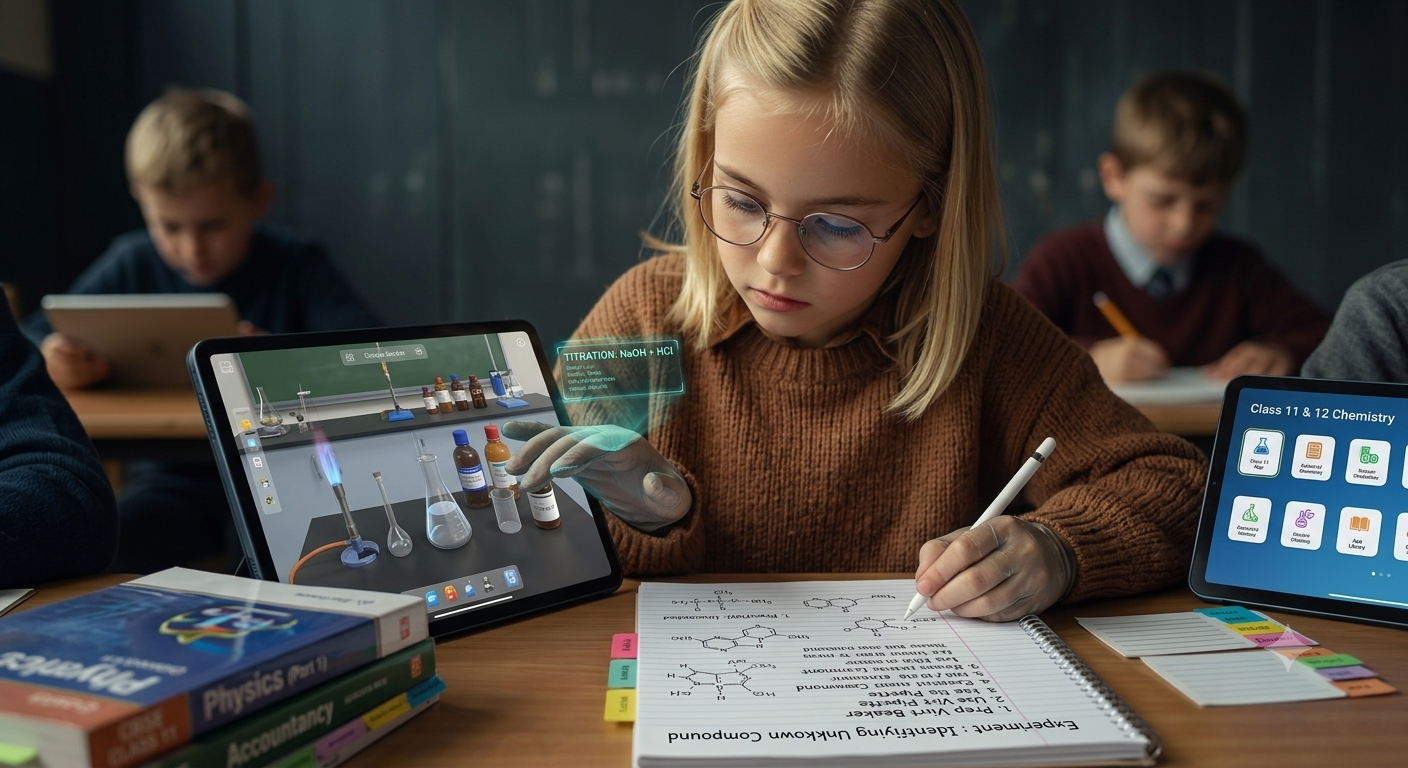
3. High-Fidelity Simulations: Making the Invisible Molecular World Visible
One of the largest barriers to mastering chemistry is that chemical reactions happen at a microscopic level that is completely invisible to the human eye. You can see a solution change color from colorless to pink during a phenolphthalein titration, but you cannot physically see the hydronium H3O^+ and hydroxide OH^-ions neutralizing each other to form water H2O.
The best virtual chemistry lab apps solve this visualization challenge by offering split-screen, multi-scale simulations. While the top half of your screen displays a realistic 3D beaker with bubbling liquids, the bottom half renders a real-time, animated molecular-level view.
You can watch individual sodium Na^+ and chloride Cl^- ions break free from solid lattices and become surrounded by polar water molecules during dissolution. This visual and conceptual reinforcement ensures that when you handle real-world physical reagents, you understand the exact microscopic mechanisms driving your observations.
4. ChemCollective: The Ultimate Virtual Lab for Analytical Chemistry
If your primary goal is to find a platform that behaves exactly like a real physical laboratory bench, ChemCollective Virtual Labs is an outstanding, highly respected academic resource. Originally developed by researchers at Carnegie Mellon University, this platform is completely free and widely used by high schools and universities globally.
ChemCollective operates as an open-ended, sandbox-style simulator. Rather than forcing you to follow a rigid, pre-programmed script, it gives you access to a massive stockroom filled with hundreds of chemical reagents, diverse concentrations of acids and bases, and high-precision physical equipment, including analytical balances, pH meters, pipettes, and bunsen burners.
You can drag a beaker to the screen, pour precise volumes of hydrochloric acid HCl and sodium hydroxide NaOH, and monitor the instant shifts in temperature, pH, and chemical species concentration. It is an unmatched platform for mastering the conceptual foundations of stoichiometry, solution chemistry, and equilibrium.
5. OLabs (Online Labs): Curriculum-Aligned Simulations for Indian Boards (CBSE/ICSE)
For students studying under CBSE, ICSE, or state board syllabi, OLabs and NCERT Virtual Labs represents the absolute gold standard for curriculum-aligned preparation. Developed by Amrita University and C-DAC under research grants from the Ministry of Education, OLabs provides complete, highly structured virtual workspaces modeled directly after standard board syllabi.
The beauty of OLabs is that its experiments correspond page-for-page with your prescribed NCERT laboratory manuals.
Whether you need to study the pH of different solutions, verify the enthalpy change of neutralization, or perform the redox titration of potassium permanganate KMnO4 against ferrous ammonium sulfate (Mohr’s salt), the platform guides you through the exact steps mandated by your board guidelines.
Each virtual module includes a thorough theoretical explanation, a detailed step-by-step procedure guide, an interactive 3D simulation laboratory, a self-assessment quiz section, and an oral viva-voce preparation panel to ensure you are fully prepared for external board examiners.
6. Top 3. PhET Interactive Simulations: Conceptual Sandbox Environments
Created by Nobel Laureate Carl Wieman in 2002, the University of Colorado Boulder PhET Project is a world-renowned leader in open-source educational simulations. While PhET is famous for physics, its chemistry collection features outstanding, research-backed models designed to build a deep, intuitive understanding of chemical properties.
PhET simulations focus on isolated, core chemical concepts rather than complex multi-step laboratory procedures.
For instance, their pH Scale simulation allows you to dilute diverse household liquids with water and observe how hydronium and hydroxide concentrations shift on a logarithmic scale.
Their Molarity simulation helps you visualize how solute and solvent volumes alter saturation limits, watching solid crystals precipitate out when a solution breaches its saturation threshold.
These highly gamified, interactive sandboxes are exceptionally useful for building the foundational qualitative intuition required before attempting advanced class 11 chemistry practicals.
7. Labster: Immersive 3D Simulations and Gamified Learning
If you are looking for a state-of-the-art, highly immersive 3D gaming experience applied to advanced science education, Labster Virtual Lab Platform is an industry leader. Labster replaces dry laboratory instructions with story-driven, cinematic quests where you act as a real-world forensic scientist, medical researcher, or environmental engineer.
In a Labster chemistry simulation, you might be tasked with investigating a mysterious water pollution outbreak or identifying an unknown powder found at a simulated crime scene.
To solve the mystery, you enter a futuristic, fully rendered 3D laboratory where you operate highly expensive, professional-grade equipment, including spectrophotometers, mass spectrometers, and nuclear magnetic resonance (NMR) devices.
While the platform is a premium service, it offers select free trials and school licensing packages, providing high schoolers with an unparalleled window into modern, cutting-edge research methodologies.
8. PraxiLabs: Immersive 3D Science Laboratories for STEM Success
For students seeking professional-grade virtual chemistry experiences that focus heavily on procedural accuracy and lab safety protocols, PraxiLabs Science Simulations is an outstanding digital platform. PraxiLabs offers curriculum-aligned 3D simulations designed to bridge the gap between abstract textbook chemistry and real-world laboratory execution.
PraxiLabs features a highly advanced, dedicated virtual chemistry lab suite. The platform guides you through organic synthesis, analytical reactions, and classic volumetric titrations in a highly detailed, realistic virtual environment.
The software includes a built-in virtual assistant that monitors your movements, providing instant hints, safety warnings, and conceptual feedback whenever you make a mistake.
With interactive 3D apparatus, instant performance reporting, and integrated post-experiment quizzes, it serves as an excellent preparation tool for high schoolers who want to master both the “how” and the “why” behind complex chemistry techniques.
9. Replicating Key Class 11 Chemistry Practicals Virtually
The Class 11 chemistry syllabus introduces foundational analytical concepts that shape your subsequent scientific journey. Using online chemistry simulations to prepare for class 11 chemistry practicals ensures you master these core topics safely:
Preparation of Standard Solutions: Practice diluting concentrated stock acids to prepare standard solutions without the risk of accidental chemical splashes. Virtual beakers and graduated cylinders show you the exact volume displacements and color changes associated with diverse concentration levels.
Chemical Equilibrium and Le Chatelier’s Principle: Simulate the classic equilibrium shift between cobalt chloride complexes or the reaction of iron chloride FeCl3 with potassium thiocyanate KSCN. By sliding virtual temperature bars and adjusting reagent concentrations, you can watch the solution instantly shift from deep blood-red to pale yellow, helping you visualize thermodynamic balance.
Inorganic Salt Analysis (Group I to VI): Practice the systematic elimination of cations and anions. Virtually test for carbonate ions CO3^2- by observing the effervescence of carbon dioxide CO2 gas, or identify ammonium ions NH4^+ through ammonia gas detection, writing down your digital observation sheets flawlessly.
10. Mastering Class 12 Chemistry Practicals in a Risk-Free Environment
Class 12 practicals are highly high-stakes, culminating in external board assessments that carry a significant percentage of your final science grades. Preparing with a virtual chemistry lab for class 11 and 12 ensures you approach these crucial exams with confidence:
Volumetric Redox Titrations: Volumetric analysis is a major component of board practicals. Practice titrating potassium permanganate KMnO4 against oxalic acid (COOH)2 or Mohr’s salt (NH4)2 SO4. FeSO4. 6H2O. The digital laboratory allows you to practice drop-wise addition, helping you learn to spot the exact, delicate pale-pink endpoint without overshooting your titration volumes.
Identification of Organic Functional Groups: Testing for alcohols, phenols, aldehydes, ketones, carboxylic acids, and amines involves handling corrosive and flammable organic solvents. Virtual environments let you safely perform the Tollens’ silver mirror test for aldehydes, the neutral ferric chloride FeCl3 test for phenols, and the esterification test for carboxylic acids, observing the visual results instantly.
Preparation of Inorganic Compounds: Practice the synthesis of double salts like potash alum KAl(SO4)2. 12H2O or Mohr’s salt, monitoring the crystallization process virtually without waiting hours for the liquid to evaporate.
11. Features to Look For When Selecting the Best Virtual Chemistry Lab Apps
With numerous applications entering the educational market, parents and educators should evaluate software against specific benchmarks to ensure maximum academic efficacy:
Essential Feature | What It Delivers | Why It Matters for Class 11/12 |
|---|---|---|
Curriculum Alignment | Alignment with NCERT, CBSE, ICSE, and global boards. | Ensures virtual practice directly supports exam-day expectations. |
Analytical Precision | Accurate replication of reaction colors, gas evolution, and precipitate structures. | Helps students build reliable observational skills for physical lab exams. |
Intuitive Doubt Solving | Integrated hints, procedural reminders, and safety feedback modules. | Prevents students from getting stuck, encouraging independent problem-solving. |
Data Privacy & Safety | Adherence to COPPA and global child privacy standards with zero ads. | Protects student metadata and prevents visual distractions during study hours. |
By prioritizing these key indicators, you can separate simple flash animations from robust, highly educational computational engines that support deep cognitive development.
12. Practical Tips: Blending Virtual Labs with Physical School Laboratory Sessions
While virtual chemistry laboratories are an incredibly powerful tool, they are never intended to completely replace the sensory experience of handling physical glassware and smelling safe chemical reactions. True academic excellence is built when you strategically blend modern online utilities with traditional physical training.
Use this balanced, hybrid approach to optimize your study routines:
The Pre-Lab Warm-Up: Before you attend your weekly school chemistry lab session, spend twenty minutes running the scheduled experiment virtually. This ensures you walk into the classroom already understanding the core apparatus, the reagent sequence, and the safety hazards, allowing you to utilize your physical lab time exceptionally efficiently.
The Post-Lab Error Check: If your physical experiment yielded unexpected results, messy precipitates, or incomplete data due to time limits, log onto your virtual platform at home. Run the exact same experiment under idealized, noise-free virtual conditions to verify what your physical observations should have looked like.
The Socratic Viva Prep: Use your virtual experiments to practice explaining chemical mechanisms out loud. If you can clearly articulate why adding diphenylamine indicator creates a deep blue-violet endpoint, you are fully prepared to answer any conceptual, oral questions from an external board examiner.
13. Conclusion: Stepping Confidently Into Your Chemistry Practical Exams
Securing top marks in your Class 11 and Class 12 chemistry practicals does not have to be a stressful battle fought with dry memorization, late-night cramming, and practical exam anxiety. By incorporating the best virtual chemistry lab apps into your weekly study schedule, you can turn complex analytical procedures into an exciting, hands-on quest of discovery.
Whether you are using open-ended beakers in ChemCollective to study equilibrium shifts, following curriculum-aligned paths in OLabs to master redox titrations, or exploring molecular models in PhET, virtual simulations make the invisible visible, turning stress into conceptual mastery.
Be patient with your learning process, experiment freely, utilize the outstanding free resources highlighted in this guide, and step confidently onto your laboratory bench ready to conquer your chemistry exams and build a bright, scientific future!