DST INSPIRE Awards MANAK Scheme: How to Pitch an Award-Winning Idea in Class 6 to 12
For decades, school science exhibitions in India centered around standard, pre-packaged demonstrations. Students frequently replicated classic experiments—such as baking soda volcanoes, water filtration models, or lemon batteries—which evaluated their ability to follow textbook instructions rather than their capacity for raw, independent innovation. However, today’s scientific landscape demands localized, practical, and highly creative problem-solving. To foster this vital developmental shift, the Government of India launched a landmark initiative designed to find and nurture the country’s most promising young minds.
If you are a student striving to make a tangible impact on society, a parent seeking prestigious platforms to validate your child’s scientific intellect, or a school principal aiming to elevate your institution’s academic credentials, you have landed in the perfect spot. This comprehensive guide explores the ins and outs of the DST INSPIRE Awards MANAK Scheme, providing actionable strategies on how to draft an award-winning idea, map your concepts to standard guidelines, and secure national-level recognition.
1. Demystifying the DST INSPIRE Awards MANAK Scheme: An Overview
The Innovation in Science Pursuit for Inspired Research (INSPIRE) program represents one of the flagship initiatives of the Department of Science and Technology DST, Government of India. The specific component targeted at school-level innovation is known as the MANAK (Million Minds Augmenting National Aspirations and Knowledge) Scheme. Jointly executed by the DST and the National Innovation Foundation NIF India, this national program is designed to attract talented young students to study science and choose careers in research.
Rather than conducting dry, standardized academic examinations to identify gifted minds, the MANAK scheme relies on the existing school ecosystem to discover creative ideas. The core philosophy of the project is to target one million original ideas rooted in science and societal applications in a single academic year. By encouraging middle and high school students to address localized, real-world problems, the government seeks to foster a vibrant national culture of grassroots creativity, technological independence, and innovative thinking.
2. Eligibility Criteria: Who Can Apply Under the MANAK Scheme Guidelines?
Before your school initiates the registration process, it is vital to understand the structural eligibility guidelines established by the governing councils. The INSPIRE Award Scheme is open to school students across India who satisfy the following criteria:
Age Bracket: Meritorious students must be within the age group of 10 to 15 years at the time of nomination.
Grade Levels: Enrolled students must be studying in Classes 6 to 12.
School Affiliation: All recognized middle, high, and senior secondary schools across India—whether government-managed, private, semi-private, aided, or un-aided—are fully eligible to participate.
Nomination Limit: Each school is permitted to nominate a maximum of five of their best original student ideas in a financial year.
Stream Restraints for Higher Classes: Within the limit of five nominations, a maximum of two student ideas can be from Class 11 or Class 12, and these senior students must belong exclusively to the Science stream.
By establishing these structural pathways, the scheme ensures that students across all socioeconomic backgrounds have an equal opportunity to pitch their science projects to national panels.
3. The 10-Step Workflow of the National Innovation Competition
The journey from a simple classroom brainstorm to presenting a working prototype at a national exhibition follows a highly organized, ten-step developmental workflow:
Capacity Building and Awareness: District, state, and school authorities hold orientation programs to educate teachers about the scheme’s core objectives.
Internal School-Level Screening: Each registered school organizes internal competitions, creative workshops, or brainstorming sessions to select their five best student ideas.
Submission on the E-MIAS Portal: The designated school authorities upload the selected student profiles, bank details, and project synopses onto the national portal.
National Shortlisting: The technical juries at the National Innovation Foundation review all submitted concepts, filtering the entries to select the top 1,00,000 (one lakh) ideas.
DBT Fund Disbursement: The selected one lakh students receive a direct payment of ₹10,000 in their verified bank accounts to fund prototype preparation.
District Level Exhibition and Project Competition (DLEPC): Students showcase their developed working models before district-level S&T experts.
State Level Exhibition and Project Competition (SLEPC): The top ten percent of projects from the district stage advance to state-level showcases.
Collaborative Mentorship Workshops: NIF partners with leading science and technological institutes of the country to provide professional, hands-on mentorship to refine student designs before the national event.
National Level Exhibition and Project Competition (NLEPC): The top 1,000 student innovators showcase their refined projects at a prestigious national exhibition.
Incubation and Showcase at FINE: The final top 60 innovations are selected for national awards, considered for formal patent applications, linked with business incubation programs, and showcased at the annual Festival of Innovation and Entrepreneurship (FINE).
4. How the E-MIAS Portal Powers the Nomination System
To manage a massive volume of student submissions efficiently, the entire administrative backend is digitized. Schools cannot submit physical paper files; all transactions must proceed through the official E-MIAS Portal, which stands for the E-Management of INSPIRE Awards MANAK Scheme.
The school principal or headmaster acts as the primary “School Authority” on this website. First, the school must complete a one-time registration to generate a unique login ID. Once registered, the school coordinator logs in to enter the student’s personal details, verified bank account details (to ensure safe fund transfer), Aadhaar numbers, and a brief, descriptive write-up of the proposed project.
This online system ensures absolute transparency, prevents duplicate entries, and ensures that the financial award money is transferred directly to the student’s bank account through the secure Direct Benefit Transfer (DBT) pathway, keeping the entire process free of bureaucratic delays.
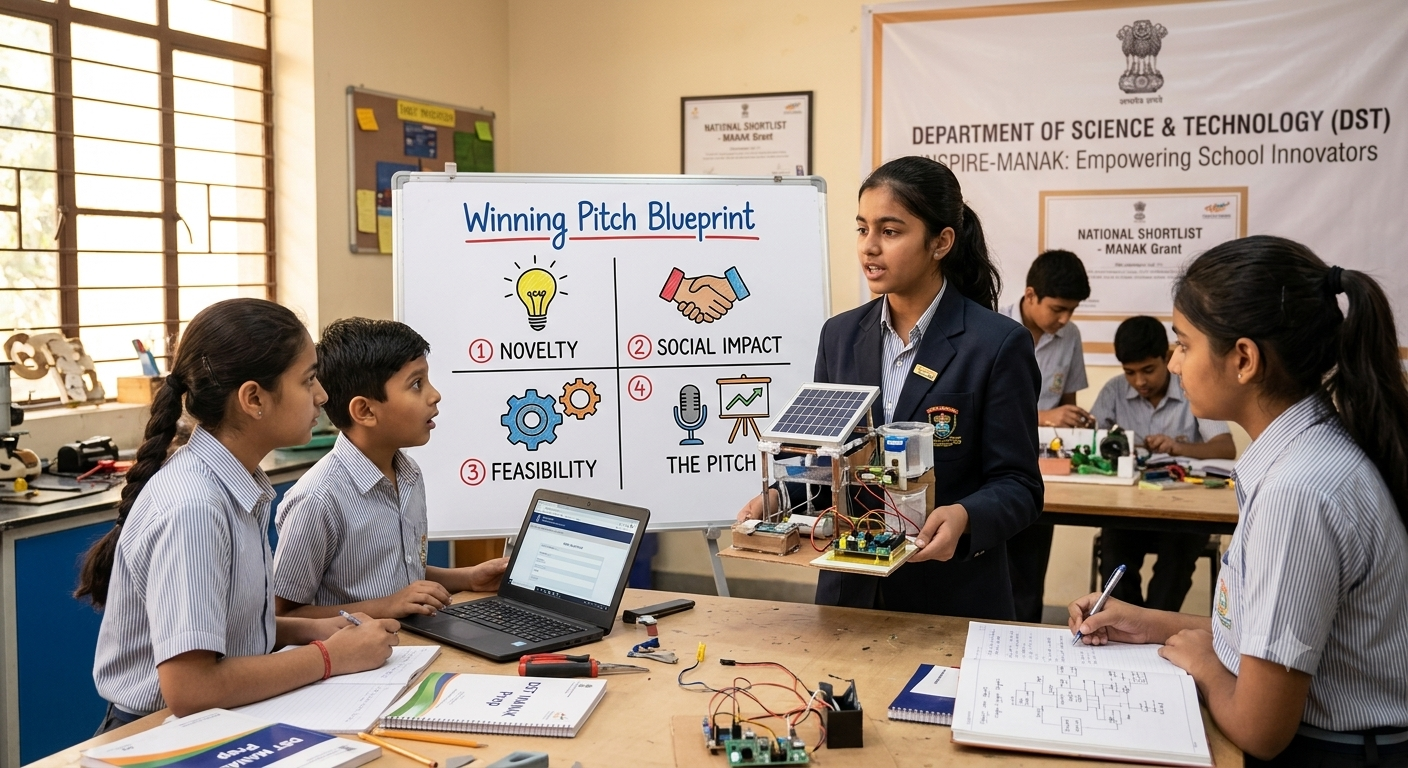
5. Core Selection Benchmarks: What Makes an Idea Award-Winning?
With one million ideas targeted annually, competition is exceptionally fierce. Juries do not look for complex, expensive machines that require high-level engineering. Instead, they value elegant, simple, and practical solutions.
When NIF reviews your submitted synopsis, they grade your proposal against five non-negotiable benchmarks:
Novelty and Originality: Is the concept a completely new approach, or is it a minor variation of an existing market solution?
Social Applicability: Does the project address a widespread, everyday issue faced by ordinary people, farmers, weavers, or laborers?
Environmental Friendliness: Does the design prioritize sustainable, eco-friendly materials, minimizing carbon footprints and plastic waste?
User-Friendliness: Can the intended audience—such as elderly citizens, physically challenged individuals, or young children—operate the device easily and safely?
Comparative Advantage: Does your proposed innovation offer a clear advantage in terms of cost, portability, durability, or efficiency over existing market technologies?
6. How to Brainstorm an Innovation Rooted in Science
To locate an award-winning idea, students must shift their gaze away from textbook theory and start observing their immediate physical environment. Real innovation is always born out of everyday frustrations.
Use these practical strategies to kickstart your brainstorming sessions:
The "Observation Diary" Technique
For one full week, carry a small notebook with you. Whenever you observe someone struggling with a task—whether it is your mother lifting heavy pots in the kitchen, a farmer struggling to water crops evenly, a street sweeper dealing with dust inhalation, or a commuter navigating muddy roads—write down the problem. Do not try to solve it immediately; simply document the struggle.
The "Socio-Environmental" Audit
Look around your neighborhood or school. Identify recurring environmental hazards, such as water clogging during rainstorms, plastic pollution in local ponds, excessive food wastage in school canteens, or high energy consumption in public buildings. Brainstorm small, smart, and localized mechanical interventions that can mitigate these specific challenges, turning environmental awareness into active innovation.
7. Structuring the Project Pitch: How to Draft a Winning Synopsis
Once you have identified a high-potential concept, the next step is to translate that idea into a compelling, logical, and highly structured written pitch. This project pitch, also known as the project synopsis, is what the NIF experts read to decide if your project deserves the milestone funding.
Your project pitch should be divided into five clear, qualitative sections:
Title of the Project
Create a title that is descriptive, clear, and highly focused. Avoid vague, artistic names. For example, instead of naming your project “Green Earth,” name it “An Ergonomic, Low-Cost Manual Seed Sowing Device for Small-Scale Farmers.”
The Problem Statement
Clearly describe the exact real-world problem your project addresses. Explain who suffers from this issue, why current market solutions are inadequate or too expensive, and the negative consequences of leaving this problem unsolved.
The Proposed Solution
Detail your innovative design. Explain how your device or process functions qualitatively. Describe the primary components of your system, how they interact, and how your design physically solves the problem outlined in your problem statement.
Key Materials and Construction Plan
List the materials you intend to use to build your working model. Emphasize the use of low-cost, readily available, recycled, or biodegradable elements to show the jury that your design is highly scalable and sustainable.
Intended Societal Benefits
Conclude your synopsis by explaining the positive impact your project will have on society. Detail how your innovation improves safety, saves time, reduces physical strain, lowers costs, or protects the local ecosystem.
8. Navigating the Direct Benefit Transfer (DBT) and the ₹10,000 Prototype Fund
Once NIF completes its initial nationwide screening, the shortlisted students receive a direct financial grant of ₹10,000. This fund is not a personal prize; it is an active investment designed specifically to help you build your working model.
To ensure proper utilization of this award, students should construct a detailed budget plan:
Sourcing Raw Materials: Spend a portion of the fund to source high-quality, durable, and safe construction materials, avoiding fragile elements that might break during transport to exhibition halls.
Fabrication and Assembly: Utilize local fabrication shops, carpentry units, or school workshops to assemble structural elements safely.
Iterative Testing: Build a preliminary prototype, test its performance, identify weak components, and use the remaining funds to refine and rebuild the system.
Visual Presentation Materials: Keep a small portion of the fund to print clean, professional banners, charts, and information booklets to decorate your exhibition stall.
9. Advancing Through the Exhibition Stages: DLEPC to SLEPC
Receiving the ₹10,000 funding is only the first step. The true test of your communication and pitching skills occurs during the live exhibition cycles, beginning with the District Level Exhibition and Project Competition (DLEPC).
At the district stage, you will set up a physical booth where you must present your working model to S&T officers, school groups, and general visitors. Juries look for students who can explain their ideas with clarity, confidence, and passion.
To stand out at the DLEPC and SLEPC stages, focus on these performance tips:
The 2-Minute Elevator Pitch: Prepare a concise, high-impact summary of your project that you can deliver in under two minutes. Explain the problem, show your working model in action, and summarize the societal benefits.
Live, Flawless Demonstrations: Ensure your prototype is fully functional and ready to be operated repeatedly throughout the day.
Neat Visual Presentations: Use clean, professional charts and color-coded flowcharts to show the chronological development of your project, making it easy for passing judges to grasp your logic instantly.
10. The Ultimate Destination: Mentorship and the National Stage (NLEPC)
Projects that clear the state level (SLEPC) represent the top 1,000 innovations in the country. Before these elite designs are showcased at the National Level Exhibition and Project Competition (NLEPC), the National Innovation Foundation organizes intensive, collaborative mentorship bootcamps.
During these workshops, student innovators are paired with professional scientists, university engineers, and product designers from India’s premier technical institutions.
These experts help you refine your designs, upgrade your materials, integrate smart sensors, and prepare professional presentation slides. The national stage is an incredibly inspiring environment where you can interact with fellow young creators, pitch your ideas to senior government ministers, and stand a chance to win prestigious national awards.
11. Lifelong Career Milestones for National MANAK Winners
The benefits of participating in the MANAK scheme extend far beyond school-level recognition. For the top 60 national winners, the Department of Science and Technology and NIF provide extraordinary, life-changing career support:
Professional Patent Filings: If your innovation is deemed highly novel, NIF will employ patent attorneys to file formal patents in your name, protecting your intellectual property at zero cost to your family.
Incubation and Prototyping Support: Winners receive access to national fabrication laboratories and manufacturing units to help scale their student models into commercial, market-ready products.
Global Exposure (Sakura Exchange Program): Select national winners are chosen to represent India on international scientific tours, including the prestigious Sakura Science High School Program in Japan, where they visit cutting-edge research laboratories and meet Nobel laureates.
Felicitation at the President’s House: National awardees are invited to exhibit their innovations at the Annual Festival of Innovation and Entrepreneurship (FINE) held at the Rashtrapati Bhavan, receiving direct appreciation from the President of India.
To keep track of competitive deadlines, eligibility criteria, and annual winners’ lists, families can consult updates on tracking portals like the Buddy4Study Portal, which serves as an excellent resource for national student scholarship programs.
12. Crucial Pitfalls to Avoid in Your Project Pitch
To maximize your chances of clearing the initial NIF screening, ensure your project pitch stays free of these common student mistakes:
Pitching Standard Textbook Models: Avoid submitting ideas that are already extensively documented in school textbooks (e.g., wind turbines, standard solar cookers, or basic drip irrigation models). Your proposal must show a unique twist or localized innovation.
Proposing Sci-Fi or Unrealistic Technologies: Do not pitch projects that rely on non-existent technologies, highly expensive materials, or physical laws that cannot be executed in the real world (e.g., perpetual motion machines).
Vague Write-Ups: Ensure your submitted synopsis is specific, descriptive, and clear. Avoid vague declarations like “This machine will solve global warming” and focus on precise, localized impacts.
Using Group Ideas: The MANAK scheme values individual, self-directed innovation. Group projects or combined student nominations are not accepted.
13. Conclusion: Step Confidently Onto the National S&T Stage Today
Preparing a successful pitch for the DST INSPIRE Awards MANAK Scheme is not an exclusive milestone reserved only for naturally gifted academic geniuses. By observing your local environment, identifying daily human struggles, constructing simple, sustainable, and cost-effective solutions, and drafting a clear, logical project synopsis, any student from Class 6 to 12 can unlock their full creative potential.
Remember that scientific progress is a marathon built on daily consistency, endless curiosity, and a willingness to try, fail, and rebuild. Treat mistakes as valuable design feedback, use the incredible government-backed resources highlighted in this guide, and step confidently onto your laboratory bench ready to conquer your design goals and build a bright, highly successful future!