Mastering School Olympiads & National Talent Exams: The Ultimate Guide to Academic Triumph
In the modern educational landscape, securing excellent grades in school examinations is only the first step toward long-term academic success. As global standards become more rigorous, students from Class 1 through Class 12 need to demonstrate deeper cognitive abilities, higher-order critical thinking, and robust problem-solving skills. This is where national and international competitive evaluations play an indispensable role. Engaging with these advanced testing systems early in a student’s academic journey bridges the gap between rote memorization and true conceptual mastery.
If you are an ambitious student striving to stand out, a parent looking to support your child’s cognitive development, or an educator seeking structured frameworks to implement in your classroom, you are in the perfect place. This comprehensive guide explores everything you need to know about mastering school olympiads & national talent exams, detailing key exam boards, prep strategies, and psychological tips to foster a lifetime love for learning.
1. The Competitive Edge: Why School Olympiads and National Talent Exams Matter
The traditional school curriculum is designed to ensure that students meet baseline academic benchmarks for their respective grade levels. While this baseline is vital, it often relies on repetitive practice and memorization to ensure passing marks. In contrast, national competitive assessments challenge students to apply standard classroom concepts to unfamiliar, complex, and highly analytical scenarios.
Participating in these elite evaluations teaches students how to deal with academic pressure early, builds exam temperament, and enhances cognitive flexibility. Furthermore, performing well on a national level provides students with prestigious awards, certificates, and scholarships that dramatically elevate their academic profiles.
Whether a student is preparing for future engineering entrance tests, medical evaluations, or Ivy League admissions, the foundational skills built during early competitive preparation act as an unmatched launchpad.
2. Understanding the Ecosystem: School Olympiads vs. Talent Exams
To build an effective preparation strategy, families must first understand the differences within the competitive academic ecosystem. While the terms are often used interchangeably, these exams generally fall into two distinct categories:
School Olympiads: These are subject-specific national and international competitions focusing deeply on areas like Mathematics, Physics, Chemistry, Biology, Astronomy, English, and Computer Science. They test lateral thinking, conceptual depth, and creative applications of subject theories.
National Talent Exams: These are broader diagnostic evaluations designed to identify intellectually gifted students across multiple disciplines simultaneously. They typically incorporate scholastic subject testing alongside dedicated mental ability and logical reasoning components to evaluate a student’s overall cognitive capacity.
By recognizing the unique focus of each format, students can choose the specific competitions that align with their personal interests, academic strengths, and future career aspirations.
Note : The Ultimate Guide to School Olympiads (SOF, NSTSE, IMO): Eligibility, Syllabus & Preparation Tips
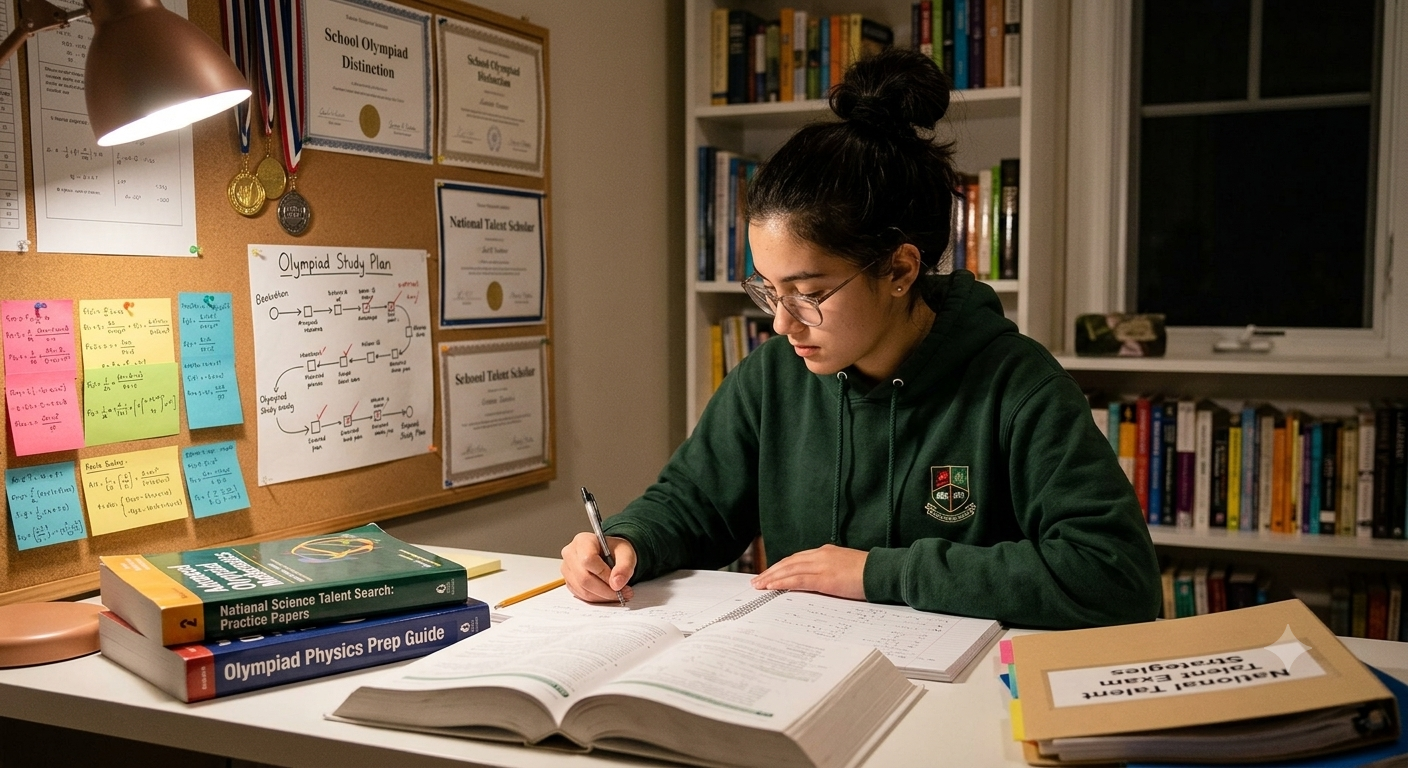
3. Major National Talent Exams and Olympiad Boards to Explore
In India and across the globe, several highly organized private and government-backed boards conduct prestigious annual evaluations. Some of the most widely recognized and globally respected platforms include:
The Science Olympiad Foundation (SOF): Renowned for organizing massive, multi-level competitions across thousands of schools globally. To register for their seasonal evaluations and explore official schedules, students can visit the Science Olympiad Foundation Portal.
The Unified Council: Celebrated for its highly diagnostic assessment style that prioritizes conceptual understanding over rote recall. Families can find detailed syllabus information and mock exams directly on the Unified Council Portal.
The Indian Talent Olympiad (ITO): A leading national platform providing monthly and annual testing cycles designed to build continuous, year-round study habits. Explore their program structures on the Indian Talent Olympiad Platform.
Homi Bhabha Centre for Science Education (HBCSE): The official government-supported premier body responsible for selecting and training the national squads representing India at international science and mathematics olympiads. Ambitious secondary students can review eligibility criteria on the official HBCSE Olympiad Portal.
4. The Cognitive Benefits of Early Competitive Exam Preparation
Preparing for highly competitive national tests does not simply help students score better on standardized exams; it physically alters how their brains process information. Cognitive science shows that when students engage with complex, non-linear problems, they build stronger neural connections associated with executive function and logical deduction.
Key cognitive transformations include:
Enhanced Spatial Reasoning: Visualizing multi-dimensional patterns, rotational geometries, and complex organic cycles.
Improved Linguistic Precision: Developing an advanced vocabulary and analytical reading skills to comprehend dense, multi-layered text prompts.
Structured Logical Frameworks: Learning to systematically isolate variables, analyze causal relationships, and construct logical arguments to solve abstract puzzles.
These cognitive upgrades help students complete their standard school homework faster and with significantly less mental fatigue, freeing up valuable time for extracurricular activities and rest.
5. How to Transition from School Curriculum to Higher-Order Thinking
One of the most common mistakes students make when entering their first competitive exam is assuming that their standard school textbooks are sufficient for success. While school curricula provide the foundational definitions, competitive tests require what educators call Higher-Order Thinking Skills (HOTS).
To successfully make this transition, students must change how they study:
Deconstruct the “Why” and “How”: Never accept a scientific fact or conceptual formula at face value. Always ask: Why does this physical law hold true under these specific conditions? How does changing one environmental variable affect the entire system?
Apply Concepts Externally: Try to identify classroom concepts in the real world. For instance, analyze how the refraction of light functions in household optics or how biological ecosystems self-regulate.
Embrace Cognitive Discomfort: Standard school assignments are designed to be easily solvable to build confidence. Competitive questions are designed to challenge you. Learn to sit with a single, complex concept for hours without rushing to look up the answer sheet.
6. Mastering the Science Olympiad Foundation (SOF) Suite
The Science Olympiad Foundation conducts some of the most popular examinations in the school ecosystem. Mastering this suite requires a highly targeted approach tailored to each specific subject track:
International Mathematics Olympiad (IMO) and National Science Olympiad (NSO)
These exams are structured to evaluate both core subject expertise and logical deduction. The question papers are divided into distinct sections, including a dedicated Logical Reasoning Section and an Achievers Section. The Achievers Section carries higher mark weightage per question and contains complex, multi-concept problems that decide the top national rankings.
International English Olympiad (IEO) and Cyber Olympiad (ICSO)
The linguistic and computer science tracks focus heavily on contextual application. For the IEO, students must go beyond basic grammar rules and master nuanced reading comprehension, advanced vocabulary, and conversational usage. For the ICSO, preparation should center on the foundational logic of algorithmic thinking, software history, and modern digital technologies.
7. Deciphering the Unified Council’s NSTSE: A Diagnostic Approach
The National Level Science Talent Search Examination (NSTSE), conducted by the Unified Council, is a highly diagnostic, independent test. Unlike traditional school exams that evaluate how much a student can remember, the NSTSE is designed to pinpoint exactly how a student thinks and where their conceptual learning gaps lie.
Every participant in the NSTSE receives a highly detailed, individualized Student’s Performance Report (SPR). This diagnostic sheet breaks down the student’s performance by specific sub-topics, cognitive skill groups, and national averages.
Instead of treating this exam as a pass-or-fail test, students should use it as an academic map. By analyzing the SPR, you can isolate precise conceptual weaknesses—such as struggling with spatial relationships or qualitative biological logic—and systematically address them before your final school board evaluations.
8. The Elite HBCSE Road: From IOQM and NSEJS to International Arenas
For high school students (Class 8-12) looking for the ultimate academic challenge, the government-backed national Olympiad program coordinated by HBCSE represents the peak of scholastic achievement. This program is divided into rigorous, multi-stage elimination rounds:
Stage 1: National Standard Examinations: Exams like the Indian Olympiad Qualifier in Mathematics (IOQM) or the National Standard Examination in Junior Science (NSEJS) serve as the initial screening phases. These tests are notoriously challenging, requiring students to solve complex, non-calculus-based analytical problems.
Stage 2: National Olympiad Rounds: The top performers from Stage 1 are invited to sit for the Indian National Olympiads (e.g., INPhO, INChO, INBYO), which feature advanced subjective questions evaluated by university professors and research scientists.
Stage 3 & 4: Training Camps & Pre-Departure: The select few who clear the national rounds attend residential academic camps at HBCSE, where they receive intensive theoretical and practical training before representing the nation on the global stage.
9. Highly Productive Study Strategies for Competitive School Exams
Securing a top national rank requires structured planning, consistent study habits, and the right approach to learning. To build an optimized study routine, incorporate these proven strategies into your schedule:
Formulate a Weekly Concept Block: Allocate dedicated study blocks of 45 to 60 minutes specifically for advanced competitive topics, keeping this preparation completely separate from your daily school homework.
Master the Art of Shorthand Summaries: When reading through advanced reference books, translate complex scientific processes and structural relationships into your own plain-language summaries and flowcharts.
Use Active Recall with Closed Books: After studying a challenging chapter, close all your materials and write down every key concept, taxonomy, and scientific law you can recall on a blank sheet of paper, using a colored pen to fill in what you missed.
10. The Power of Diagnostic Mock Tests and Analyzing Past Papers
You should never walk into a national-level exam hall without practicing under timed, realistic conditions. Solving past Olympiad papers and taking full-length mock exams is one of the most effective ways to build speed and accuracy.
Set a timer, find a quiet, distraction-free corner of your home, and attempt a previous year’s paper in a single sitting. This practice helps you:
Develop Time Management Skills: Identify how much time you should spend on straightforward multiple-choice questions versus complex, multi-layered analytical prompts.
Eliminate Exam Anxiety: Familiarizing your brain with the structure, formatting, and pacing of the actual paper minimizes the physical stress response on the day of the exam.
Isolate Recurring Errors: Maintain a dedicated “Mistake Log” where you write down every question you answered incorrectly during practice, noting the underlying conceptual misunderstanding and revising that topic immediately.
11. Balancing School Board Preparation with Competitive Olympiad Studies
A common concern among high school families is that preparing for advanced national talent exams will distract from essential school board exams. However, when managed strategically, these two academic pursuits actually support and enhance one another.
Because Olympiad syllabi are heavily aligned with standard school boards (like CBSE, ICSE, and various state boards), studying advanced concepts automatically reinforces your school curriculum.
The key is to maintain a balanced, structured weekly schedule. Use your weekdays to focus on standard school assignments, homework, and writing practice. Then, dedicate your weekend study blocks to exploring advanced competitive concepts, taking diagnostic quizzes, and solving logical reasoning puzzles. This balanced approach ensures you achieve top-tier marks in school while building the critical thinking skills required to conquer national evaluations.
12. A Parent's Guide to Supporting Young Minds Without Burnout
Preparing for high-stakes national competitions can occasionally be stressful for young minds. Parents play a vital role in shaping how children perceive these academic challenges. To foster a healthy, positive competitive environment at home, follow these guidelines:
Praise Effort Over Outcomes: Focus your encouragement on your child’s consistency, curiosity, and resilience during study sessions, rather than demanding a specific national rank.
Ensure Physical and Mental Balance: Protect your child’s sleep schedule, encourage outdoor physical activities, and ensure they have guilt-free free time to decompress.
Provide Tactile, Screen-Free Tools: Supply your home study space with physical reference books, whiteboards, and logical puzzle kits to make learning interactive and hands-on.
By acting as an encouraging partner rather than an additional source of academic pressure, parents can prevent burnout, lower exam anxiety, and foster a lifelong love for intellectual discovery.
13. Conclusion: Starting Your Academic Conquest Today
Mastering school olympiads & national talent exams is not an impossible challenge reserved only for naturally gifted geniuses. By utilizing targeted study techniques, practicing active recall, analyzing diagnostic mock tests, and choosing the right competitions to fit your profile, any student can unlock their full intellectual potential.
Remember that academic success is a marathon built on daily consistency and curiosity. Be patient with your learning process, view mistakes as valuable diagnostics, and treat every difficult problem as an exciting opportunity to level up your brain.
Explore the official platforms highlighted in this guide, structure your weekly study blocks, and step confidently onto your competitive path, ready to conquer your academic goals and build a bright, highly successful future!