The Ultimate Guide to School Olympiads (SOF, NSTSE, IMO): Eligibility, Syllabus & Preparation Tips
Staring at standard classroom blackboards, memorizing predefined textbook passages, and writing predictable school-unit tests can only take a student’s cognitive growth so far. In the modern educational landscape, young minds require challenges that go beyond simple memory recall. If you are looking to unlock your child’s analytical potential, foster deep critical thinking, and build competitive stamina early in life, introducing them to school Olympiads represents the ultimate academic catalyst.
Historically, competitive exams were reserved only for high school seniors preparing for college entrances. Today, prestigious talent search systems have made it possible for students as young as Class 1 to benchmark their capabilities on national and global stages.
Among the myriad of national talent assessments, programs conducted by the Science Olympiad Foundation (SOF) and the Unified Council (NSTSE) stand out as the gold standards. If you are a parent searching for a structured pathway to elevate your child’s logical reasoning, a student aiming for national academic recognition, or an educator designing a high-performance STEM classroom, this comprehensive guide is your ultimate roadmap. We detail the eligibility requirements, demystify the syllabus layouts of major assessments like the International Mathematics Olympiad (IMO), and provide actionable preparation strategies to ensure your child achieves academic excellence.
1. Decoding School Olympiads: Why These Talent Tests Matter
Many parents and educators wonder if preparing for a school Olympiad is worth the additional academic effort alongside daily school routines. The answer is a resounding yes. These competitive tests are not designed to measure how well a student can copy definitions from a blackboard. Instead, they are engineered to evaluate spatial visualization, conceptual synthesis, logical deduction, and the real-world application of scientific and mathematical laws.
Appearing for national and international Olympiads offers several key benefits:
Fosters Conceptual Clarity: To solve Olympiad questions, students must look beyond surface-level rules, understanding the “why” and “how” behind every scientific phenomenon and mathematical relationship.
Builds Early Exam Temperament: Most prestigious Olympiads are conducted in a two-stage format using Optical Mark Recognition (OMR) sheets or digital proctored screens. This early exposure completely eliminates the exam-day technical anxiety that frequently compromises student performance in high-stakes boards later in life.
Pinpoints Learning Gaps: Participating in standardized exams provides detailed diagnostic reports. These reports compare a student’s performance with lakhs of peers globally, highlighting exact conceptual weaknesses in physical sciences, computational thinking, or logical reasoning.
Enhances Future University Profiles: Winning a prestigious national rank or earning a certificate of merit from global bodies looks outstanding on college applications, demonstrating high academic initiative and a passion for self-improvement.
2. The Science Olympiad Foundation (SOF): The Global Benchmark
When evaluating the most prominent and highly recognized competitive exam organizers in the world, the Science Olympiad Foundation (SOF) stands completely unchallenged. Established in New Delhi, the non-profit organization has spent decades promoting scientific temper, mathematical skills, and linguistic competencies among school students globally.
To review active registration portals, school empanelment lists, exam schedules, and ranking criteria, students and parents can consult the official Science Olympiad Foundation (SOF) Portal.
The SOF conducts a diverse array of specialized Olympiads, each catering to different academic streams:
NSO (National Science Olympiad): Testing deep conceptual understanding of physics, chemistry, biology, and environmental sciences.
IMO (International Mathematics Olympiad): Famous for its challenging, application-based mathematical problems and logical reasoning modules.
IEO (International English Olympiad): Focused on global grammar rules, sentence structuring, comprehension, and vocabulary precision.
NCO (National Cyber Olympiad): Testing computational logic, basic programming concepts, and digital safety standards.
3. Exploring the International Mathematics Olympiad (IMO)
The International Mathematics Olympiad (IMO) is widely considered the absolute pinnacle of mathematical talent searches for school students. The exam is designed to dismantle the habit of rote-memorizing steps, forcing students to treat mathematics as a logical, spatial puzzle.
The IMO paper is divided into four highly strategic sections:
Logical Reasoning: Testing spatial visualization, pattern identification, direction sense, and verbal and non-verbal reasoning.
Mathematical Reasoning: Assessing the student’s mastery of core mathematical concepts, requiring them to utilize arithmetic, algebraic, and geometric principles to solve structural problems.
Everyday Mathematics: Applying mathematical concepts to solve real-world daily scenarios, such as calculating discounts, resource distribution, and operational efficiencies.
Achievers Section: The tie-breaker zone of the exam. This section features high-order thinking skills (HOTS) questions that carry higher weightage, testing deep, advanced conceptual synthesis.
To prepare effectively, students must focus on understanding the visual and logical meaning of mathematical laws rather than simply memorizing execution steps.
4. Understanding the National Level Science Talent Search Examination (NSTSE)
While some Olympiads focus on broad competitive speeds, the National Level Science Talent Search Examination (NSTSE) is designed specifically as a diagnostic assessment. Conducted by the Unified Council, the primary goal of the NSTSE is to measure how well a student has understood the underlying concepts of their science and mathematics curricula.
To purchase official previous years’ question banks, review state-wise cutoffs, and access diagnostic sample papers, candidates can consult the Unified Council NSTSE Official Portal.
The NSTSE is highly respected because it provides students with a personalized, comprehensive “Student’s Performance Report.” This diagnostic feedback goes beyond a simple scorecard; it breaks down the student’s cognitive strength across specific parameters—such as knowledge, understanding, application, and critical thinking—making it incredibly easy to identify and correct individual learning gaps before high school.
5. Central Eligibility Criteria for Major School Olympiads
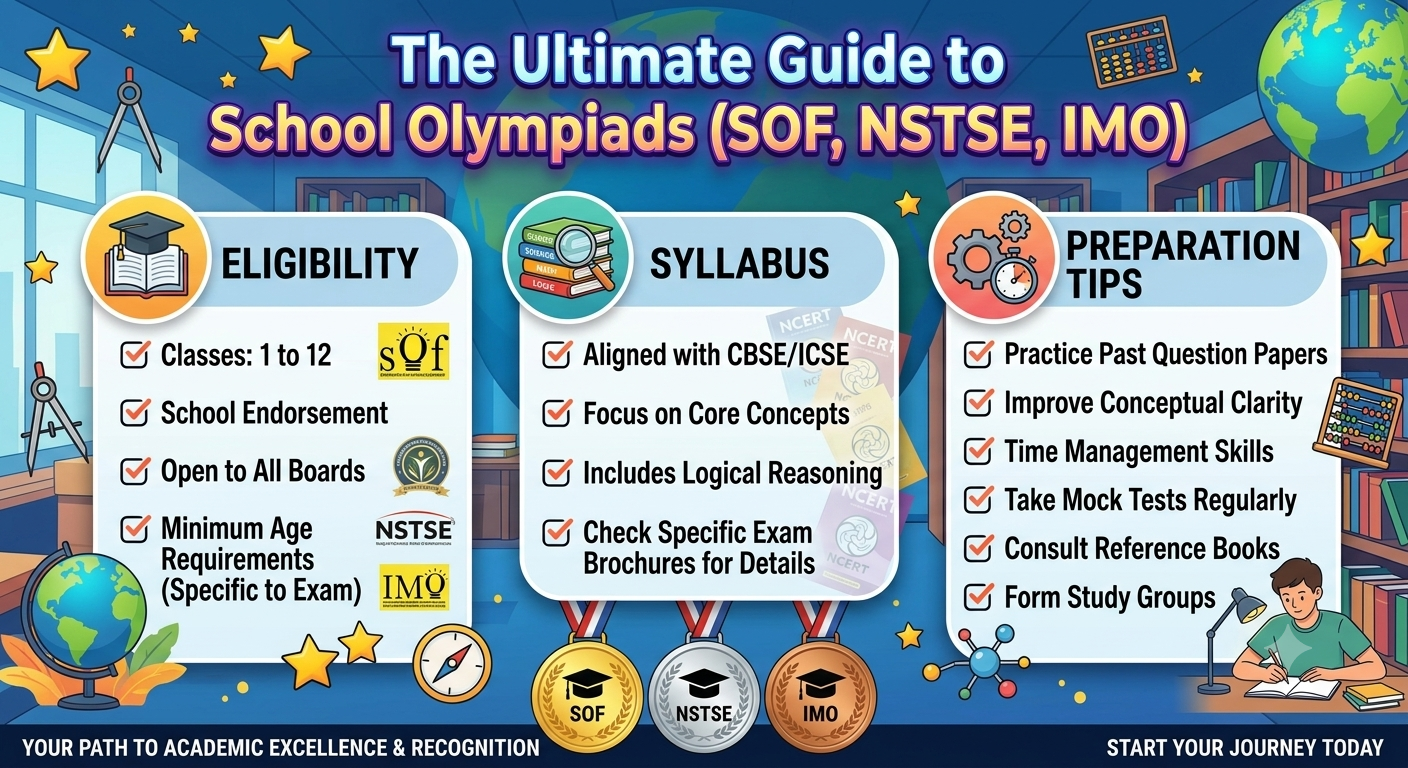
One of the greatest advantages of modern school talent tests is their highly inclusive accessibility guidelines. The Olympiad eligibility criteria ensure that almost any motivated student can benchmark their skills:
Grade Level Boundaries: For major SOF and NSTSE exams, students studying in Class 1 to Class 12 are fully eligible to participate.
Board Affiliations: The exams are open to students enrolled in any recognized national, state, or international educational board—including CBSE, ICSE, state boards, and IB (International Baccalaureate).
Registration Channels: Typically, students register through their respective schools. If a school is not registered with the SOF or Unified Council, students can often apply directly as individual candidates through the online portals of the respective organizers, ensuring no child is excluded due to administrative limitations.
6. Navigating the Olympiad Syllabus: How It Differs from School Boards
A common point of confusion for parents is assuming that the Olympiad syllabus is completely different from the standard school board curriculum. This is a myth. The syllabus of major Olympiads is, in reality, closely aligned with national school frameworks.
To ensure your home study is fully synchronized with standard national academic benchmarks, students can reference the textbook guidelines and curriculum indices hosted on the NCERT National Educational Portal.
The critical difference lies not in what is taught, but in how the concepts are tested:
The School Board Level: Evaluates direct, memory-based questions (e.g., “State the definition of friction.” or “Solve this standard algebraic equation using the step-wise method.”).
The Olympiad Level: Evaluates application-based, conceptual questions (e.g., presenting a diagram of a sliding block on varying physical surfaces and asking the student to analyze the friction dynamics under fluctuating forces).
This means that while the syllabus topics remain identical, Olympiad questions require a much deeper, multi-dimensional conceptual understanding.
7. Stage-Wise Testing Formats: Multiple-Choice and OMR Sheet Systems
To excel in competitive exams, students must understand the physical mechanics of the testing format. Major school Olympiads utilize highly structured, multiple-choice question (MCQ) systems.
For most grades, the exams are divided into two distinct stages:
Level 1 (The National Round): Conducted inside the student’s own school premises. The paper consists of thirty to fifty multiple-choice questions to be completed within a strict sixty-minute limit. Students record their answers by bubbling OMR sheets using a pen or pencil.
Level 2 (The International Round): Open strictly to the top five percent of scorers from the Level 1 round, along with state-level and school-level zone toppers. This round is highly rigorous, conducted at centralized test centers, and proctored strictly to identify the absolute finest analytical minds.
Mastering the physical act of bubbling OMR sheets accurately, without making double marks or leaving incomplete bubbles, is a vital skill that students must practice during their mock runs.
8. Five Proven Olympiad Preparation Tips for High Scores
Securing a national or international rank in competitive school tests requires transitioning from passive study habits to a highly disciplined, active learning model. Use these five Olympiad preparation tips to optimize your study routine:
Prioritize Active Recall over Passive Reading: Do not simply re-read your notes or highlight passages in textbooks. Close your book, take a blank sheet of paper, and write down every concept, definition, and scientific cycle you can recall from memory. This active retrieval signal is the only way to build permanent neural pathways.
Maintain a Comprehensive Error Log: Keep a dedicated “Mistake Journal.” Whenever you solve a mock question incorrectly, do not just check the answer and move on. Copy the question down, write out the correct logical solution, and write a one-sentence diagnostic explanation of why you made the error.
Master the Art of Elimination: In multiple-choice exams, finding the correct option is often about eliminating the incorrect ones. Teach your child to analyze the options critically, stripping away logical inconsistencies to narrow down the choices.
Practice Spaced Repetition: Do not cram all your study hours into a single week before the exam. Set up a spaced study schedule where you revisit difficult concepts at regular intervals—three days, one week, and one month after first studying them—to prevent memory decay.
Utilize Standardized Sample Papers: Practice with authentic previous years’ question papers under strict, timed conditions to build your speed, accuracy, and paper-solving stamina.
9. The Role of Analytical Aptitude and Logical Reasoning (Mental Ability)
One of the most underestimated segments of school Olympiads is the Logical Reasoning or Mental Ability section. In exams like the IMO and NSO, this section can make up to twenty to thirty percent of the overall paper.
Logical reasoning does not rely on any specific scientific or mathematical syllabus. Instead, it tests the brain’s native cognitive processing speed, spatial awareness, and pattern recognition. Typical questions include:
Mirror Images and Paper Folding: Visualizing how a geometric shape changes when rotated or folded.
Series Completion and Coding-Decoding: Identifying the hidden numerical or alphabetical patterns in a sequence of values.
Direction Sense and Blood Relations: Solving abstract logical puzzles involving physical directions or family lineage connections.
Developing this analytical aptitude early is exceptionally valuable. It trains the brain to think structurally, building the core cognitive tools required to solve complex, open-ended problems in high school and adult professional careers.
10. Crucial Resource Checklist: Balancing School Work and Competitive Exams
Preparing for Olympiads must never turn into an exhausting, high-stress chore that causes a student to slip behind in their school exams. The key is integration.
Use this checklist to design a balanced, healthy, and highly productive preparation ecosystem:
Sync Your Calendars: Align your Olympiad preparation with your school’s weekly test schedule. If your school has scheduled a unit test on “Cell Structure” in Biology, make that exact topic the centerpiece of your Olympiad practice for the week.
Keep It Screen-Free: Limit digital distractions. Ensure that study blocks are conducted in a quiet, organized study corner using physical books, notebooks, and a simple kitchen timer to manage study sessions (e.g., twenty-five minute Pomodoro blocks).
Prioritize Physical and Mental Health: High stress releases cortisol, which actively impairs the hippocampus—the brain region responsible for memory formation and retrieval. Ensure the student sleeps at least seven to eight hours daily, eats fresh, balanced meals, and participates in outdoor play.
11. Conclusion: Stepping Confidently Onto the Pathway of Academic Excellence
The definitive verdict for school education is highly encouraging: excellence in analytical reasoning, science, and mathematics is not a genetic trait reserved only for “natural geniuses.” It is a skill set built through structured habits, conceptual clarity, and strategic study methods.
By identifying the right school Olympiads for your child’s grade level—whether by targeting the conceptual science challenges of the NSTSE, qualifying for the highly prestigious SOF NSO and IMO rounds, or building linguistic accuracy through the IEO—you can build a highly competitive and confident academic mindset.
Do not let fear of failure, administrative confusion, or lack of resources hold back your child’s potential. Trust their capabilities, guide them with logical study schedules, register early on official talent portals, and watch them confidently translate their scientific curiosity into life-making discoveries for the entire world.