How to Choose Between Science, Commerce, and Arts After Class 10: Logic-Driven Guide to Avoid Career Regret
The transition from Class 10 to Class 11 is one of the most defining crossroads in an individual’s life. For decades, Indian students have been faced with a rigid, high-pressure choice: Science, Commerce, or Arts—which is best? Historically, this choice was dictated by social expectations, parental desires, or academic percentages. High scorers were pushed into Science, average scorers were directed to Commerce, and Arts was often treated as a last resort.
But as we navigate the academic landscape of 2026, the job market has completely transformed. Automation, generative artificial intelligence, and new-age business models have shifted what employers value. Furthermore, with the ongoing implementation of the National Education Policy (NEP), the traditional, watertight boundaries between streams are actively dissolving.
This logical, data-backed stream selection guide Class 10 will dismantle common myths, outline the shifting career landscapes of each domain, present a robust decision-making matrix, and help you determine how to choose stream after Class 10 to permanently avoid career regret after Class 10.
1. The New Paradigm: How NEP is Restructuring Stream Selection in 2026
Before diving into the individual streams, it is vital to understand that the Indian education system is moving away from rigid silos. Under the progressive National Education Policy reforms, schools are increasingly offering multidisciplinary options.
In 2026, you are no longer strictly locked into old-school combinations. Many schools now allow students to major in Physics (Science) while taking Economics (Commerce) and Political Science (Arts) as optional subjects.
However, your primary stream selection still dictates your fundamental academic foundation. It establishes the core subjects you will master and outlines the undergraduate degrees you can comfortably pursue. Therefore, choosing your primary academic stream requires a deep, logical analysis rather than an impulsive guess based on board exam scores.
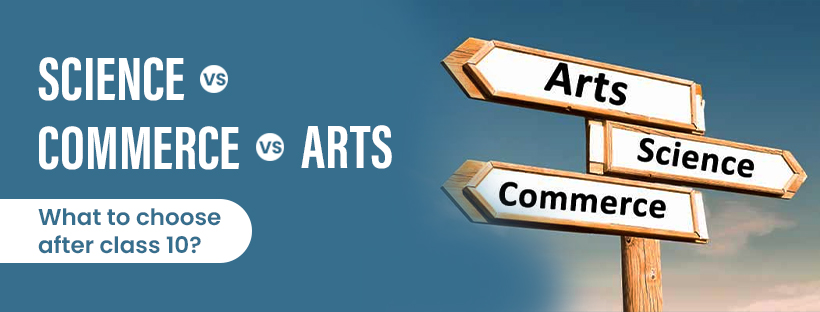
2. Demystifying the Science Stream: Innovation, Analytical Rigor, and Tech Frontiers
The Science stream after Class 10 remains the most sought-after pathway for students who enjoy logical reasoning, structural problem-solving, and empirical research. It is generally divided into two main groups:
PCM (Physics, Chemistry, Mathematics): Ideal for engineering, architecture, computer science, and physical science fields.
PCB (Physics, Chemistry, Biology): Ideal for medicine, dentistry, biotechnology, pharmacy, and agricultural sciences.
Choosing Science requires a high level of mathematical or analytical aptitude. It is a highly demanding stream that requires consistent study hours, laboratory practicals, and conceptual mastery.
Top Career Options After Class 10 in Science
Computer Science & AI Engineering: Building next-generation software, LLMs, and autonomous systems.
Medicine & Healthcare Professionals: Pursuing MBBS, BDS, or specialized research in genetics and neurosciences.
Data Science & Quantitative Analytics: Interpreting massive corporate datasets to drive strategic decisions.
Space Sciences & Astrophysics: Working with national organizations like ISRO to explore aerospace engineering.
3. Demystifying the Commerce Stream: Finance, Global Markets, and Business Strategy
If you are fascinated by the flow of money, the mechanics of corporate business, trade policies, and economic systems, then the Commerce stream after Class 10 is your natural academic home. The core subjects in this stream include Accountancy, Business Studies, Economics, and optional Applied Mathematics.
Commerce is highly practical and directly linked to the global economy. It does not require the intense laboratory work of Science, but it demands strong numerical abilities, critical reading skills, and logical reasoning to interpret market dynamics.
Leading Career Options After Class 10 in Commerce
Chartered Accountancy (CA): Managing financial audits, corporate taxations, and fiscal planning.
Investment Banking & Venture Capital: Managing mergers, acquisitions, and high-growth investment portfolios.
Corporate Law: Navigating business regulations, intellectual property rights, and commercial treaties.
Actuarial Sciences: Utilizing advanced statistics to calculate risks for insurance and financial conglomerates.
4. Demystifying the Arts & Humanities Stream: Creativity, Critical Thought, and Governance
Historically misunderstood, the Arts and Humanities stream after Class 10 has experienced a massive resurgence in 2026. As artificial intelligence automates repetitive technical tasks, the value of uniquely human skills—critical thinking, emotional intelligence, complex communication, and ethical reasoning—has skyrocketed.
Core subjects include History, Geography, Political Science, Sociology, Psychology, and Literature. This stream is ideal for students who love reading, analyzing social behavior, writing persuasive arguments, and understanding human history.
High-Growth Career Options After Class 10 in Arts
Civil Services (IAS, IPS, IFS): Leading national public administration, diplomacy, and law enforcement.
Clinical Psychology & Behavioral Science: Addressing the global demand for mental health professionals and human resource analysts.
Media, Journalism & Digital Content Strategy: Leading massive communication networks, public relations, and narrative design.
Product Design & UI/UX Design: Blending human psychology with artistic design to build digital product interfaces.
5. Logical Pitfalls: The Worst Reasons to Select a Stream (And How to Avoid Career Regret)
To ensure you make a decision that you will be proud of five years from now, you must identify and dodge common psychological traps. Here are the most dangerous ways students choose their streams:
The Peer Pressure Trap: “All my friends are taking Science, so I will too.” Choosing a stream based on social circles is the fastest path to academic struggle and career misalignment. Your friends have different strengths and interests; honor your own.
The Parental Projection Trap: “My parents want me to be a doctor, so I must choose PCB.” While parental guidance is vital, pursuing a difficult stream without personal interest leads to severe stress and high burnout rates.
The “Board Score” Illusion: “I scored 95% in Class 10, so I must choose Science.” Class 10 scores are often a measure of basic memorization. High scores do not automatically mean you will enjoy advanced calculus or organic chemistry.
The Stereotype Fallacy: “Arts has no career scope; Commerce is only for businessmen.” In the modern economy, exceptional performers in Arts and Commerce frequently out-earn median performers in engineering. Success is driven by skill mastery, not just the stream label.
6. The Logic-Driven Decision Matrix: A 4-Step Framework for Class 10 Students
To strip emotion out of this process, use this logical formula to calculate your personal Stream Alignment Score (SAS):
Stream Alignment Score = w1(Interest) + w2(Aptitude) + w3(Market Demand)
Here is how to run this self-assessment step-by-step:
Step 1: Audit Your Natural Aptitude (What are you actually good at?)
Do not confuse interest with aptitude. You might find astrophysics highly interesting, but if you consistently struggle with basic algebraic equations, PCM will be an uphill battle. Look at your academic track record. Do you excel at writing long essays, solving abstract math puzzles, or analyzing historical timelines? Choose a stream that aligns with your natural cognitive strengths.
Step 2: Identify Your Core Interests (What energizes you?)
What topics do you naturally gravitate toward when you are not studying for school exams? Do you read about geopolitical conflicts (Arts), track stock market fluctuations (Commerce), or build basic software programs (Science)? Select a domain that sparks your curiosity.
Step 3: Map Out Long-Term Career Lifestyles
Look beyond college and examine the day-to-day lifestyle of your target careers. Do you want to work in a laboratory, lead corporate boardroom discussions, work in field public administration, or design creative digital art? Ensure the stream you choose acts as a stepping stone to that lifestyle.
Step 4: Take a Standardized Psychometric Test
If you are still highly confused, do not guess. Take a scientifically validated psychometric test. These tests evaluate your personality traits, cognitive aptitudes, and vocational interests to match you with the stream where you are statistically most likely to thrive.
Direct Comparison Table: Science vs Commerce vs Arts after Class 10
The table below provides a structured, side-by-side comparison of the core facets of each primary stream in 2026:
+---------------------------+---------------------------------+---------------------------------+---------------------------------+
| Dimension                 | Science Stream                  | Commerce Stream                 | Arts & Humanities Stream        |
+---------------------------+---------------------------------+---------------------------------+---------------------------------+
| Core Cognitive Skill      | Logical, Analytical, Spatial     | Numerical, Strategic, Analytical| Critical Thinking, Creative     |
| Academic Workload         | Very High (Labs + Theory)       | High (Mathematical Practice)    | Moderate to High (Heavy Reading)|
| Key Study Subjects        | Physics, Chemistry, Math/Bio    | Accountancy, Economics, B.St.   | History, Pol. Sci, Psychology   |
| Mathematical Intensity    | Exceptionally High              | Moderate to High                | Low to Moderate                 |
| Entry Barrier to Tech     | Direct, immediate pathway       | Accessible (Data Analytics)     | Accessible (UX/UI & Digital Art)|
| Major Career Fields       | Engineering, Medicine, Research | CA, Corporate Finance, MBAs     | Civil Services, Law, Design     |
+---------------------------+---------------------------------+-----------------------------
8. Official Portals, Psychometric Testing, and External Career Guidance Resources
To aid your stream-selection journey with professional counseling and verified national frameworks, utilize these official portals:
For personalized career counseling, psychometric assessment tools, and exhaustive career directories compiled by the Government of India, visit the National Career Service (NCS) Portal.
To explore official educational curriculums, subject combinations, and syllabus weightage, check the CBSE Academic Portal.
To read comprehensive guidance reports on transitioning from secondary education to undergraduate options, refer to the National Council of Educational Research and Training (NCERT) Guidance Division.
9. Conclusion: Making a Future-Proof Choice Without Regret
The ultimate verdict of this guide is highly empowering: There is no universally “best” stream. The best stream is the one where your interest, aptitude, and long-term career goals intersect perfectly.
As a Class 10 student in 2026, you are entering an incredibly dynamic global economy. The strict boundaries of the past are disappearing, and success belongs to those who build highly specialized, interdisciplinary skillsets.
Do not let societal expectations, peer pressure, or temporary board exam grades dictate your professional destiny. Audit your strengths honestly, consult professional guidance resources, use the logic-driven decision matrix, and confidently select the stream that will serve as the ultimate launching pad for a fulfilling, successful, and regret-free career.