CBSE Class 10 Board Exam Strategy vs. Daily School Routine: Finding the Perfect Balance
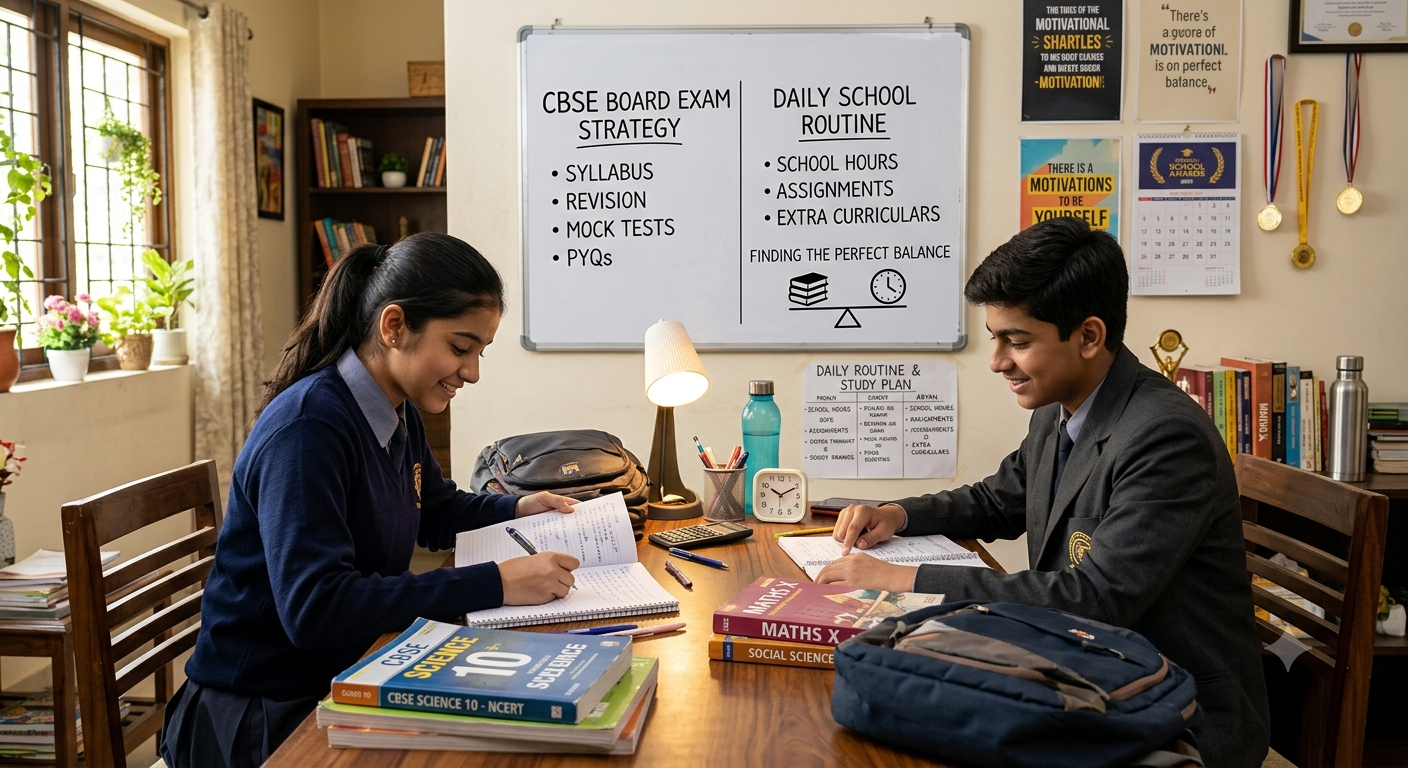
The Class 10 academic year is widely regarded as the first major milestone in an Indian student’s educational journey. The pressure to secure a high percentage in the Central Board of Secondary Education (CBSE) examinations can feel overwhelming. Suddenly, students find themselves caught in a daily tug-of-war: on one side is the demanding, structured daily school routine full of lectures, laboratory practicals, assignments, and pre-board examinations; on the other side is the self-directed CBSE Class 10 board exam strategy required to truly master the vast syllabus.
As we progress through the 2026-2027 academic cycle, the competition has only intensified. Simply attending classes is no longer enough to secure a top-tier score. However, completely ignoring school work to focus solely on private coaching or self-study is a recipe for administrative disaster.
So, how can you bridge the gap? This ultimate guide details how to balance school and board exams, outlines the ideal CBSE study timetable Class 10, and provides actionable insights on how to manage school and self study for Class 10 without succumbing to academic burnout.
1. The Tug-of-War: Why Balancing School Work and Board Prep is Tough
Many students struggle because they treat their school curriculum and their board preparation as two completely separate entities.
A typical student wakes up at 6:00 AM, spends 6 to 7 hours at school, returns home exhausted by 3:00 PM, and then rushes to tuition classes or log into online coaching portals. By the time they sit down for independent self-study, it is late at night, and their cognitive energy is entirely drained.
To break this exhausting cycle, you must shift your mindset. Your school routine should not be a barrier to your CBSE Class 10 preparation; instead, it must be strategically aligned to act as the foundation of your board preparation.
2. Decoding the CBSE Class 10 Board Exam Strategy in 2026
A successful board exam strategy requires a clear understanding of how your final grades are computed. The CBSE curriculum divides the evaluation into two clear segments:
Final Class 10 Subject Score =Board Theory Exam (80 Marks)+Internal School Assessments (20 Marks)
Because internal assessments make up 20% of your final grade, maintaining a healthy relationship with your school teachers, completing project portfolios, and performing well in periodic school unit tests is essential. You cannot afford to skip school or neglect internal homework, as it directly impacts your overall aggregate score. Your board strategy must work in tandem with your school’s academic schedule.
3. The Daily School Routine Bottleneck: Where Does Your Time Go?
Before constructing the best study schedule for Class 10 CBSE, we must analyze the typical allocation of a student’s daily time:
School Hours (including travel): 7–8 Hours
Sleep (essential for memory consolidation): 7–8 Hours
Daily Utilities (meals, bathing, chores): 2 Hours
Recreation & Physical Activity: 1 Hour
This leaves approximately 5 to 6 hours of potential study time per day. If a student squanders this remaining time on unfocused tuition lectures or passive social media scrolling, they lose the critical window for active recall and self-study, which are the absolute core of high-performance learning.
4. Structuring the Ultimate CBSE Study Timetable Class 10 Students Need
To maximize those precious 5 to 6 hours of free time, you need a highly structured, realistic daily timetable. Below is a balanced weekday schedule designed to optimize both school performance and independent board preparation:
+---------------------+--------------------------------------------------------+
| Time Slot           | Activity / Focus Area                                  |
+---------------------+--------------------------------------------------------+
| 06:00 AM - 07:00 AM | Quick revision of formula sheets, dates, or vocabulary |
| 07:30 AM - 02:30 PM | Active School Hours (Utilize free periods for homework)|
| 02:30 PM - 04:00 PM | Unwind, eat a nutritious meal, and take a power nap    |
| 04:00 PM - 06:00 PM | Phase 1 Self-Study: High-difficulty subjects (Math/Sci)|
| 06:00 PM - 06:45 PM | Physical recreation, walk, or family interaction       |
| 06:45 PM - 08:45 PM | Phase 2 Self-Study: Social Science or Languages        |
| 08:45 PM - 09:30 PM | Dinner and relaxation                                  |
| 09:30 PM - 10:30 PM | Solve previous year questions (PYQs) or write answers  |
| 10:30 PM            | Wind down and go to sleep                              |
+---------------------+--------------------------------------------------------+
5. How to Manage School and Self Study for Class 10: Actionable Methods
To successfully execute this timetable, you must master the art of parallel processing. Here are three highly effective tactics to balance your dual academic lives:
The "Do It Once, Do It Right" Lecture Method
When a teacher is explaining a chapter in class (e.g., carbon compounds in Chemistry or the national movement in History), pay absolute, undivided attention. Do not treat school lectures as passive background noise. If you actively digest the concept, ask questions, and take notes during school hours, your evening self-study session changes from a “learning phase” to a rapid “revision phase,” saving you hours of double labor.
Capitalize on "Dead Time" Inside the School Premises
Every school day contains hidden pockets of idle time—substitution classes, transit periods, lunch break leftovers, or early arrivals. Instead of using all of these blocks for idle chatting, dedicate just 20 to 30 minutes of this school “dead time” to complete your school homework, copy write-ups, or wrap up practical files. By finishing your school homework at school, you free up your entire evening for dedicated self-study.
Sync Your Exam Calendars
Align your home study plan with your school’s test schedule. If your school has scheduled a weekly test for “Sectors of the Indian Economy” on Monday, make that topic the centerpiece of your weekend board exam preparation. This synchronization ensures you score highly on school assessments while simultaneously checking off chapters from your long-term board preparation list.
6. The Role of NCERT Solutions Class 10 in Saving Revision Time
When it comes to the CBSE board examinations, the NCERT textbook is your holy scripture. Almost 95% of the questions in the theory paper are directly or indirectly derived from the exercises, in-text questions, and exemplar problems of NCERT.
To optimize your study hours, integrate high-quality NCERT solutions Class 10 resources into your daily routine. Do not waste hours trying to solve highly obscure, non-syllabus questions from heavy reference books. Focus on:
Thoroughly reading the NCERT theory.
Solving every single in-text blue question.
Mastering the end-of-chapter exercises.
Reviewing solved exemplar problems to understand the precise step-by-step marking scheme utilized by CBSE evaluators.
Using reliable, structured solutions helps you verify your answers instantly, pinpointing conceptual gaps before they turn into exam-day mistakes.
7. Smart Time-Blocking: Constructing the Best Study Schedule for Class 10 CBSE
On weekends and school holidays, your CBSE study timetable Class 10 should shift to a block-based structure. Avoid studying a single subject for 10 straight hours, as cognitive saturation will set in, drastically reducing your retention rate.
Instead, employ a 3-Block Study Method:
Morning Block (8:00 AM – 11:30 AM): Focus on Problem-Solving (Mathematics & Physics). Your brain is fresh, alert, and ready to tackle complex numerical problems and logical proofs.
Afternoon Block (1:30 PM – 4:30 PM): Focus on Theoretical Analysis (Chemistry & Biology). Read through chemical equations, biological diagrams, and make short, colorful mind maps.
Evening Block (6:00 PM – 9:00 PM): Focus on Social Science & Languages. Read through historical events, geographical maps, or practice English grammar and formal letter writing.
This structured rotation keeps your brain continuously stimulated and prevents the fatigue associated with repetitive study patterns.
8. Managing Practical Exams, Internal Assessments, and Board Revision
As the board exams approach, school schedules become chaotic with practical assessments, file submissions, and multiple rounds of pre-board examinations. It is easy to lose control of your revision schedule during this time.
To maintain your balance, treat pre-boards as diagnostic simulations. Do not panic if your pre-board scores are lower than expected; evaluators in schools often grade pre-board papers strictly to encourage students to refine their presentation. Use your pre-board answer sheets to identify your weak points—such as poor time management, unclear handwriting, or a lack of precise keywords in your answers—and systematically correct them before the final boards.
9. Crucial CBSE Class 10 Board Exam Preparation Tips to Maximize Scores
To elevate your score from a 90% to a 98%, you must master the art of paper presentation. Adopt these vital CBSE Class 10 board exam preparation tips:
Write Point-Wise Answers: Avoid long, dense paragraphs. CBSE examiners prefer clean, structured, bulleted points with key terms underlined using a pencil.
Include Diagrams and Flowcharts: In Science and Social Science, draw simple, labeled pencil diagrams or flowcharts to illustrate processes. This makes your sheet visually appealing and instantly conveys conceptual mastery.
Solve Last 10 Years PYQs: Standard question formats repeat consistently in CBSE boards. Solving previous year papers under strict 3-hour exam conditions builds your speed, confidence, and exam temperament.
Follow the Word Limit: Do not write exhaustive answers for 2-mark questions. Adhere strictly to the recommended word limits to ensure you have ample time left to review your 5-mark long answers at the end.
10. Mental Wellness and Preventing Burnout During Board Exam Prep
A healthy mind lives in a healthy body. It is easy to fall into the trap of sleep deprivation, consuming excess caffeine, and completely giving up outdoor activities. However, extreme stress releases cortisol, which actively impairs your hippocampus—the brain region responsible for forming and retrieving memories.
Ensure you maintain a healthy lifestyle throughout your board year:
Prioritize 7 Hours of Sleep: Sleep is when your brain organizes and consolidates what you learned during the day.
Stay Hydrated and Eat Well: Avoid heavy, greasy junk foods that induce lethargy. Opt for fresh fruits, nuts, and balanced meals.
Take Screen Breaks: Limit your social media scrolling during breaks. Instead, take a short walk, listen to instrumental music, or chat with your family to truly recharge your cognitive batteries.
11. Official CBSE Resources and Educational Portals for Aspirants
To ensure you are studying the correct syllabus, downloading authentic sample papers, and tracking sudden schedule modifications, always cross-reference your preparation with official national portals:
For official syllabus copies, curriculum guidelines, and updated grading parameters, check the CBSE Academic Official Website.
To download the latest official sample papers and marking schemes, refer to the CBSE Examination Digital Portal.
To access high-quality, free, digital textbooks and interactive educational resources, visit the NCERT Official Portal.
12. Conclusion: Navigating the Board Year with Confidence
Finding the perfect balance between your daily school routine and your CBSE Class 10 board exam strategy is not about studying 18 hours a day. It is about studying smart, maintaining consistent discipline, and optimizing every hour available to you.
By synchronizing your school tests with your self-study goals, utilizing NCERT solutions to save time, and using structured study schedules, you can easily conquer both internal school assessments and the final board theory exams. Trust your preparation, maintain your physical and mental wellness, and step confidently into your exam hall ready to achieve academic success.