Exam Strategies & Academic Excellence (Class 9-12)
The transition into high school marks a monumental shift in a student’s educational path. From Class 9 through Class 12, the academic landscape undergoes a dramatic evolution. The volume of information increases, concepts become highly abstract, and the pressure of standardized testing and board examinations begins to loom large. To succeed in this competitive environment, traditional study habits like last-minute cramming and passive reading must be replaced with structured, scientifically backed methods.
If you are a student striving for top-tier marks, a parent looking to support your teenager, or an educator seeking practical classroom methods, you are in the perfect place. This comprehensive guide outlines the ultimate exam strategies for class 9 and 10, explores advanced study tips for class 11 and 12, and details how to foster long-term academic excellence in high school while maintaining physical and mental well-being.
1. The High School Academic Transition: Why Class 9-12 Requires a Shift in Strategy
Many students enter Class 9 assuming they can rely on the same rote memorization techniques that got them through middle school. However, they are quickly met with a steep learning curve. Class 9 serves as the conceptual gateway to senior secondary education, while Class 10 culminates in board examinations. Meanwhile, Class 11 and 12 introduce specialized, university-level tracks in Science, Commerce, or Humanities.
Achieving academic excellence in high school is not about studying harder; it is about studying smarter. The sheer volume of the syllabus means that time is your most precious commodity. Without a shift from passive reading to active, strategic learning, academic burnout becomes almost inevitable.
To thrive, students must learn to analyze syllabus weightage, master exam-taking systems, and build structured, long-term revision habits that ensure information is retained long after the exam day is over.
2. Defining Academic Excellence in High School: It’s More Than Just High Grades
Before diving into specific preparation methods, it is essential to redefine what academic excellence actually means. While high test scores and grade point averages are traditional markers of success, true academic excellence lies in the development of intellectual curiosity, critical thinking, and resilient study habits.
A student who memorizes a textbook to score a perfect mark but forgets the material a week later has not achieved academic excellence. True excellence is demonstrated when a student:
Understands the foundational “why” and “how” behind complex concepts.
Can apply classroom theories to solve unfamiliar, real-world problems.
Develops a disciplined, self-directed routine that prepares them for university life.
Maintains a healthy balance between academic pursuits, extracurricular activities, and physical health.
By reframing the goal from “getting a perfect score” to “mastering the material and building life skills,” we reduce toxic academic anxiety and foster genuine motivation.
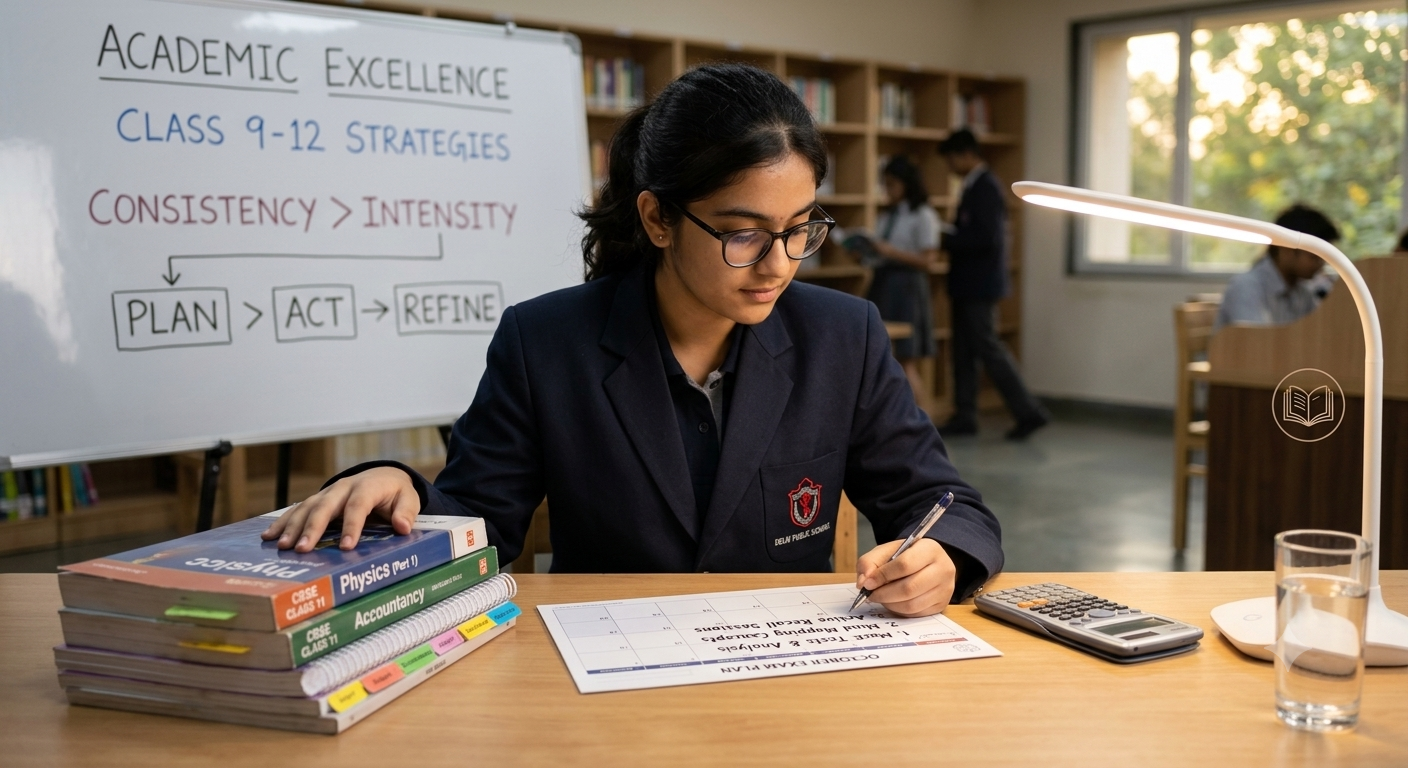
3. Fundamental Exam Strategies for Class 9 and 10: Building the Foundation
Class 9 and class 10 represent the initial foundation of a student’s high school career. During these two years, the focus should be on building strong academic discipline and mastering core subjects like languages, social sciences, and basic sciences.
To excel in school tests and build confidence, students should implement these core exam strategies for class 9 and 10:
Syllabus Mapping: Before opening a textbook, download the official syllabus from portals like the CBSE Academic Website to identify exactly which topics are designated for evaluation.
Concept Notebooks: Keep a dedicated notebook for each subject where you write down core summaries, definitions, and conceptual flowcharts in your own words.
Daily Micro-Revision: Spend fifteen minutes at the end of every school day reviewing the notes taken in class to move information from short-term memory to long-term storage.
Mastering these foundational habits early ensures that when students transition into the highly competitive senior secondary years, they already possess the study skills required to handle advanced coursework.
4. Advanced Study Tips for Class 11 and 12: Mastering Specialized Subjects
When students enter Class 11, the academic volume multiplies. Whether a student chooses specialized sciences, advanced accountancy, or detailed humanities, the curriculum requires deep analysis rather than simple recall.
To navigate this demanding phase, students should adopt these advanced study tips for class 11 and 12:
The Feynman Technique: Attempt to explain a highly complex concept in simple terms, as if you were teaching a ten-year-old. If you struggle or resort to complicated jargon, you have identified a gap in your own understanding that needs review.
Interleaved Practice: Instead of studying one subject for an entire day, block your schedule to study two or three different subjects in shorter intervals. This technique forces the brain to constantly adapt, improving long-term retention and mental agility.
Referencing Standard Material: Ensure your primary study resource is the official curriculum textbooks, such as those provided on the NCERT Official Portal, which serve as the direct benchmark for national competitive evaluations.
5. The Psychology of Exam Anxiety: How to Maintain Calm Under Pressure
Even the most well-prepared student can underperform if they are overwhelmed by test anxiety. When the brain experiences acute stress, it enters a “fight or flight” mode, which actively impairs the prefrontal cortex—the region responsible for logical reasoning, memory retrieval, and decision-making.
Managing exam anxiety is a critical component of effective exam preparation strategies. Students can build mental resilience by practicing mindfulness, utilizing deep-breathing exercises before entering the exam hall, and reframing their nervous energy as excitement.
For comprehensive mental health resources and guided cognitive strategies to manage academic stress, families can explore the expert articles hosted on Psychology Today. Learning to regulate your nervous system ensures that your brain remains clear, focused, and ready to retrieve stored information under timed conditions.
6. Active Recall vs. Passive Rereading: The Science of High School Study Techniques
Many high school students waste hours highlighted in textbooks or highlighting paragraphs, believing this passive exposure builds knowledge. Cognitive science proves otherwise. Rereading creates an “illusion of competence”—the material feels familiar because it is right in front of you, but your brain has not actually built the pathways required to retrieve that information independently.
The gold standard of high school study techniques is Active Recall. This method involves actively testing your brain to retrieve information without looking at your notes.
To implement Active Recall, students can:
Use Closed-Book Summaries: After reading a chapter, close the book and write down everything you can remember on a blank piece of paper. Then, open the book and use a different colored pen to fill in the missing details.
Flashcards: Write a key term or question on one side of a card and the explanation on the other. Test yourself regularly, sorting the cards into piles based on how easily you recalled the answer.
Self-Generated Quizzes: Turn textbook headings into questions and attempt to answer them descriptive-style before reading the actual content.
By forcing your brain to work hard to retrieve information, you strengthen neural connections, ensuring the knowledge is easily accessible during high-stakes exams.
7. Time Management Systems: Creating an Optimized Weekly Study Schedule
One of the biggest hurdles to achieving academic excellence in high school is time management. Between school hours, extra coaching, homework, and personal life, students often feel completely overwhelmed.
To reclaim control, students should move away from vague “I will study tonight” plans and implement a structured Time-Blocking System.
First, create a weekly master grid and block out non-negotiable times, such as school hours, sleep, and meals. Next, divide your remaining free hours into dedicated study blocks of 45 to 50 minutes, separated by short 10-minute breaks.
Ensure each block has a highly specific, action-oriented goal (e.g., “Write a history summary of the industrial revolution” instead of “Study history”). This prevents decision fatigue and ensures that every minute spent at your desk is highly productive.
8. How to Prepare for Board Exams: Standardized Testing Blueprints
Board examinations represent a unique challenge because they are evaluated by external examiners who do not know the student personally. Therefore, knowing how to prepare for board exams involves understanding the exact criteria utilized by paper checkers to award marks.
To align your preparation with board expectations, students should study the official marking schemes and answer keys. Board examiners look for specific keywords, clear structural headings, and neat presentations.
When writing your answers, ensure your handwriting is legible, leave spaces between points, and draw clear, labeled diagrams where applicable. Presenting your knowledge in a highly organized, professional format makes it incredibly easy for examiners to award maximum marks.
9. The Power of Mock Tests and Solving Previous Years' Papers
You would not run a marathon without practicing long-distance running first. Similarly, you should never walk into a major national exam without practicing under timed, realistic conditions. Solving previous years’ question papers and taking full-length mock exams is the single most effective way to build exam temperament.
Set a timer, sit in a quiet, distraction-free room, and complete a past paper without looking at your notes. This practice helps you:
Identify how much time you should spend on short-answer questions versus long-form essays.
Locate conceptual gaps under pressure.
Build the physical endurance required to sit and focus intensely for three hours straight.
Treat mock exams as diagnostic tools; analyze your mistakes carefully, review the weak chapters, and retake the test to track your improvement.
10. Healthy Habits for Peak Cognitive Performance: Sleep, Nutrition, and Screen Limits
Your brain is a biological organ, and its ability to store and retrieve information is directly dependent on how you treat your body. Many students sacrifice sleep to cram for exams, unaware that sleep is the exact physiological phase where the brain consolidates short-term memories into long-term storage.
To ensure your cognitive engine is running at peak capacity, prioritize:
Consistent Sleep: Aim for 7 to 8 hours of uninterrupted sleep every night, especially during the weeks leading up to exams.
Brain-Boosting Nutrition: Stay hydrated and fuel your body with whole foods, avoiding excessive sugar and caffeine crashes that impair concentration.
Digital Boundaries: Put screens away at least one hour before sleeping to prevent blue-light disruptions.
For parents looking to build healthy digital boundaries at home during high-stress study periods, Common Sense Media offers exceptional, research-backed guides on screen time management and teenage wellness.
11. Essential Digital Resources and Portals for Exam Preparation
To supplement school learning, students should actively leverage high-quality, verified digital platforms that offer free, structured academic support. Here are some of the absolute best global resources available online:
Khan Academy: A phenomenal, completely free educational platform that offers highly structured, conceptual video lessons and interactive practice questions across diverse subjects. Explore their resources directly on the Khan Academy Platform.
Official Board Portals: Regularly check official state and national education boards to download authentic specimen papers, blue-prints, and direct academic circulars.
Educational Forums: Participate in moderated, peer-to-peer study forums where high school students from around the world collaborate to solve conceptual doubts.
Using these resources responsibly transforms your devices from sources of distraction into powerful avenues for academic advancement.
12. The Parent’s Role in Fostering Academic Excellence Without Burnout
Achieving academic excellence in high school is a collaborative journey that requires a supportive, low-stress home environment. Parents play a critical role in shaping how teenagers perceive academic challenges.
Instead of focusing solely on the final report card grades, parents should praise a student’s effort, consistency, and resilience.
Provide a quiet, well-lit study corner at home, ensure healthy meals are readily available, and actively encourage screen-free family breaks to help your child decompress.
By acting as an encouraging partner rather than an source of additional pressure, parents can drastically lower academic anxiety, boost their teenager’s self-esteem, and foster a lifelong love for learning.
13. Conclusion: Your Step-by-Step Road to High School Academic Triumph
Succeeding in Class 9 through Class 12 is not an impossible challenge reserved only for naturally gifted students. By implementing targeted exam strategies for class 9 and 10, applying advanced study tips for class 11 and 12, and practicing active learning methods like Active Recall and Time-Blocking, any student can unlock their full academic potential.
Remember that academic excellence is a marathon, not a sprint. Be consistent, treat mistakes as valuable learning experiences, and approach your exams with a clear, strategic mindset.
Explore the high-quality digital platforms highlighted in this guide, structure your weekly study blocks, and step confidently into your classroom ready to conquer your high school journey!