Space, Astronomy & Deep Tech for Young Minds (Class 5-12)
For centuries, looking up at the night sky has inspired humanity’s greatest questions. Today, we stand on the precipice of a new space age—one defined not just by massive government telescopes, but by private spaceflight, artificial intelligence, satellite constellations, and quantum computing. For students in Class 5 through 12, this scientific revolution represents an unprecedented opportunity. The traditional school curriculum is rapidly expanding to include cutting-edge concepts once reserved for university lecture halls.
If you are a student, parent, or educator seeking high-quality resources to fuel a passion for cosmic exploration, you are in the perfect place. This comprehensive guide explores the fascinating world of space, astronomy & deep tech for young minds, outlining how high schoolers and middle schoolers can master space science for kids, discover astronomy for middle school students, and engage with deep tech education for school students to build the future of cosmic discovery.
1. The Cosmic Spark: Why Space, Astronomy & Deep Tech for Young Minds is the Future
The world of tomorrow will be built by individuals who understand how to merge the mysteries of the universe with advanced technology. Introducing space, astronomy & deep tech for young minds at an early age is no longer just about fostering a fun hobby; it is about preparing students for the future global workforce.
By engaging with these disciplines, students in Class 5 through 12 develop critical cognitive skills. They learn to think systemically, visualize complex structures in three dimensions, and analyze massive systems with logical clarity.
Whether a student dreams of piloting a spacecraft to Mars, designing autonomous rovers, or programming quantum algorithms to map distant exoplanets, starting early ensures they build an unshakeable conceptual foundation before entering university.
2. Demystifying the Cosmos: Introducing Astronomy for Middle School Students
For students in Class 5 through 8, the journey begins with observation. Understanding astronomy for middle school students does not require immediately memorizing complex formulas or calculating orbital velocity. Instead, it starts with understanding the scale, movement, and composition of our cosmic neighborhood.
Middle schoolers can explore the phases of the Moon, the rotation of the planets, the life cycles of stars, and the architecture of our home galaxy, the Milky Way.
By framing these topics as dynamic, evolving stories rather than lists of facts to memorize, students develop a deep emotional connection to the subject. They begin to see Earth not as an isolated bubble, but as a vibrant planet floating within a massive, interconnected celestial ecosystem.
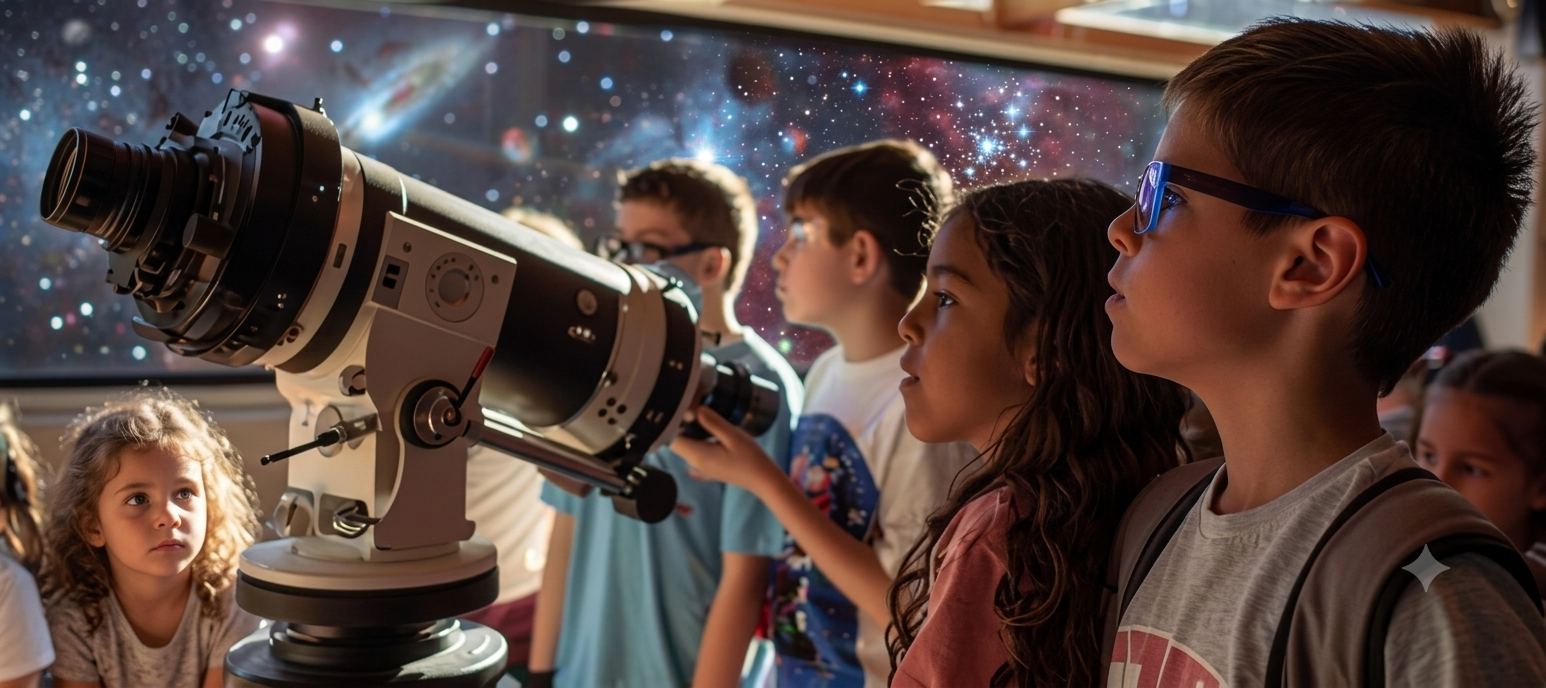
3. What Exactly is "Deep Tech" and Why Should School Students Care?
While “tech” generally refers to everyday software, apps, and consumer electronics, the term deep tech refers to pioneering technologies based on substantial scientific advances and high-tech engineering innovations. Deep tech is where science fiction meets modern engineering.
For young minds, understanding deep tech involves exploring:
Artificial Intelligence and Machine Learning: How automated systems analyze massive astronomical data sets to find hidden exoplanets.
Robotics and Autonomous Navigation: How planetary rovers make decisions on the surface of Mars without human intervention.
Biotechnology in Space: How scientists design closed-loop life support systems to grow crops in microgravity environments.
Quantum Technologies: How secure quantum communications could protect interstellar data transmission.
By introducing deep tech education for school students, we encourage young learners to look beyond consumer software and start thinking about the foundational technologies that will reshape human civilization.
4. Mapping Space Science for Kids: Tailoring Concepts from Class 5 to Class 12
To ensure that space education remains inspiring rather than overwhelming, the curriculum must be carefully calibrated to a student’s developmental stage. Here is how we can structure space science for kids across different grade brackets:
Elementary level (Class 5-6): Focus on the physical geography of the Solar System, the basic mechanics of gravity, and the history of human spaceflight, starting with the Apollo missions.
Middle School level (Class 7-9): Introduce the electromagnetic spectrum, how telescopes capture different wavelengths of light (infrared, ultraviolet, X-ray), and the basic principles of planetary geology.
High School level (Class 10-12): Dive into stellar astrophysics, dark matter, cosmological expansion, orbital dynamics, and the deep tech systems required to construct deep-space probes.
This progressive model ensures that as a student’s cognitive capacity grows, their conceptual understanding of the universe deepens alongside it.
5. The Gateway to Astrophysics: How to Start Small with Naked-Eye Stargazing
You do not need a multi-million dollar telescope to begin your journey into astronomy. The ancient astronomers mapped the entire sky using nothing but patience and their own eyes.
Students can begin by locating major constellations like Ursa Major, Orion, and Cassiopeia. By tracking the positions of visible planets like Venus, Mars, and Jupiter over several weeks, they can directly observe the geometry of our solar system.
To help identify stars and satellites in real-time, students can utilize outstanding interactive, web-based tools like the Stellarium Astronomy Web Portal. Learning the geography of the night sky builds a deep spatial awareness that serves as the perfect springboard for advanced astronomical studies.
6. Rockets, Satellites, and Beyond: Understanding Aerospace Engineering Conceptually
How do we actually break free from Earth’s gravity to explore the deep cosmos? Understanding aerospace engineering is a key pillar of space, astronomy & deep tech for young minds.
Students can study the qualitative principles of rocketry, focusing on Newton’s laws of motion, aerodynamic drag, thrust-to-weight ratios, and the stages of rocket launches.
They can also explore how modern satellites are constructed—analyzing payload systems, solar power grids, thermal shielding, and communication antennas. Understanding these physical constraints helps students appreciate the immense engineering hurdles scientists must overcome to send missions to the outer reaches of our solar system.
7. Demystifying Artificial Intelligence, Robotics, and Quantum Computing in High School
In high school (Class 10-12), the study of space science merges directly with deep tech. Today’s space agencies are overwhelmed with data. For instance, modern space telescopes capture petabytes of images every week. Humans cannot possibly sort through this data manually.
This is where artificial intelligence and machine learning step in. High school students can learn how AI algorithms are trained to recognize the slight dimming of a star, which indicates an exoplanet is passing in front of it.
They can also study how quantum sensors will allow future spacecraft to navigate deep space without relying on GPS. This intersection of astronomy and deep tech shows students that computer science is just as critical to space exploration as rocket fuel.
8. Top Interactive Digital Platforms to Explore Space and Astronomy for Free
To bring these abstract, cosmic concepts to life, students should actively engage with interactive digital environments. Here are some of the absolute best, entirely free resources available online:
NASA’s Eyes on the Solar System: An incredible, interactive 3D simulation that allows you to ride along with real-time NASA spacecraft and explore planets, asteroids, and comets. Learn more on the NASA STEM Engagement Portal.
ESA Kids: A dedicated learning platform operated by the European Space Agency, featuring highly interactive games, animations, and news articles tailored for younger students. Explore their resources on the ESA Kids Platform.
PhET Interactive Simulations: Created by CU Boulder, this platform features fantastic gravity, orbit, and wave simulations that allow students to experiment with physical variables. Access them directly on the PhET Physics Simulation Portal.
Using these platforms regularly transforms passive reading into active, hands-on scientific experimentation.
9. Citizen Science Projects: How Young Minds Can Contribute to Real NASA Research
One of the most exciting aspects of modern astronomy is that you do not need a PhD to make a real scientific discovery. Through the power of crowdsourced “citizen science,” students in Class 5 through 12 can contribute directly to active research projects.
By participating in collaborative online communities, young minds can help professional astronomers classify the shapes of distant galaxies, map craters on Mars, or identify solar flares.
The premier platform for this is Zooniverse Citizen Science, which hosts dozens of active, space-focused research projects. Engaging in citizen science gives students a thrilling taste of real-world scientific collaboration, showing them that their efforts can directly expand humanity’s cosmic knowledge.
10. Designing a Hands-On Space and Deep Tech Learning Workspace at Home
To truly unleash focus and cultivate a passion for deep tech, parents can help students build a dedicated, low-cost astronomy workspace at home. This space does not need to be expensive; it simply needs to encourage curiosity.
Consider adding these screen-free, highly tactile elements to your home learning environment:
Large Star Maps and Celestial Globes: Physical references that help students visualize the celestial coordinate system.
DIY Spectroscopes: Building a simple spectroscope using cardboard and a spare CD allows students to split household light into beautiful rainbow spectrums, demonstrating how astronomers analyze the chemical composition of distant stars.
Physical Engineering Kits: Lego Technic sets, cardboard rover models, or simple breadboard electronics kits that teach the tactile basics of robotics and structural design.
A dedicated physical space acts as an environmental cue, signaling to the brain that it is time to transition into a creative, scientific mindset.
11. Career Pathways: From Curious Classroom Observers to Future Aerospace Pioneers
The study of space, astronomy & deep tech for young minds opens up an incredible array of future career pathways. The space industry is no longer populated solely by astronauts and astrophysicists.
Future careers in this expanding ecosystem include:
Space Architects: Designing habitats, laboratories, and greenhouses for Mars and lunar bases.
Astrobiologists: Searching for microbial life in the subterranean oceans of moons like Europa and Enceladus.
Satellite Data Analysts: Utilizing AI to monitor Earth’s climate, track deforestation, and predict natural disasters from orbit.
Space Law and Policy Experts: Drafting international treaties to govern lunar mining, orbital debris management, and satellite traffic.
By showing students the vast diversity of careers available, we help them connect their current school assignments with exciting, real-world professions.
12. Step-by-Step Weekly Blueprint: Launching Your At-Home Space Exploration Quest
To help your family or classroom smoothly integrate space science and deep tech into your weekly routine, follow this easy-to-use, action-oriented study roadmap:
Stargazing Night (Monday): Spend twenty minutes in the evening locating three major stars or constellations using stargazing apps or physical star maps.
The Interactive Exploration (Wednesday): Spend half an hour playing with an orbital simulator, adjusting planetary mass to watch how gravity alters orbits.
The Citizen Science Mission (Friday): Spend fifteen minutes on citizen science platforms classifying real galaxies or identifying Martian terrain features.
The Weekly Debrief (Sunday): Sit down as a family or class and discuss one recent space discovery, discussing the deep tech systems required to make the discovery possible.
Following this structured, low-stress routine keeps space science highly active, deeply collaborative, and incredibly rewarding!
13. Conclusion: Fueling a Lifelong Journey of Cosmic Discovery
Unlocking the wonders of space, astronomy & deep tech for young minds is one of the most powerful ways to inspire the next generation of thinkers, creators, and pioneers. By encouraging students in Class 5 through 12 to look beyond their textbooks and engage with the real tools of modern science, we build a future defined by curiosity and innovation.
Whether you are scanning the night sky for the ISS, analyzing galaxy shapes on citizen science portals, or experimenting with virtual gravity simulators, you are actively participating in the grand human journey of exploration.
Explore the platforms highlighted in this guide, set up your at-home space lab, and step confidently into the cosmos, ready to uncover the next great mystery of the universe!