The Ultimate Checklist: NCERT Solutions vs. Reference Books for 10th-12th Exams
Preparing for the CBSE Class 10 board exams and Class 12 board exams is one of the most high-stakes academic phases for millions of students in India. Every year, classrooms, corridors, and online study forums buzz with the exact same frantic debate: Should I stick strictly to NCERT textbooks and NCERT Solutions, or do I need to buy heavy, expensive reference books to score above ninety-five percent?
This classic dilemma often leads to immense study anxiety. Some students spend hours highlighting lines in standard textbooks, while others collect dozens of reference books, only to end up paralyzed by resource overload.
To help you clear the confusion, this comprehensive, SEO-optimized blog post provides a logic-driven analysis. We evaluate the regulatory importance of official school textbooks, detail the precise role of reference books, and provide the ultimate checklist to help you structure your board exam preparation without last-minute panic.
1. Understanding the Core Syllabus: Why NCERT is the Official Blueprint
When it comes to securing a top-tier rank in your Class 10 and Class 12 board exams, you must understand that the entire exam paper is designed around a single, highly standardized framework. The Central Board of Secondary Education (CBSE) designs its official syllabus, marking schemes, and question paper blueprints directly from the NCERT curriculum.
For any board aspirant, the official NCERT textbooks are your holy scripture. Every single question in the final board exam—whether it is a multiple-choice question, an analytical case-study, or a long-form descriptive answer—is derived directly or indirectly from the paragraphs, diagrams, and summary points of your NCERT books.
Attempting to skip these core textbooks to study exclusively from heavy reference volumes is a highly dangerous academic trap. To align your study routine with the officially prescribed syllabus, you can monitor the CBSE Academic Official Portal, which serves as the central administrative hub for curriculum updates, official circulars, and model question papers.
2. The Power of Precision: Decoding the Role of NCERT Solutions
Simply reading the chapters is not enough; you must master the art of writing answers that align perfectly with the expectations of board evaluators. This is where high-quality NCERT Solutions become your ultimate competitive weapon.
CBSE evaluators utilize a strict, step-wise marking scheme to grade your paper. They look for specific scientific terms, historical dates, and structured definitions. NCERT Solutions Class 10 and NCERT Solutions Class 12 provide the exact templates for these high-yield answers. By studying these solutions, you learn:
How to define complex terms clearly and concisely.
How to structure long-form descriptive answers using bullet points.
How to incorporate essential academic keywords that evaluators actively search for.
How to present neat, labeled diagrams to secure full marks in science papers.
To download free, digital, and fully verified copies of these essential textbooks and marking guides on the go, you can browse the NCERT National Educational Portal, which serves as the centralized government directory for school study materials.
3. When to Level Up: The Real Purpose of Reference Books
While NCERT is your foundation, there are specific academic scenarios where relying only on basic textbooks can limit your performance. This is where strategic reference books enter the picture.
The primary limitation of NCERT textbooks is their brevity. To keep the books lightweight and accessible, concepts are often explained in very condensed paragraphs. If a student struggles to grasp a difficult scientific law or a complex grammatical structure, the brief explanation in NCERT may feel insufficient.
Reference books are designed to provide:
Exhaustive Explanations: Breaking down abstract concepts into simpler, highly detailed, and conversational paragraphs.
Diverse Practice Material: Offering hundreds of additional questions, ranging from basic fill-in-the-blanks to high-order thinking skills (HOTS) questions.
Comparative Tables and Mind Maps: Providing visual summaries that make it easy to revise vast chapters rapidly.
Previous Year Questions (PYQs): Aggregating past board papers in a topic-wise format, allowing you to see exactly how concepts have been tested over the last decade.
4. Stream-Specific Breakdown: Science, Commerce, and Humanities
The decision to choose between NCERT Solutions and reference books is highly dependent on your academic stream. Let’s analyze how the requirements differ across various subjects.
The Science Stream (Physics, Chemistry, and Biology)
In Class 12 Physics, Chemistry, and Biology, the split between NCERT and reference books is highly critical:
Biology: Stick 100% to NCERT. The final board paper is drawn almost entirely from the lines, footnotes, and diagrams of the NCERT biology textbook. You do not need external reference books for theory; instead, focus on practicing diagram labeling and mastering NCERT Solutions.
Chemistry: For Inorganic and Organic Chemistry, NCERT is absolute. Named reactions, chemical properties, and coordination compound structures must be memorized directly from your school textbooks. However, for Physical Chemistry, you may use a reference book to access a wider variety of practice questions.
Physics: While the theory and standard derivations must be studied from NCERT, the textbook contains a limited number of numerical practice questions. To build your speed and accuracy in solving complex physics problems, utilizing a dedicated reference book is highly recommended.
The Commerce Stream (Accountancy, Business Studies, and Economics)
Management, accountancy, and economics require a strong focus on real-world application and case studies:
Accountancy: This subject demands intensive practice. While NCERT provides the basic formats and theoretical principles, you must use a reputed reference book (like TS Grewal or DK Goel) to solve a wide variety of partnership, company, and ledger accounts.
Business Studies: The modern CBSE paper focuses heavily on long, paragraph-based case studies. While NCERT covers the core principles of management, a reference book is essential to practice identifying specific organizational terms from complex case narratives.
Economics: For Indian Economic Development, NCERT is your primary source. For Macroeconomics, a reference book is highly useful to understand the structural relationships between national income, monetary policies, and fiscal budgets through clean visual flowcharts.
The Humanities and Arts Stream (History, Political Science, and Geography)
In social sciences and languages, answer presentation, chronological mapping, and conceptual clarity dictate your scores:
History and Political Science: NCERT is the gold standard. Evaluators look for precise historical timelines, constitutional articles, and political event sequences. Reference books should only be used to access chapter summaries, flashcard-style dates, and sample papers.
Geography: Map marking carries a high weightage. Use your NCERT atlas maps continuously. A reference book can help you practice locating key industrial corridors, major seaports, and international trade routes.
5. Spotting the Trap: The Dangers of Resource Overload
One of the most common psychological traps for board aspirants is “resource hoarding.” Many students assume that buying five different reference books for a single subject will automatically translate into a ninety-five percent score. This is a massive mistake that can actively damage your preparation.
When you study the same concept from five different sources, you expose your brain to varying terminology, different writing styles, and disorganized structures. This lack of consistency leads to cognitive fragmentation, where your brain struggles to consolidate what you have learned, doubling your academic workload and inducing severe exam-day panic.
To avoid this trap, stick to a highly disciplined Single Source Rule:
Choose one primary textbook (NCERT), one high-quality, verified solution set (NCERT Solutions), and one trusted reference book per subject. Revise this single set of resources five to ten times rather than skimming five different books once.
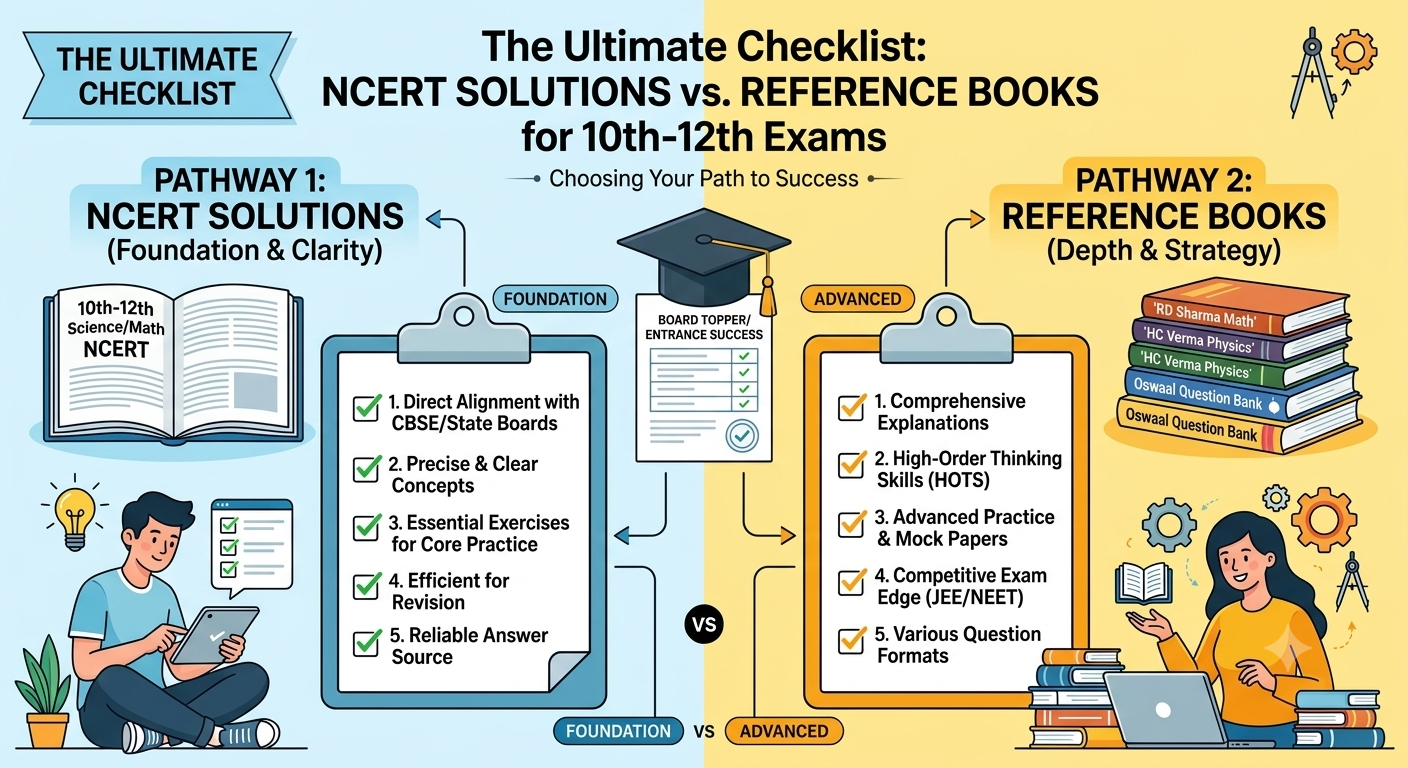
6. The Ultimate Checklist: NCERT vs. Reference Books Decision Matrix
To simplify your resource selection, use this logic-driven checklist to determine exactly when to open your NCERT textbook and when to reach for your reference books:
+------------------------------------+-------------------------+-------------------------+
| Learning Task / Goal               | Open NCERT Textbook     | Open Reference Book     |
+------------------------------------+-------------------------+-------------------------+
| Building core conceptual foundation| YES (Absolute First Step)| No                      |
| Checking official CBSE syllabus    | YES                      | No                      |
| Learning precise definitions       | YES                      | No                      |
| Practicing standard board diagrams | YES                      | No                      |
| Explaining complex, dry theories   | No                      | YES (For simple notes)  |
| Solving high-volume practice papers| No                      | YES                     |
| Reviewing topic-wise past papers   | No                      | YES                     |
| Writing timed, full-syllabus mocks | No                      | YES (Sample papers)     |
+------------------------------------+-------------------------+-------------------------+
7. Maximizing Board Exam Scores: How to Balance Both Resources
To secure an elite score in your final board exams, you must learn to integrate these resources into a highly synchronized, daily study routine. Use this step-by-step method to balance both worlds seamlessly:
The First-Pass Reading: Read the NCERT chapter thoroughly. Highlight key terms, underline central definitions, and try to understand the core message of the text.
The Simplification Pass (If Stuck): If a specific section feels too dense or confusing, open your reference book. Read their simplified explanation, review their comparative flowcharts, and clear up your conceptual doubts.
The Active Solution Pass: Go back to your NCERT book and solve the in-text questions and end-of-chapter exercises independently. Cross-reference your answers with your NCERT Solutions to verify if your answer structure matches the board evaluation guidelines.
The Deep Practice Pass: Open your reference book and solve the topic-wise previous year questions (PYQs) for that specific chapter. This ensures you master both the theoretical depth and the exam application.
8. Best Practices for Active Revision and Self-Assessment
Your preparation is ultimately won or lost in the revision phase. To ensure long-term retention and prevent memory decay under pressure, adopt these science-backed self-assessment habits:
Draft 2-Page Chapter Micro-Notes: As you finish each chapter, summarize the core definitions, essential chemical reactions, or historical dates onto a single, double-sided sheet of paper. These micro-notes will serve as your primary revision material during the high-stress winter months.
Practice Spaced Retrieval: Do not simply re-read your notes. Close your books, take a blank sheet of paper, and write down everything you can recall from memory. This active retrieval signal tells your brain to strengthen those neural memory pathways.
Solve Sample Papers Under Strict Timers: During the final months of your preparation, download the official CBSE sample papers. Sit in a quiet room, turn off your devices, and solve the entire paper within the strict three-hour limit (typically 9:30 AM to 12:30 PM) to align your biological clock with the actual exam day.
To explore additional resources, student wellness programs, and educational support guidelines compiled by the central government, you can consult the Ministry of Education India Portal, which provides active support networks for secondary and higher secondary students.
9. Conclusion: Your Roadmap to Board Exam Glory
The definitive verdict of this comprehensive dual-resource analysis is highly empowering: academic excellence in your CBSE board exams is not a result of luck, nor is it reserved only for “natural geniuses.” It is the natural outcome of a highly disciplined, scientifically paced, and balanced study strategy.
By using your NCERT textbooks as your foundation, utilizing NCERT Solutions to master your answer presentation, and leveraging a single reference book to run targeted, deep-practice sessions, you completely eliminate the space for last-minute academic panic.
Embrace this structured checklist, stay consistent in your daily study blocks, protect your physical and mental wellness, and walk into your examination hall with the quiet confidence of an aspirant who truly understands their subject.