Online vs Offline Coaching: Which is Better for Your Child’s Learning Style?
The modern educational landscape has undergone a monumental shift. Gone are the days when traditional, face-to-face tuition classes were the only pathway to academic success. Today, parents face an increasingly complex decision: choosing between online coaching vs offline coaching.
With advanced digital platforms offering interactive simulations on one hand, and physical academies emphasizing personal discipline and face-to-face connection on the other, selecting the best coaching for kids is no longer a simple task. The correct choice depends heavily on one vital, often overlooked factor: your child’s learning style.
Every young mind processes, retains, and retrieves information differently. What works beautifully for a self-motivated, highly visual student might fail completely for an active, social learner who requires tactile interaction. In this comprehensive parent’s guide, we will break down the structural, cognitive, and psychological differences between physical and digital education environments, helping you choose the path that aligns perfectly with your child’s academic journey.
1. The Modern Parent's Dilemma: Navigating the New Age of Education
As a parent, you want to provide every possible resource to support your child’s academic success. However, the sheer volume of choices in the modern education market can be overwhelming. On one hand, you have massive online edtech giants promising hyper-personalized curriculum tracks, gamified study modules, and access to top-tier national educators from the comfort of your living room. On the other hand, established neighborhood academies offer structured schedules, direct human supervision, and an environment free from home-based distractions.
To make the right choice, parents must move away from comparing which platform has the better technology or the fancier building. Instead, the focus must shift inward. You must ask: How does my child actually learn? By aligning the tutoring medium with your child’s innate cognitive profile, you can unlock their true academic potential, maximize their performance in competitive exams, and prevent chronic study burnout.
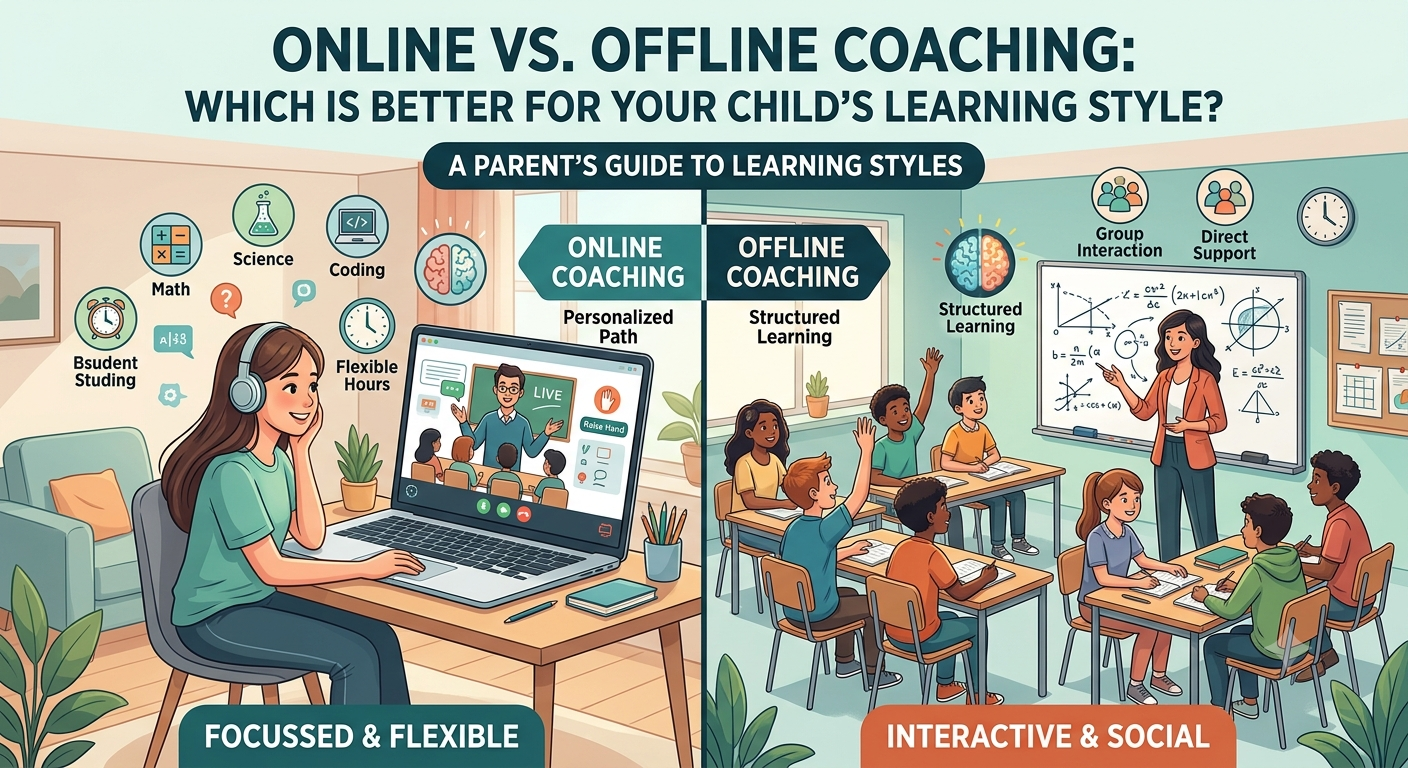
2. Deconstructing the Debate: Online vs. Offline Coaching
Before examining individual learning styles, it is essential to establish what each coaching medium structurally offers.
Feature / Metric | Online Coaching | Offline Coaching |
|---|---|---|
Schedule Flexibility | Extremely high; recorded classes are viewable anytime. | Rigid; fixed hours require travel and physical attendance. |
Social Environment | Virtual chats, limited peer interaction, self-directed. | High face-to-face social engagement, healthy peer competition. |
Distraction Level | High risk of digital distractions (tabs, gaming, social media). | Controlled classroom environment designed for focus. |
Feedback Loop | Often automated via dashboards or periodic live chats. | Immediate, real-time feedback from the instructor in the room. |
Personalization | Adaptive learning paths powered by diagnostic tests. | Pace is generally set by the average learning speed of the batch. |
Both models possess distinct structural advantages. Understanding these baseline parameters allows you to cross-reference them with your child’s daily behavior, focus thresholds, and social needs to find the best coaching for kids.
Note : National Policy, Board Reforms & Coaching Rules For 5th to 12th
3. Understanding Your Child's Unique Learning Style
To determine whether digital or physical classrooms are more effective, we must look to established educational psychology. A widely accepted framework is the VARK model, which categorizes learners into four primary modalities: Visual, Auditory, Reading/Writing, and Kinesthetic.
If you place a kinesthetic learner in front of a computer screen for four hours, they will likely struggle, regardless of how brilliant the online instructor is. Conversely, a highly sensitive visual learner might find the loud, chaotic environment of a physical classroom highly distracting. To explore deeper scientific frameworks on child pedagogy and cognitive development, check out the resources compiled on Edutopia’s Learning Styles Research, which details how modern classrooms adapt to diverse student needs. Understanding these nuances is crucial when weighing online coaching vs offline coaching.
4. Visual Learners: Navigating the Digital vs. Physical Board
Visual learners process information best when they can “see” the concepts. They rely on diagrams, color-coded notes, spatial maps, and high-quality video demonstrations to anchor abstract ideas in their minds.
How they fare in Online Coaching:
Online platforms are an absolute paradise for visual learners. Digital education software utilizes advanced 2D and 3D animations, interactive whiteboards, and real-time screen sharing. If a student is trying to understand the structure of a cell, the movement of tectonic plates, or the geometric properties of a wave, a dynamic, animated video clip is vastly superior to a static drawing on a physical chalkboard.
How they fare in Offline Coaching:
While physical coaching centers use whiteboards and printed study materials, they often cannot compete with the sheer variety of visual media available on a high-definition computer screen. Visual learners in a physical class can sometimes lose focus if the teacher relies too heavily on verbal lectures without writing notes clearly on the board. For these students, digital education is often the clear winner.
5. Auditory Learners: Lectures vs. Dynamic Classroom Discussions
Auditory learners retain information through listening and speaking. They benefit immensely from the tone, pitch, and tempo of an instructor’s voice, and they master complex topics by discussing them out loud.
How they fare in Online Coaching:
Online coaching can work well for auditory learners, especially if classes are live and interactive. Features like pausing and rewinding recorded lectures allow these students to listen to explanations multiple times. However, if the digital setup lacks a functional microphone channel for students to talk back, auditory learners can feel isolated and struggle to engage with the passive audio feed.
How they fare in Offline Coaching:
This is where traditional classrooms shine. The natural, unfiltered flow of a classroom discussion—where students ask spontaneous questions, debate points with peers, and hear different voices explaining the same concept—is highly stimulating for auditory minds. To understand how conversational learning impacts child behavior and retention, you can read behavioral analyses on Psychology Today, which highlights the importance of real-time vocal feedback in cognitive growth.
6. Kinesthetic and Tactile Learners: The Need for Hands-on Environments
Kinesthetic learners are hands-on individuals. They learn by doing, moving, touching, and physically experiencing the subject matter. These are the children who constantly fidget, tap their pencils, or need to walk around the room while memorizing facts.
How they fare in Online Coaching:
Online learning is often the hardest format for kinesthetic students. Sitting still in front of a laptop or tablet for extended periods goes against their physical nature. Without a hands-on element, they easily slip into daydreaming or seek physical stimulation elsewhere, often leading to poor academic performance and frustration with online coaching.
How they fare in Offline Coaching:
Offline coaching is generally much better suited for kinesthetic learners. The physical act of packing a bag, walking to a learning center, sitting at a dedicated study desk, and physically writing notes on paper provides a tactile anchor. Furthermore, physical classes often incorporate practical experiments, real-world demonstrations, and physically interactive group activities that help these active students stay engaged, making physical centers the best coaching for kids with active learning profiles.
7. The Case for Online Coaching: Unparalleled Flexibility and Personalization
For students whose learning styles align with independent, self-paced study, digital education offers historic advantages that physical centers simply cannot replicate.
┌────────────────────────────────────────────────────────┐
│            THE DIGITAL EDUCATION ADVANTAGE             │
├────────────────────────────────────────────────────────┤
│ • Hyper-Personalized Speed: Pause, fast-forward, repeat │
│ • Access to Global Experts: No geographical boundaries  │
│ • Rich Media Integration: 3D models and simulations     │
│ • Comfort & Safety: Zero travel fatigue, study from home│
└────────────────────────────────────────────────────────┘
The greatest benefit of online coaching is personalized learning. In a traditional batch of 40 students, the instructor must teach at a uniform pace. If your child is a fast learner, they might get bored; if they require extra time to process a concept, they might get left behind. Online platforms solve this by offering adaptive testing algorithms that pinpoint exact learning gaps and recommend personalized remedial videos, a model pioneered by organizations like Khan Academy to democratize high-quality, self-paced learning.
8. The Case for Offline Coaching: Peer Interaction, Structure, and Discipline
Despite the rapid rise of educational technology, traditional tuition classes remain incredibly popular for a very clear reason: they provide a structured social ecosystem.
Accountability: In a physical classroom, a teacher can look a student in the eye and instantly tell if they are confused, distracted, or bored. This immediate human accountability is incredibly difficult to replicate over a webcam.
Peer-to-Peer Learning: Healthy competition is a powerful motivator. Sitting among peers who are solving the same problems pushes students to work harder. They can quickly compare notes, form study groups, and build vital social skills.
Clear Boundaries: When a child walks into a physical coaching center, their brain receives a powerful psychological cue: It is time to study. Back at home, the boundary between leisure time (the bed, the TV, the kitchen) and study time (the desk) easily becomes blurred.
These factors make physical classes highly reliable for parents searching for the best coaching for kids who need external discipline.
9. Comparing the Cognitive and Emotional Impacts of Both Modes
Choosing an educational path is not just about exam scores; it is also about your child’s emotional well-being and mental health.
Extended screen time can lead to digital fatigue, eye strain, and a sense of social isolation. If a child spends their school day looking at a screen and their evening coaching sessions looking at the same screen, they miss out on critical real-world interactions. This can lead to a decline in communication skills and increased stress. Research shared by the Harvard Graduate School of Education frequently highlights the importance of social-emotional learning and real-world relationship building in the cognitive development of children.
Conversely, forcing a highly anxious or introverted child into a crowded, high-pressure physical coaching center can trigger performance anxiety. For these students, the privacy of online learning offers a safe space where they can make mistakes and ask questions without fear of judgment from peers, demonstrating that the choice of online coaching vs offline coaching must be highly individualized.
10. How to Run a Home Audit of Your Child's Study Habits
If you are still unsure which path is best, you can conduct a simple “home study audit” over a two-week period to gather objective observations about your child’s behavior:
Observe Focus Thresholds: How long can your child read a book or watch an educational video before looking around, picking up their phone, or leaving their desk? If their focus breaks within 15 minutes without external prompting, they likely need the physical structure of offline coaching.
Track Question-Asking Habits: When your child encounters a difficult concept, do they search for the answer independently online, or do they immediately ask you or a sibling to explain it? Independent searchers thrive online; those who seek conversational explanations prefer offline.
Monitor Energy Levels: Does your child seem energized after spending time with friends, or do they prefer quiet, solitary activities to recharge? Highly social children generally thrive in the collaborative environment of a physical classroom.
11. Hybrid Learning: Combining the Best of Both Worlds
For many families, the ultimate solution is not a strict choice between online and offline, but rather a strategic combination of both—commonly referred to as hybrid learning or blended learning.
Under a hybrid model, a student might attend physical coaching classes three days a week to benefit from structured peer discussions, hands-on teacher guidance, and disciplined exams. On the alternate days, they utilize online platforms to access animated visual explanations, take adaptive mock tests, and review complex lectures at their own pace. This approach ensures your child enjoys the social benefits of traditional schooling alongside the technological advantages of modern digital education, creating a balanced roadmap to academic success.
12. Conclusion: Making the Final Choice for Your Child’s Future
Ultimately, there is no single “correct” answer in the online coaching vs offline coaching debate. Both formats are highly effective tools designed for different types of minds.
Instead of searching for the most popular coaching center or the platform with the most advertisements, look closely at your child. Identify whether they are visual, auditory, or kinesthetic. Gauge their levels of self-discipline, their need for social interaction, and their ability to handle screen time. By putting your child’s unique learning style at the center of your decision, you will not only set them up for outstanding academic success but also foster a lifelong, genuine love for learning.