Is Starting JEE Prep in Class 12 a Realistic Goal? The Step-by-Step Recovery Blueprint
Every year, thousands of high school students wake up to a daunting realization at the beginning of their final school year: they want to study at the premier Indian Institutes of Technology (IITs), but they have not spent a single day on target competitive preparation. They look at their peers who have been attending intensive coaching classes since Class 9 or 10, and they ask themselves a sobering question: Is starting JEE prep in Class 12 a realistic goal?
The standard consensus in the coaching industry is often discouraging. You will hear that the syllabus is too vast, the competition is too fierce, and the time is too short. However, the reality on the ground is far more nuanced. While starting your Class 12 JEE prep from scratch is an uphill battle, it is entirely possible to secure an outstanding rank if you abandon traditional, slow-paced study methods in favor of a highly compressed, strategic recovery blueprint. In this comprehensive guide, we will analyze the viability of this late-start strategy and provide a step-by-step roadmap to help you bridge the gap and achieve your academic dreams.
1. The Class 12 Reality Check: Is It Truly Too Late to Start JEE Preparation?
The first hurdle any late-starting aspirant must overcome is psychological. It is easy to fall into a state of decision paralysis, believing that because you did not start early, you are mathematically locked out of success. This is a dangerous misconception.
Starting your JEE preparation in Class 12 is highly realistic, but it requires a complete shift in your expectations and strategies. You cannot afford the luxury of studying every single topic in exhaustive detail. Instead, your goal must shift from “perfect, comprehensive mastery” to “strategic scoring efficiency.” The Joint Entrance Examination (JEE) is not an exam designed to test how much you have memorized; it is an elimination test designed to measure your analytical application and problem-solving speed under pressure. By understanding how the paper is structured and where the high-yield marks lie, a late starter can outperform early starters who spent their time studying low-yield, obscure topics.
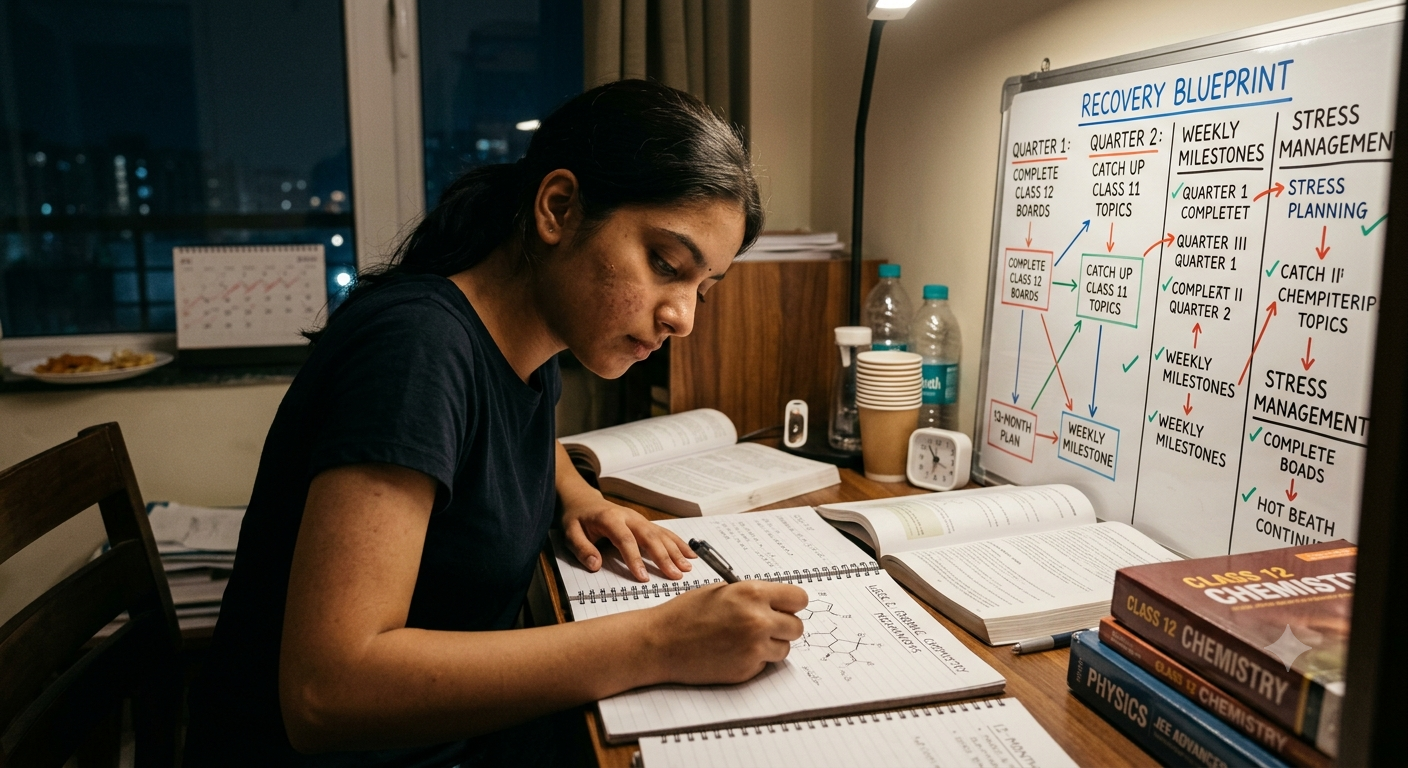
2. Deconstructing the Mountain: The Crucial Differences Between Class 11 Backlogs and Class 12 Core Syllabus
The biggest challenge of starting late is the “Class 11 backlog.” The JEE syllabus is divided almost equally between Class 11 and Class 12 topics. Since Class 12 topics build on the conceptual foundations laid in the previous year, attempting to learn advanced senior concepts without understanding basic junior concepts is like trying to build a skyscraper on wet clay.
To execute a successful Class 12 JEE recovery plan, you must categorize your syllabus into two distinct zones:
The Interconnected Foundations: These are the Class 11 chapters that are absolutely mandatory to understand before you can even begin Class 12 topics.
The Isolated Islands: These are Class 11 chapters that have no bearing on Class 12 topics. These can be safely ignored or pushed to the final weeks of your preparation.
By drawing this clear boundary, you immediately reduce the volume of your active backlog, making your daily study targets feel achievable rather than overwhelming.
3. Phase 1 of the Blueprint: The Brutal Prioritization of High-Yield Chapters
When you have less than a year to prepare, equal distribution of study time is your greatest enemy. You must apply the Pareto Principle (the 80/20 rule): 80% of your exam score will come from 20% of the syllabus.
Your first step in your JEE Mains preparation is to identify the high-yield, low-effort chapters across all three subjects. For instance, in Chemistry, chapters like Coordination Compounds, d-block and f-block elements, and Biomolecules carry massive weight and require far less analytical derivation than complex equilibrium topics. In Physics, Modern Physics and Semiconductor devices are highly scoring, conceptual, and direct.
To ensure you are aligning your priorities with the absolute latest official syllabus distributions and test patterns, make sure to regularly monitor updates published on the official National Testing Agency Portal. Staying updated with NTA guidelines prevents you from wasting precious weeks studying topics that may have been rationalized or removed from the active exam pool.
4. Phase 2: Master the Art of Concurrent Learning (Managing Class 12 and Class 11 Backlogs)
The most common trap late starters fall into is trying to finish their Class 11 backlog entirely before starting their Class 12 school syllabus. This is a recipe for disaster. If you do this, you will fall behind in your active school classes, destroy your internal board exam scores, and create a brand-new Class 12 backlog.
Instead, you must master “Concurrent Learning.” This involves dedicating 70% of your weekly study time to mastering your current Class 12 topics at a competitive JEE level, and dedicating the remaining 30% of your time to systematically clearing specific, high-priority Class 11 backlogs. For example, if your school is currently teaching Electrostatics in Physics, use your weekend backlog slot to study Class 11 Gravitation, as the mathematical and conceptual models of both chapters are highly symmetrical. This parallel approach reinforces your learning and keeps you on track with your active school curriculum.
5. The Daily Kinetic Routine: Designing a High-Output Study Schedule for Late Starters
A traditional student can afford to study casually for three to four hours a day. As a late starter trying to crack JEE starting in Class 12, your schedule must be highly disciplined, optimized, and focused on active output.
┌────────────────────────────────────────────────────────┐
│             THE KINETIC DAILY STUDY SPLIT              │
├────────────────────────────────────────────────────────┤
│ • School / Active Class Time: Conceptual listening     │
│ • Prime Afternoon Slot (3 Hours): Class 12 JEE Practice│
│ • Late Evening Slot (2 Hours): Class 11 Backlog Rescue │
│ • Night Cap (1 Hour): Active Recall & Formula Revision │
└────────────────────────────────────────────────────────┘
Your daily schedule must prioritize self-study over passive video watching. Many students spend six hours watching online lectures and call it “preparation.” This is an illusion. Passive watching does not build the neural pathways required for analytical problem-solving. Limit your lecture consumption to two hours a day, and spend the remaining four to five hours actively solving problems, analyzing your errors, and writing down conceptual summaries.
6. The Cognitive Leverage: Ditching Passive Reading for Active Recall and Dynamic Problem Solving
When time is your scarcest resource, traditional study habits like reading textbooks cover-to-cover and highlighting definitions must be completely abandoned. These methods create a “familiarity bias”—you feel like you understand the concept because you recognize the words, but you cannot apply it to an unfamiliar exam question.
Instead, utilize Active Recall and Spaced Repetition. After reading a brief conceptual summary in your official school textbooks, close the book and immediately attempt to write down the core physical principles, conditions, and assumptions in your own words. When practicing questions, do not read the solution the moment you get stuck. Struggle with the problem for at least five minutes, analyzing where your logical flow broke down. This active cognitive struggle is what builds genuine, long-term analytical capability, allowing you to recall complex concepts easily during the high-stress environment of the actual exam.
7. Subject-Wise Adaptation: Tailoring Your Strategy for Physics, Chemistry, and Mathematics
Each subject in the JEE syllabus requires a completely different cognitive approach. Trying to study Chemistry the same way you study Mathematics is a fundamental strategic error.
Physics: From Physical Principles to Multi-Step Application
In Physics, your focus must be on understanding the underlying physical mechanisms rather than memorizing formulas. You must learn to visualize the system—whether it is a charge moving through an electric field or a gas undergoing a thermodynamic cycle. Master the coordinate systems and vectors early, as these are the mathematical languages in which physics problems are written.
Chemistry: Mastering the Three Pillars
Chemistry is your highest-yielding subject where you can score maximum marks in minimum time. Divide it into three distinct strategies:
Inorganic Chemistry: Treat your school textbooks as your primary script. Line-by-line reading and active memorization of periodic trends and coordination anomalies are key.
Organic Chemistry: Do not memorize reactions in isolation. Focus on understanding the basic electronic effects (resonance, inductive effect, and hyperconjugation) and the behavior of nucleophiles and electrophiles.
Physical Chemistry: Treat this as a mathematical branch. Master the core formulas, understand the physical assumptions behind laws, and practice diverse application-oriented questions.
Mathematics: The Domain of Pattern Recognition
Mathematics cannot be learned by reading; it can only be learned by doing. Focus on developing “pattern recognition.” When you look at a coordinate geometry or vector algebra problem, you should immediately recognize which properties can simplify the equation. Prioritize high-scoring areas like Coordinate Geometry, Matrices and Determinants, and Vector Algebra, which are highly structured and rewarding.
To ensure your conceptual baselines are highly accurate across all these subjects, make sure to read the primary text sources. You can access the official, updated digital textbooks directly on the NCERT Digital Textbook Repository to ensure your foundational concepts remain perfectly aligned with the core exam blueprint.
8. How to Handle School Board Exams and Practical Classes Simultaneously
One of the greatest points of anxiety for students starting their competitive prep in Class 12 is the pressure of the school board examinations. Parents and school teachers often demand that you stop your competitive prep entirely to focus on board writing practice.
This is a false dichotomy. The syllabus for JEE and school board exams is exactly the same; the only difference is the presentation of the answers. Board exams require descriptive, step-by-step writing, while competitive exams require rapid analytical deduction and final option selection.
When you study a topic for your competitive preparation, you are automatically preparing 90% of the concept for your boards. To bridge the remaining 10% gap, dedicate one day a week (such as Sundays) to practicing descriptive answers, writing down derivations step-by-step, and reviewing past board exam papers. This integrated approach ensures you score 90%+ in your board exams while keeping your competitive preparation running at maximum velocity.
9. The Psychological Fortitude: Dealing with Low Mock Scores and the Late-Starter Syndrome
The journey of a late starter is filled with moments of intense self-doubt. When you take your first few full-length mock tests, your scores will likely be low. This is the exact point where the vast majority of late starters give up, assuming they do not have the intelligence or the time to succeed.
You must understand that a mock test score is not a reflection of your worth or your final potential; it is simply diagnostic data. It shows you exactly which concepts are fractured, where your time-management failed, and what calculation errors you are prone to making. Instead of feeling demoralized by a low score, treat every mistake as a victory—it is one less error you will make on the day of the actual exam. To explore visual learning strategies, video lectures, and diagnostic tests designed to build your confidence during these initial phases, check out the resources hosted on the Official JEE Advanced Portal, which provides previous years’ papers and structural guidelines to help you align your analytical thinking with the highest standards of the exam.
10. Mock Test Strategy: Transforming Failures Into Diagnostic Data
As a late starter, your practice testing strategy must be highly systematic. You do not have the time to take hundreds of random mock tests. You must make every single test count.
Start with Part-Syllabus Tests: Do not attempt full-syllabus tests in the first few months. Focus on part-tests that cover only the chapters you have actively prepared. This builds your confidence and validates your study methods.
Analyze Your Mistakes Systematically: Spend twice as much time analyzing a mock test as you did taking it. Create an “Error Log” where you write down every question you got wrong, the exact concept behind it, and why you made the mistake (conceptual error, calculation error, or time pressure).
Track Your Speed and Accuracy Separately: In the initial phases, prioritize accuracy over speed. Learn to get questions right first; your speed will naturally increase as your pattern recognition improves and your conceptual foundations strengthen.
11. Conclusion: Transforming the "Impossible" Into a Structured Victory
Starting your competitive engineering preparation in Class 12 is undeniably a massive challenge, but it is far from impossible. The difference between those who fail and those who succeed does not lie in their inherent intelligence; it lies in their willingness to execute a disciplined, highly targeted strategy.
By accepting your late start, brutally prioritizing high-yield chapters, mastering the art of concurrent learning, and maintaining a high-output daily routine, you can systematically close the cumulative learning gap. Stop looking at your peers who started in Class 9, and stop wasting time worrying about the months you lost. The clock is ticking, but with the right recovery blueprint in hand, you have more than enough time to transform your hard work into an outstanding rank and secure your place in the premier engineering institutes of the country.