Is NCERT Enough to Crack NEET 2027? What the Toppers Recommend
As the race for medical seats in India grows more competitive, millions of aspirants are gearing up for the National Eligibility cum Entrance Test (NEET). If you are aiming for a stellar score in the upcoming entrance exam, you have likely asked yourself: Is NCERT enough to crack NEET 2027?
Year after year, National Testing Agency (NTA) toppers emphasize the supreme importance of these fundamental textbooks. Yet, the debate persists. Can a set of basic boards-level books truly help you score 700+ in one of the toughest competitive exams in the world? In this ultimate guide to NEET 2027 preparation, we will dissect the truth about NCERT for NEET 2027, reveal what toppers actually recommend, and break down exactly how you should leverage these books across Biology, Chemistry, and Physics.
1. Understanding the Role of NCERT in NEET 2027 Preparation
To begin your NEET 2027 preparation, you must first understand the relationship between the exam conducting body, the NTA, and the National Council of Educational Research and Training (NCERT). The official curriculum for the medical entrance test is fundamentally aligned with the Class 11 and Class 12 CBSE syllabi.
When NTA designs the question paper, they use the textbook as their primary blueprint. Every line, diagram, table, and summary is a potential source for a high-yield question. If you want to check the official guidelines and curriculum updates, make sure to regularly visit the official NTA NEET Portal for the most accurate and up-to-date notifications regarding the NEET syllabus 2027. Relying on these official resources ensures that your NEET study plan stays perfectly aligned with any systemic changes.
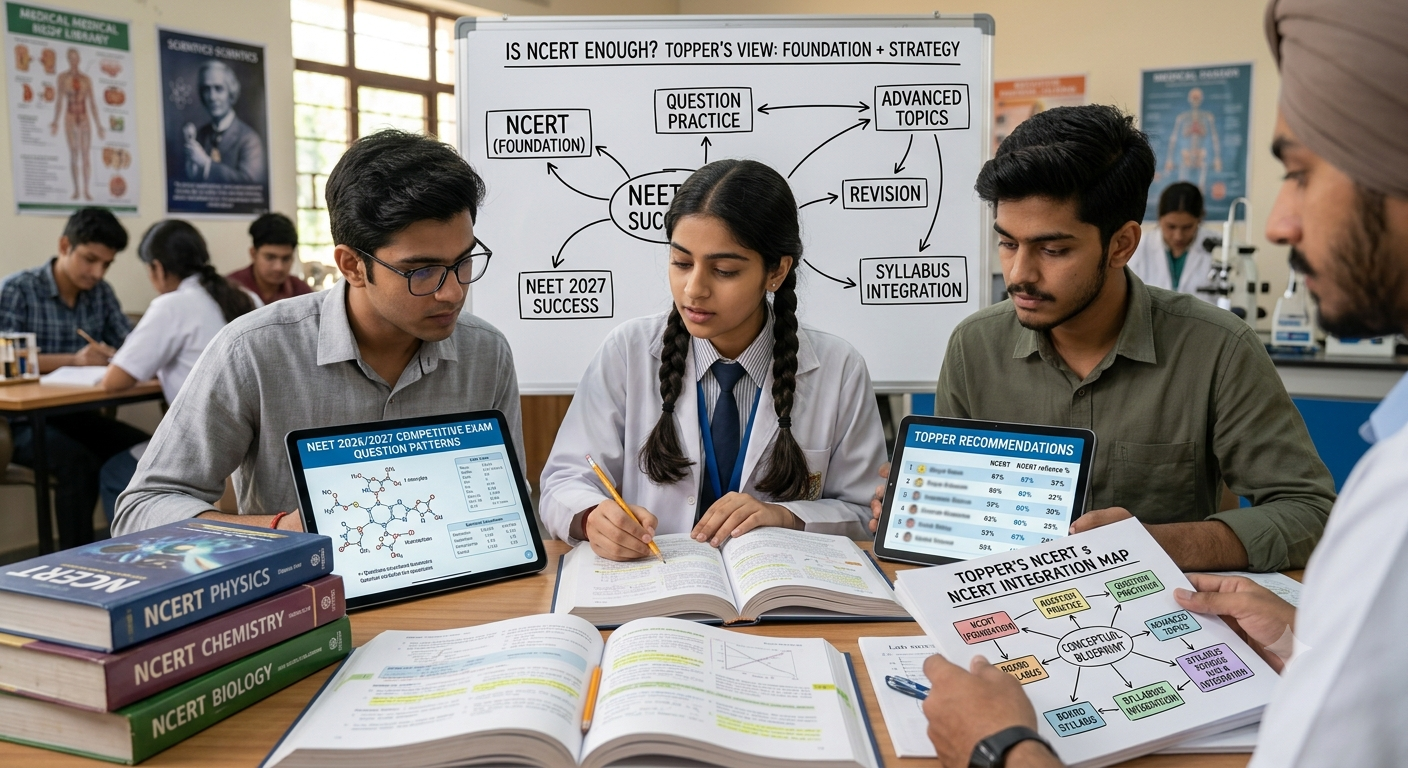
2. Why NEET Toppers Unanimously Swear by NCERT Textbooks
If you interview any top-ranking student from previous years, their primary advice remains consistent: master your school textbooks first. But why is there such a heavy emphasis on these specific books for cracking NEET 2027?
Direct Question Framing: A massive percentage of questions—especially in Biology and Inorganic Chemistry—are picked word-for-word from these texts.
Conceptual Clarity: The explanations, though concise, are conceptually dense. They lay down a solid foundation without cluttering your mind with irrelevant, out-of-syllabus details.
Time Efficiency: Trying to study multiple reference books for a single topic can lead to cognitive overload. Mastering a single source multiple times is far more effective than reading ten different books once.
Toppers recommend a strategy of “active recall” and spaced repetition with these texts. Instead of treating them as ordinary books, successful candidates treat them as holy grails that must be decoded line by line.
3. Subject-Wise Breakdown: Is NCERT Enough for NEET Biology 2027?
When it comes to the Biology section, which accounts for a massive 360 marks out of 720, the consensus is loud and clear: NCERT is absolutely indispensable and almost entirely sufficient.
┌────────────────────────────────────────┐
│         NEET BIOLOGY BREAKDOWN         │
├────────────────────────────────────────┤
│ • Direct questions from NCERT: ~95-98%  │
│ • Diagram-based questions: 100% NCERT  │
│ • Summary & Supplementary: High Yield   │
└────────────────────────────────────────┘
For NEET Biology 2027, you do not need to wander off into complex postgraduate-level medical literature. Nearly 95% to 98% of the questions are extracted directly from the Class 11 and 12 Biology textbooks. To excel, you must focus heavily on:
The Summaries: Often ignored by students, the summaries at the end of each chapter contain vital points that are sometimes missing from the main body text.
Diagrams and Captions: NTA frequently converts labels from diagrams into multiple-choice questions. Pay close attention to the small print underneath every illustration.
Scientist Contributions: The introductory pages of each unit contain biographical sketches of legendary scientists. Do not skip these, as history-of-science questions do appear.
To ensure you have the latest digital editions of these textbooks, you can download them directly from the official NCERT PDF Download Page. This ensures you are studying the correct, updated syllabus for your NEET 2027 preparation.
4. Chemistry Demystified: Can You Rely Solely on NCERT Chemistry?
Chemistry is a diverse subject divided into three sub-disciplines: Physical, Organic, and Inorganic Chemistry. Your reliance on school textbooks must vary strategically across these three branches if you wish to crack NEET 2027.
Inorganic Chemistry
For Inorganic Chemistry, your school textbook is your absolute shield. Questions concerning periodic trends, chemical bonding, s-block, p-block, d-block, and coordination compounds are lifted directly from the text. Every exception highlighted in the book is a potential question. Do not read any side reference books for this section; simply memorize and understand every reaction and trend given in the official syllabus.
Organic Chemistry
In Organic Chemistry, name reactions, mechanisms, and reagents must be mastered directly from the textbook chapters. The sequence of reactions presented in the exercises is highly crucial. Toppers recommend writing down every single reaction on a separate sheet of paper and practicing them until they become second nature.
Physical Chemistry
While the conceptual explanations in the textbook are brilliant, Physical Chemistry requires intensive numerical practice. The textbook gives you the formulas and core concepts, but to build speed and accuracy, you will need to practice a wider variety of conceptual and mathematical application questions from external question banks.
5. Physics Reality Check: Where NCERT Falls Short and How to Bridge the Gap
If there is one subject where students struggle when relying only on basic textbooks, it is Physics. Can you rely solely on school textbooks for NEET Physics 2027? The short answer is: No, but it is still your starting point.
Physics in the medical entrance exam is highly application-oriented. While the textbook is excellent for building a conceptual base, explaining theories, and understanding derivations, it does not provide enough practice problems to help you build the problem-solving speed required for the exam.
How to approach Physics:
Read the Theory: Read the chapter to understand the physical phenomena, laws, and definitions.
Focus on “Points to Ponder”: This section at the end of every Physics chapter contains deep, conceptual insights that NTA loves to turn into tricky assertion-reasoning questions.
Bridge the Gap with External Practice: Once you understand the theory, immediately transition to a dedicated question bank. You need to practice applying these concepts to varying scenarios, ranging from mechanics to modern physics.
6. The Science of Reading NCERT: Topper-Approved Strategies for NEET 2027
Reading a textbook for a board exam is vastly different from reading it for a highly competitive national-level entrance test. Toppers employ specific, scientific reading methodologies to extract the maximum value from every page.
The Three-Pass Reading System
First Pass (Skimming): Read through the chapter quickly to get a bird’s-eye view of the topics, headings, and diagrams. Do not try to memorize anything yet.
Second Pass (Deep Dive): Read slowly, highlighting key phrases, underlining definitions, and working through the conceptual explanations. This is when you try to understand the “why” behind every scientific fact.
Third Pass (Active Recall & Annotation): Write down active recall questions in the margins of your book. For example, next to a paragraph about photosynthesis, write: “What is the primary electron donor in Photosystem II?” When you revise, cover the paragraph and try to answer your own marginal questions.
7. Common Pitfalls to Avoid When Relying on NCERT Books
While these textbooks are your best friends during your NEET 2027 preparation, relying on them incorrectly can lead to failure. Here are the most common mistakes aspirants make:
Passive Reading: Just running your eyes over highlighted text is a passive study method. It creates an illusion of competence. You must actively test yourself to ensure retention.
Ignoring Exemplar Problems: Many students ignore the NCERT Exemplar books. These books contain higher-order thinking skills (HOTS) questions that are incredibly relevant to the actual exam pattern.
Skipping Tough Passages: When a passage in Physics or Chemistry feels too dense, students often skip it in favor of simplified notes from coaching institutes. This is a mistake, as NTA often targets those exact complex passages for analytical questions.
8. Supplementary Resources: What to Use Alongside NCERT for a 700+ Score
To elevate your score from a decent 600 to an outstanding 700+ in NEET 2027, you must supplement your core reading with external practice tools.
┌────────────────────────────────────────────────────────┐
│             RECOMMENDED SUPPLEMENTARY STACK            │
├────────────────────────────────────────────────────────┤
│ 1. Previous Year Questions (PYQs) - Last 15-20 Years   │
│ 2. NCERT Exemplar (For high-yield conceptual MCQs)     │
│ 3. National Test Abhyas Mock Tests                     │
│ 4. Subject-Wise Question Banks (For Physics practice)  │
└────────────────────────────────────────────────────────┘
Previous Year Questions (PYQs): Solve at least the last 15 to 20 years of entrance exam papers. This will help you see exactly how statements from the textbooks are converted into multiple-choice questions.
Mock Test Series: Regularly enrolling in a simulated test series will teach you time management, stress control, and how to avoid silly mistakes under pressure.
Concept Maps: Use visual aids and flowcharts to connect different chapters, especially in Biology and Organic Chemistry.
9. Designing Your NEET 2027 Daily Study Schedule with NCERT
Success in this exam is not just about hard work; it is about consistency and structure. To optimize your learning, you must design a daily routine that balances textbook reading with active question practice.
Morning Sessions (High Cognitive Load): Dedicate your morning hours to conceptual reading of new chapters in Physics or Physical Chemistry when your mind is fresh.
Afternoon Sessions (Active Practice): Use your afternoons to solve multiple-choice questions, analyze your mistakes, and review the topics where you faltered.
Evening Sessions (Rote Learning & Revision): Evenings are ideal for high-memorization topics such as Inorganic Chemistry trends, Biology taxonomic classifications, and environmental science chapters.
Always leave the last hour of your study day for quick revision. What you read today must be quickly reviewed tomorrow to prevent it from slipping out of your short-term memory.
10. Final Verdict: Is NCERT Truly Enough to Crack NEET 2027?
To conclude, is NCERT enough to crack NEET 2027?
The answer is yes, but with a major condition. It is absolutely enough to build your foundational concepts, and it is 100% sufficient for securing a great score in Biology and Inorganic Chemistry. However, to achieve an elite rank, you must pair your textbook study with extensive external MCQ practice, systematic revision, and regular mock testing.
Think of the textbook as your foundation. Without it, you cannot build a structure. But to complete the building, you also need the bricks and mortar of problem-solving practice, time management skills, and analytical deduction. Master the lines of these books, supplement your preparation wisely, and you will find yourself well on your way to earning your dream apron and stethoscope in 2027.
Frequently Asked Questions (FAQs) About NCERT for NEET 2027
Q1: Should I buy old or new NCERT editions for NEET 2027?
Ans: You should always follow the latest syllabus prescribed by the NMC and NTA. If certain topics are officially deleted from the board curriculum but retained in the competitive exam syllabus, you must study those specific topics from older editions or supplementary material. Keep an eye on official notifications closer to 2027.
Q2: How many times should I read Biology NCERT before the exam?
Ans: Toppers generally recommend reading the Biology textbooks at least 10 to 15 times thoroughly before walking into the exam hall. Each read-through will reveal subtle nuances, connections, and details you missed previously.
Q3: Are NCERT examples important for Physics?
Ans: Yes! The solved examples inside the chapters of the Physics textbook are incredibly high-yield. NTA frequently adapts these exact solved examples, changing only the presentation format, to test your conceptual understanding.
Q4: Is it necessary to make self-written notes from the textbooks?
Ans: While not mandatory, creating concise, high-yield short notes, mind maps, and formula sheets in your own handwriting dramatically speeds up your revision process during the final critical weeks before the exam.