How to Build a Strong Science Foundation in Middle School, (Grades 5-8)
The educational transition between elementary school and high school represents one of the most critical windows for cognitive development in a student’s life. During Grades 5 through 8, the human brain undergoes a massive structural reorganization, shifting from concrete operational thinking to abstract reasoning. In the realm of academia, this is the exact phase where general childhood curiosity must be systematically structured into a disciplined scientific mindset.
Faced with increasingly complex topics in biology, chemistry, physics, and earth sciences, many middle schoolers struggle. They often default to passive, linear study habits like memorizing vocabulary lists or copying definitions straight from a whiteboard. While this rote learning might help them pass a basic spelling test, it fails to build a resilient, logical framework.
To survive and thrive in high school and college STEM tracks, students do not need to memorize more textbooks; they need to learn how to think like scientists. By understanding how to build a strong science foundation in middle school, you can turn dry, abstract classroom concepts into a lifelong, hands-on quest for discovery and academic excellence.
1. Introduction: The Crucial Window of Middle School Science
For decades, early science education has treated students as passive vessels to be filled with pre-established facts. We teach young minds to memorize the parts of a plant cell, the order of the planets, or the phases of water. While these facts are important, they represent the outcomes of science, not the process of science.
When students transition into Grade 5, the sheer volume of science vocabulary and concepts begins to multiply exponentially. If they have only been trained to memorize facts, they quickly experience cognitive overload and academic anxiety. They begin to view science as a chore rather than an exciting, collaborative journey.
Middle school is the golden window to prevent this academic burnout. By focusing on active, inquiry-based learning, we can teach students how to ask testable questions, analyze variables, and construct logical arguments. This foundational shift ensures that when they encounter highly abstract high school concepts, they possess the critical thinking skills required to succeed
2. Shift from Memorization to Inquiry-Based Learning
The greatest barrier to mastering science is the illusion of competence built by rote memorization. A student can easily memorize the definition of photosynthesis or define cell organelles without actually understanding how these biological systems function dynamically. When presented with an unfamiliar conceptual question on an exam, the memorized definitions quickly fall apart.
To build a resilient foundation, middle schoolers must shift to inquiry-based learning. This cognitive strategy treats science not as a static body of knowledge, but as an active process of questioning, experimenting, and analyzing.
Whenever you encounter a new scientific concept, train your brain to ask three core questions: Why does this phenomenon happen? How does this system interact with its surrounding environment? What would happen if we changed one variable in this system? By constantly questioning the mechanisms behind the facts, you transition from a passive recorder of information to an active scientific thinker. To explore how inquiry-based learning is integrated into modern academic frameworks, educators can browse the research curated on Edutopia Learning Frameworks.
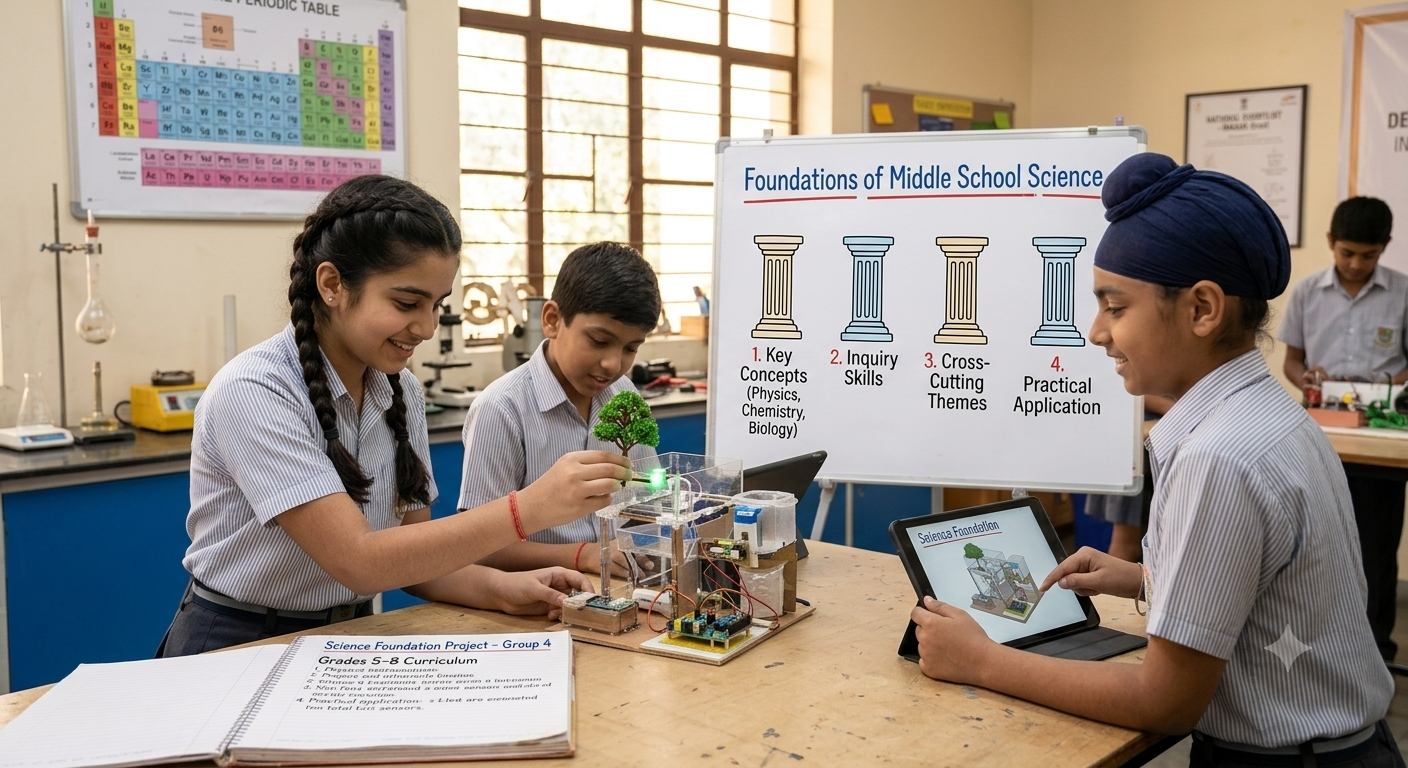
3. Mastering the Scientific Method Step-by-Step
At the heart of all scientific discovery is a single, elegant logical framework: the scientific method. Middle school is the perfect phase to master this process, turning it into an automated way of thinking. The scientific method is not a rigid checklist to be memorized for a test; it is a systematic blueprint for solving problems.
The process begins with observation, which naturally sparks a question. From that question, a scientist formulates a hypothesis—a testable, qualitative prediction about how variables interact. Next comes the execution of a controlled experiment, where variables are systematically isolated. Finally, the scientist analyzes the qualitative results to draw a conclusion, sharing their findings with the broader community.
By practicing this logical loop regularly, middle schoolers develop critical reasoning skills. They learn to separate correlation from causation, understand the importance of fair testing, and realize that a failed hypothesis is not an academic defeat, but a valuable data point that brings them closer to the truth.
4. Incorporating Hands-On Science Experiments at Home
One of the most effective ways to demystify abstract science is to bring it off the textbook page and into physical reality. You do not need a high-tech school laboratory to conduct high-fidelity scientific research. Your kitchen, backyard, and neighborhood park serve as the ultimate living laboratories.
Engaging in grades 5-8 science activities at home makes abstract concepts instantly tangible. For example, instead of simply reading about cellular membranes, you can place raw potato slices in fresh water and salt water to visually and physically experience the effects of plant cellular water movement.
Similarly, you can use simple household ingredients like baking soda and vinegar to study gas evolution and chemical reactions qualitatively, observing how temperature alters the speed of the reaction. Practicing these safe, hands-on explorations builds physical intuition, turning dry school lessons into exciting sensory discoveries. To find a vast database of safe, high-quality, and curriculum-aligned home projects, families can explore the resources hosted on the Science Buddies Platform.
5. The Role of Visual Organizers and Concept Mapping in Science
Scientific systems are highly interconnected. For instance, a change in geological plate tectonics directly influences atmospheric carbon dioxide levels, which in turn alters global weather patterns and shifts biological ecosystem dynamics. Trying to study these massive, multi-layered concepts using linear, paragraph-based notes is incredibly exhausting for the human brain.
To organize this complex web of information, middle schoolers should master the art of visual note-taking, particularly through concept mapping and mind mapping.
Start with a primary scientific theme in the center of a horizontal page—such as “The Water Cycle” or “Forces and Motion.” Radiate outward to create primary branches for sub-topics, using colorful lines, simple hand-drawn icons, and single keywords to map out relationships. Visually tracing how energy flows from one system to another creates a spatial map in your brain, drastically improving memory retention and making last-minute exam revision exceptionally efficient.
6. Navigating Middle School Science Curriculums (CBSE, ICSE, and NGSS)
Depending on your geographical location and school system, your middle schooler will navigate different structural science curriculums. Understanding these guidelines helps parents and educators align home-study sessions with official school benchmarks:
Next Generation Science Standards (NGSS): Widely utilized in international school systems, this framework emphasizes “Three-Dimensional Learning,” integrating crosscutting concepts, science and engineering practices, and core disciplinary ideas.
CBSE and ICSE Curriculums: These national Indian boards focus heavily on building deep foundational pathways across Physics, Chemistry, and Biology, prioritizing systematic experiment execution and clear qualitative explanations.
To ensure your student’s home preparation aligns perfectly with modern digital literacy and educational standards, educators and parents can regularly consult curriculum-mapping tools and professional development guidelines curated on the National Science Teaching Association (NSTA).
7. How to Build a Strong Science Foundation in Middle School Through Reading
While classroom lectures are essential, a primary driver of scientific literacy is independent reading. Science textbooks are excellent for structured study, but they can occasionally obscure the human stories, historical context, and pure excitement of scientific discovery.
To cultivate a genuine, lifelong passion for STEM, parents should introduce middle schoolers to popular science literature, biographies of legendary pioneers, and high-quality science journalism.
Reading about the struggles, accidental discoveries, and creative breakthroughs of historical scientists helps students realize that science is a living, human endeavor driven by curiosity rather than dry memorization. It expands their vocabulary, improves analytical reading comprehension, and teaches them how to articulate complex qualitative arguments—a skill that directly translates to scoring higher marks on descriptive school board evaluations.
8. Leveraging High-Quality, Free Digital Science Simulations Safely
In our modern digital landscape, students have access to incredible educational technology that can simulate complex scientific environments right on their personal devices. When physical laboratory equipment is unavailable or safety constraints prevent real-world experimentation, virtual simulations step in as the perfect learning companion.
Using high-fidelity, research-backed virtual sandboxes allows students to experiment with variables that are impossible to manipulate in a school classroom.
For instance, you can enter a virtual circuit-building laboratory, connect virtual resistors and batteries, and watch individual electrons speed up or slow down in real-time. You can adjust gravity sliders to see how an object’s weight alters without changing its physical mass, or mix virtual chemical reagents safely with zero risk of toxic fumes. The absolute gold standard for these open-ended, educational models is the PhET Interactive Simulations by CU Boulder, which provides free, highly interactive science models designed specifically to build conceptual intuition.
9. Fostering a Growth Mindset and Overcoming Science Anxiety
Science anxiety is a very real psychological barrier that prevents many otherwise highly capable middle schoolers from pursuing advanced STEM courses in high school. This anxiety often stems from a fear of making mistakes, struggling with technical terminology, or feeling overwhelmed by complex, multi-step processes.
To build a strong foundation, we must replace this anxiety with a robust growth mindset. In science, making mistakes is not a sign of failure; it is the exact mechanism through which knowledge is built.
Every time a virtual circuit fails to power a bulb, a chemical reaction yields unexpected colors, or an experiment fails to support a hypothesis, treat it as a design problem. Analyze the system, isolate the weak component, adjust the variables, and try again. Normalizing this “trial-and-error” mindset lowers stress, builds cognitive resilience, and fosters an adventurous attitude toward difficult academic challenges.
10. Cultivating Long-Term Curiosity Through Citizen Science Projects
Sometimes, middle school students lose interest in science because they feel their classroom assignments are completely disconnected from the real world. They struggle to see how identifying parts of a cell relates to actual global challenges. To spark continuous, year-round curiosity, parents can connect their children’s study blocks with global, active scientific research.
Through the power of crowdsourced “citizen science,” middle schoolers can upload their soil, plant, weather, and insect data to global research communities.
By taking photos of backyard biodiversity using mobile apps or classifying galaxy shapes using online telescope databases, young minds can help professional researchers map climate shifts and track invasive species in real-time. The premier platform for these collaborative missions is Zooniverse Citizen Science, which hosts dozens of active, space-focused, ecological, and earth science research projects designed for young explorers.
11. Designing a Productive Weekly Science Study Routine
Balancing school homework, extracurricular activities, and physical rest requires a highly structured weekly plan. To optimize your study hours and prevent academic burnout, implement this easy-to-use, conceptual study blueprint:
Day | Study Focus | Suggested Duration | Recommended Middle School Strategy |
|---|---|---|---|
Monday & Wednesday | Conceptual Warm-Up | 30 Minutes | Read through your daily classroom notes. Translate complex scientific terms into your own vocabulary, highlighting key concepts. |
Friday Afternoon | Interactive Visualization | 45 Minutes | Open a virtual lab simulation related to your weekly chapter. Adjust variables, run experiments, and observe physical reactions. |
Saturday Morning | Hands-On Home Science | 60 Minutes | Execute a safe, qualitative backyard or kitchen science experiment, recording your observations in a dedicated notebook. |
Sunday Evening | Complete Rest & Nature Walk | 0 Minutes | Keep screens entirely off, spend time outdoors in a local park, and observe ecological and biological systems in real-life action. |
Following this balanced, consistent routine ensures that middle schoolers digest the material thoroughly, keeping stress to an absolute minimum while building deep, long-term memory.
12. Essential Digital Portals for High-Yield Middle School Science Study
To help you expand your digital study workspace and locate curriculum-aligned projects, we have compiled a list of the most secure, reliable, and completely free educational platforms available online:
NASA STEM Engagement: A phenomenal, world-renowned platform featuring highly engaging videos, games, and space-science modules for young explorers. Access their resources directly on the NASA STEM Portal.
National Geographic Kids: Access highly interactive articles, structural animal databases, and geological videos designed to spark curiosity about our physical planet on National Geographic Kids.
Amrita OLabs and NCERT Labs: For students seeking highly structured, curriculum-aligned virtual science labs, check the centralized resources hosted on the NCERT Virtual Labs Portal.
Utilizing these verified, secure platforms ensures your digital study sessions remain organized, highly productive, and aligned with modern digital literacy expectations.
13. Conclusion: Stepping Confidently Into High School Science
Succeeding in middle school science does not have to be a stressful battle fought with dry textbooks, late-night cramming, and practical exam anxiety. By incorporating hands-on science for middle school into your weekly schedule, mastering the scientific method conceptually, using mind maps to visualize systems, and embracing a growth mindset, you can turn science into an exciting, lifelong quest of discovery.
Remember that scientific progress is a marathon built on daily curiosity, consistency, and a willingness to try, fail, and rebuild. Treat mistakes as valuable design feedback, use the outstanding free tools highlighted in this guide, and step confidently onto your laboratory bench ready to conquer your high school journey!