Active Recall vs Re-reading: 5 Proven Science-Backed Study Habits for Middle Schoolers
The transition into middle school—spanning Class 5, Class 6, Class 7, and Class 8—brings a dramatic shift in academic expectations. For the first time, students are introduced to dense historical timelines, abstract algebraic variables, complex biological processes, and systematic physical laws. Many middle schoolers, accustomed to the simpler demands of primary education, attempt to tackle this increased volume using passive study methods, such as highlighting paragraphs in textbooks or repeatedly re-reading class notes.
However, cognitive scientists agree on a fundamental truth: passive review is the least effective way to study.
To excel in modern competency-based school systems and build lifelong academic confidence, students must transition from “input-driven” studying to “output-driven” studying. This comprehensive guide details the neuro-cognitive battle of active recall vs. re-reading, provides five science-backed study habits tailored specifically for middle schoolers, and explains how to implement these strategies to dramatically improve grades while reducing study time.
1. The Cognitive Shift: Moving Beyond the "Illusion of Competence"
When a student sits down to study by re-reading their textbook or highlighting lines with colorful markers, a dangerous psychological phenomenon occurs: the illusion of competence.
As the student’s eyes slide across familiar words, their brain registers recognition. The brain whispers, “Yes, I have seen this before, therefore I know it.” But recognition is not the same as retrieval. Recognizing a fact when it is printed directly in front of you requires almost zero cognitive effort. However, when the exam paper is placed on their desk and that visual cue is removed, the student’s brain experiences a complete block because it has never practiced the physical act of pulling that information out of memory.
By prioritizing active recall vs. re-reading, students shift their focus from putting information into their heads to pulling information out of their heads. Middle school is the absolute make-or-break phase to break the passive study habit, establishing self-reliant learning strategies that will carry them successfully through high school board exams and competitive university entrance tests.
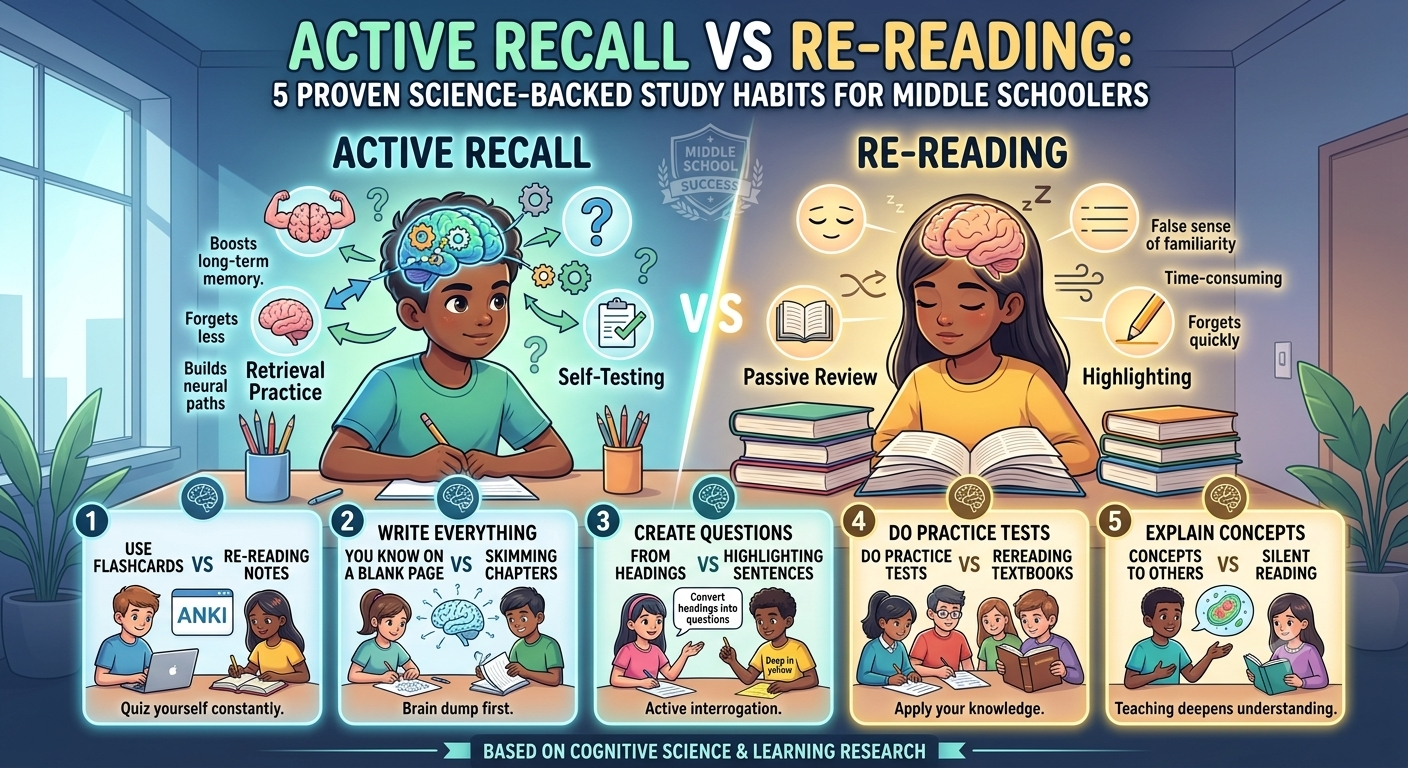
2. Decoding Active Recall vs. Re-reading: What the Research Shows
The superiority of active retrieval over passive review is backed by decades of robust, peer-reviewed educational research.
In a landmark study published by cognitive scientists Jeffrey Karpicke and Janell Blunt in the journal Science, researchers compared four distinct study strategies: repeated study (passive re-reading), elaborative study, concept mapping, and retrieval practice (active recall). The results were staggering. Students who utilized retrieval practice recalled over 50% more information on delayed comprehension tests than those who used any other method, including concept mapping, even when the passive groups spent significantly more time studying.
Furthermore, a comprehensive meta-analysis of ten popular learning techniques published by professor John Dunlosky and colleagues in Psychological Science in the Public Interest rated practice testing (the academic term for active recall) and distributed practice as having “high utility” for learners of all ages. Conversely, highlighting, underlining, and re-reading were rated as “low utility” because they fail to stimulate the deep cognitive processing required to form permanent neural pathways.
3. The Science of Memory: How Your Brain Builds Permanent Connections
To understand why active recall is so effective, we must look at how the human brain processes and stores memories.
The brain consists of a complex web of billions of neurons. When you learn a new scientific fact or mathematical formula, your brain creates a temporary connection—a memory trace—between specific neurons in your working memory. However, working memory is highly finite and decays rapidly. To move that information into your long-term memory, you must trigger a biological process called reconsolidation.
Every time you force your brain to search through its memory bank, locate a specific piece of information, and bring it to conscious awareness, you reactivate the neural pathways associated with that concept. This effortful retrieval signal tells the brain: “This information is vital for survival; strengthen this connection.” The brain responds by wrapping the neural pathway in myelin, a protective sheath that accelerates signal transmission. Passive re-reading bypasses this vital step entirely, leaving memory traces weak, fragile, and highly prone to decay.
4. Modeling Memory Decay: Why Active Retrieval Flattens the Forgetting Curve
We can qualitatively analyze how memory decay occurs over time using the classic Ebbinghaus Forgetting Curve. This model demonstrates that after a student first encounters a new piece of information in class, their memory retention drops off precipitously within the first 24 to 48 hours.
In a passive study model—such as re-reading a textbook or flipping through highlighted sheets—the strength of the memory trace remains remarkably low. Consequently, the retention score plummets rapidly back to near-zero, forcing the student to re-learn the same material from scratch before every major test.
However, when a student engages in active recall, the effortful retrieval process acts as a biological reset button. Each successful retrieval attempt instantly brings memory retention back to one hundred percent. More importantly, this active struggle alters the rate of decay itself. With every retrieval cycle, the curve flattens, meaning the information stays fresh in the mind for a progressively longer period of time. This qualitative shift allows middle schoolers to achieve superior academic results in far less time than they would spend on repetitive, brute-force re-reading.
To explore further research on how classroom-based retrieval activities reduce test anxiety and improve comprehension, check out the resources aggregated on the Retrieval Practice Educational Hub.
5. Habit 1: The "Blurting" Method (Closed-Book Brain Dumps)
One of the easiest and most effective middle school study tips to transition away from passive re-reading is the Blurting Method, sometimes referred to as a closed-book brain dump.
How to Implement It:
Read and Focus: Have the student read a single section of their science or social studies textbook (e.g., “The Water Cycle” or “The Mughal Empire”) for 10 to 15 minutes. They may highlight key terms during this reading phase.
Close the Book: Close the textbook completely. Place it out of sight.
The Blurt Phase: Give the student a blank sheet of paper and a colored pen. Set a timer for 5 minutes. Have them write down every single fact, definition, cycle, diagram, or date they can recall from the reading. Do not worry about neatness, grammar, or organization; the goal is a rapid, raw retrieval of information.
The Gap Audit: Open the textbook and compare the brain dump to the source material. Have the student use a different colored pen (like red or green) to write down the vital details they missed or got wrong directly onto their sheet.
This gap audit serves as a highly targeted, personalized study guide. Instead of wasting time re-reading what they already know, the student can focus their next study session exclusively on correcting those specific gaps.
6. Habit 2: Formulating "Question-Key" Notes (The Cornell Method Evolution)
Standard note-taking is often another form of passive copying. Middle schoolers spend hours copying paragraphs from whiteboards into their notebooks, processing almost none of the underlying concepts. To make note-taking an active learning event, students should adopt the Question-Key Method.
+--------------------------------------------------------------------------+
|                       THE QUESTION-KEY NOTE FORMAT                       |
+--------------------------------------------------------------------------+
| STUDY QUESTION (Left Column)      | CORE CONCEPT KEY (Right Column)      |
+-----------------------------------+--------------------------------------+
| What is the primary difference     | Eukaryotic cells contain a membrane- |
| between eukaryotic and prokaryotic| bound nucleus holding genetic        |
| cells?                            | material; prokaryotic cells do not.  |
|                                   |                                      |
| What are the three states of      | Solid, liquid, and gas. Controlled   |
| matter, and what controls them?   | by thermal energy and pressure.      |
+-----------------------------------+--------------------------------------+
How to Implement It:
Divide the Page: Draw a vertical line down a blank page, dividing it into a narrow left column (approximately thirty percent of the width) and a wider right column (seventy percent of the width).
Write Keys on the Right: During class or while reading, the student writes standard, concise notes on the wider right column.
Formulate Questions on the Left: Immediately after class, have the student review their notes and convert each key fact into a challenging study question on the narrow left column.
Self-Test: To study, the student covers the right column with a sheet of paper, reads the questions on the left, and attempts to answer them from memory.
This simple structural modification transforms their daily notebook into an interactive, self-testing tool, turning every revision session into an active recall exercise. For more insights on how to build these structured recall routines into daily study patterns, you can refer to the Washington University in St. Louis Cognitive Research Resources.
7. Habit 3: High-Yield Spaced Flashcards (Leveraging Desirable Difficulty)
Flashcards are the classic vehicle for active recall study method execution. However, most middle schoolers use them incorrectly—either by flipping the card too quickly before trying to retrieve the answer, or by cramming fifty cards in a single, exhausting session.
To maximize retention, students must combine flashcards with spaced repetition:
The 15-Second Rule: When reviewing a flashcard, the student must struggle to recall the answer for at least 15 seconds before flipping it. Even a failed retrieval attempt strengthens memory pathways more than looking at the answer immediately.
The Leitner Box System: Divide flashcards into three physical boxes. Box 1 is reviewed daily, Box 2 every three days, and Box 3 once a week. When a student answers a card correctly, it moves to the next box. If they answer incorrectly, it drops back to Box 1. This ensures they spend more time practicing their weakest concepts.
Keep It Simple: Each flashcard should contain only one question and one answer. Overcrowding a card with multiple paragraphs of text induces cognitive load and compromises the retrieval pathway.
8. Habit 4: Peer Teaching and Socratic Explanations (The Feynman Technique)
The ultimate test of conceptual understanding is the ability to explain a complex topic simply, without using heavy technical jargon. This active learning strategy, known as the Feynman Technique, is exceptionally engaging for middle schoolers.
Select a Concept: Have the student choose a challenging topic they are currently studying (e.g., “Photosynthesis” or “Fraction Division”).
Teach an Inanimate Object: Have the student explain the concept out loud to a sibling, a parent, or even an inanimate object (like a rubber duck or a stuffed animal). The rule is they must explain it using their own words, as if teaching a 7-year-old child.
Identify the Friction Points: Pay close attention to where the explanation stutters, gets overly complicated, or relies heavily on repeating textbook definitions verbatim. These friction points highlight exact gaps in their conceptual understanding.
Re-Study and Simplify: Have the student go back to their textbook, patch up those specific friction points, and repeat the explanation until it is smooth, clear, and simple.
By forcing the brain to translate abstract technical terms into simple, analogical explanations, the student builds deep, permanent conceptual connections.
9. Habit 5: Multi-Sensory "Dual Coding" Retrieval (Sketching from Memory)
Middle school science and geography are filled with complex visual structures—including cellular models, digestive tracts, continental maps, and water cycles. Many students attempt to study these by simply staring at the textbook diagrams.
To build true spatial mastery, students should practice visual active recall:
Step 1: Study a labeled diagram (e.g., the structure of a plant cell) for 5 minutes, paying close attention to the shapes and labels.
Step 2: Close the book. On a blank sheet of paper, draw the diagram completely from memory. Do not worry about artistic perfection; focus on the relative positions of the components.
Step 3: Label the diagram from memory.
Step 4: Open the textbook and compare. Did they misplace the mitochondria? Did they forget to label the cell wall? Correct the mistakes in red pen.
This multi-sensory practice—combining visual memory, spatial reasoning, and physical hand coordination—creates exceptionally durable cognitive traces that are highly resistant to exam-day stress.
10. Setting Up the Ideal Digital-Free Study Zone
Fostering independent, science-backed study habits requires establishing an environment that allows for deep, uninterrupted cognitive focus.
Middle schoolers face a massive threat from digital distractions. The continuous ping of smartphone notifications, social media alerts, and online gaming releases dopamine, which actively disrupts the working memory. When a student’s focus is interrupted, it takes an average of 23 minutes to return to their original state of deep concentration.
Therefore, parents and educators must enforce a strict digital-free study zone:
No Devices in Sight: During study blocks, smartphones, tablets, and gaming consoles must be powered off and kept in a completely separate room.
Keep It Organized: The study desk should contain only the necessary textbooks, notebooks, pens, and a physical timer.
Utilize a Simple Physical Timer: Instead of using phone apps (which act as gateways to distraction), use a simple kitchen timer to manage study sessions (e.g., 25-minute Pomodoro blocks followed by 5-minute movement breaks).
For additional science-backed guides, learning theories, and evidence-based strategies to share with middle schoolers, you can explore the Edutopia Science of Learning Resources.
11. Conclusion: Empowering Middle Schoolers for Lifelong Academic Success
The definitive verdict of cognitive science is clear: excellence in mathematics, science, and history is not a genetic trait reserved for “natural geniuses.” It is a skill set built through structured, active study habits.
By helping your middle schooler transition from the passive, comfortable routine of re-reading and highlighting to the active, effortful discipline of retrieval practice—whether through closed-book blurting, question-key note systems, spaced flashcards, or visual sketching—you build an exceptionally resilient, future-proof academic foundation.
Do not let study anxiety, long hours of unproductive cramming, or exam-day panic compromise your child’s educational journey. Embrace the productive struggle of active recall, establish healthy study routines, protect their emotional and physical well-being, and watch them step confidently into their classrooms, ready to conquer any academic challenge tomorrow throws their way.