The Ultimate Blueprint to Master Board Exams and JEE/NEET Coaching in Class 11 & 12.
The transition from Class 10 to Class 11 represents a seismic shift in an Indian student’s academic life. Overnight, the volume of the syllabus multiplies, concepts become highly abstract, and the pressure of standardized testing peaks. For millions of high schoolers, these two years are defined by a high-stakes balancing act: securing top marks in senior secondary board examinations while simultaneously preparing to crack national-level competitive entrance tests.
Faced with this overwhelming double workload, many students experience severe cognitive fatigue, falling into the trap of treating school boards and coaching centers as two separate, conflicting battles. However, surviving this phase successfully does not require twice the study hours; it requires a unified, highly strategic approach.
This comprehensive guide serves as the ultimate blueprint to master board exams and JEE/NEET coaching in Class 11 & 12. By understanding curriculum design, optimizing weekly schedules, and adopting healthy cognitive habits, you can excel in both evaluations and turn academic stress into an empowering journey of triumph.
1. Introduction: The High-Stakes Balancing Act of Class 11 and 12
For decades, the Indian school system evaluated students primarily based on their performance in final, year-end exams. However, the modern higher-education landscape is governed almost entirely by competitive national entrance examinations. Admission to premier engineering institutes is dictated by the Joint Entrance Examination (JEE), while medical college seats are governed by the National Eligibility cum Entrance Test (NEET).
At the same time, maintaining a respectable percentage in Class 12 boards remains a mandatory milestone for securing basic eligibility, satisfying university admission portfolios, and building a strong resume for studies abroad. This dual pressure creates a complex environment where students feel pulled in opposite directions.
To explore the broader national guidelines governing these academic standards, parents and educators can browse the research and policy briefs curated on the official Ministry of Education Portal. Recognizing that board exams and entrance coaching can coexist harmoniously is the first step toward reclaiming control of your high school journey.
2. Decoupling the Myth: Why Boards and JEE/NEET Preparation Are Not Mutually Exclusive
The most common misconception among high schoolers is that school board exams and coaching center classes require entirely different sets of knowledge. Students often assume that board exams are strictly about memorizing text, while JEE and NEET coaching focuses entirely on shortcuts and objective problem-solving. This belief is not only incorrect, but it also triggers unnecessary academic anxiety.
The truth is that both evaluations are built upon the exact same physical, chemical, and biological laws. The difference lies solely in the output format, not the conceptual input.
Whether you are deriving a physical law for a written board paper or eliminating incorrect multiple-choice options under timed entrance exam conditions, you are using the identical scientific foundation. By decoupling the myth that these pathways are mutually exclusive, you can streamline your study blocks, using your board preparation as an active conceptual warm-up for your advanced competitive prep.
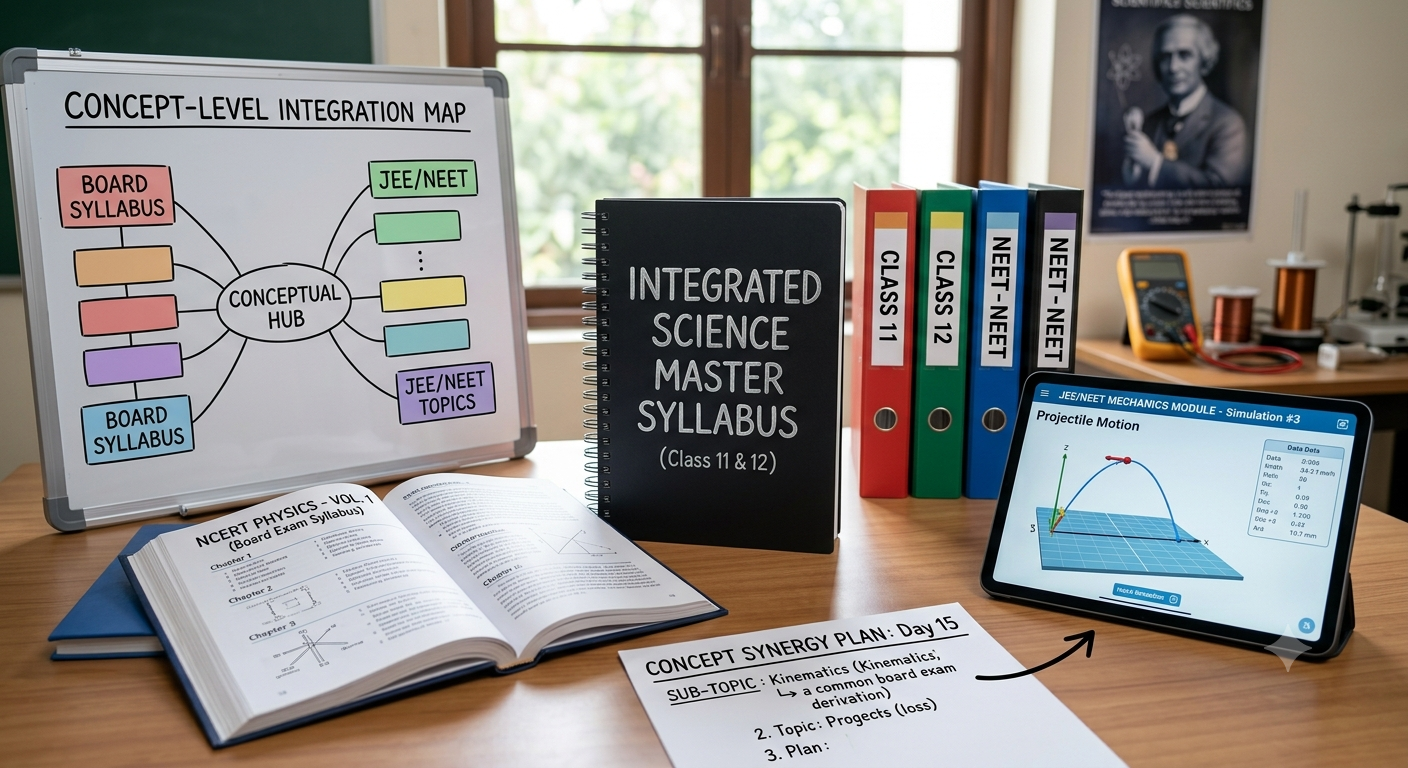
3. The Foundation Stone: Leveraging NCERT Alignment for Dual Success
When analyzing competitive exams conducted on a national scale, the single most important factor to consider is curriculum alignment. National-level entrance tests—including JEE and NEET—are conducted by the National Testing Agency (NTA). The NTA uses the national curriculum framework developed by the NCERT as the absolute blueprint for designing entrance exam question papers.
This NCERT-centric design gives students an immediate, massive structural advantage. Because standard board curricula rely directly on NCERT textbooks as their primary teaching materials, studying for your boards and your competitive exams simultaneously is highly feasible.
For a Class 11 or 12 student, the chapters they read in school Biology, Physics, and Chemistry match the competitive entrance syllabus page-for-page. To access official curriculum standards and digital text materials directly, families can consult the central resources hosted on the NCERT Textbooks Portal. By treating NCERT as your primary study bible, you build a resilient, multi-dimensional mental map that satisfies both board and coaching requirements.
4. Strategic Time-Blocking: Creating an Optimized Weekly Study Schedule
Balancing school classes, coaching center sessions, homework, self-study, and personal rest requires a highly disciplined schedule. Trying to manage this workload with vague daily goals is a direct path to burnout. Instead, students must master the art of strategic time-blocking to allocate their weekly hours efficiently.
First, construct a weekly master grid and block out non-negotiable times, such as school hours, travel, and sleep. Next, divide your remaining free hours into dedicated study blocks of 45 to 50 minutes, separated by short 10-minute breaks.
Ensure your study blocks are balanced throughout the week:
-
Weekdays (Mon-Fri): Dedicate these blocks to school homework, board-specific writing practice, and reviewing daily classroom notes. Use this time to consolidate the basic concepts taught at school.
-
Weekends (Sat-Sun): Allocate these longer, uninterrupted blocks to tackling advanced coaching modules, practicing higher-order multiple-choice questions (MCQs), and analyzing entrance-level mock tests.
This balanced distribution ensures that neither board preparation nor competitive coaching is neglected, helping you maintain continuous, low-stress progress.
5. Mastering the Shift: From Subjective Board Answers to Rapid MCQ Elimination
While the underlying concepts are identical, board exams and competitive coaching demand completely different exam-taking temperaments. Board exams evaluate your ability to write detailed, structured, and legible subjective explanations, whereas competitive tests demand rapid, mental elimination of incorrect options.
To succeed in both formats, you must train your brain to transition smoothly between these two output styles:
Board Answer Writing: Practice structuring your answers with clear headings, bullet points, and neat, labeled diagrams. Learn the specific marking schemes utilized by board examiners, such as those published on the CBSE Academics Website, which award marks for step-wise logical progressions.
MCQ Elimination Strategies: Coaching classes will teach you how to analyze questions rapidly. Focus on learning how to eliminate obviously incorrect options, use dimensional analysis to verify trends, and estimate values qualitatively to save precious seconds during entrance evaluations.
Alternating between these two styles during your weekly self-study blocks ensures your brain remains highly flexible, preventing mental blocks on exam days.
6. The Practical Dilemma: Regular School vs. Integrated Dummy School Models
One of the most critical decisions families must make in Class 11 is choosing between a traditional, regular physical school and an integrated “dummy school” model. Both pathways offer unique advantages and disadvantages, and the right choice depends heavily on the student’s natural learning style.
Traditional Regular Schools:
Pros: Highly structured daily discipline, face-to-face interaction with peers, holistic personality development, mandatory laboratory practicals, and direct teacher guidance.
Cons: Rigid attendance requirements, commute fatigue, and less time available for self-directed competitive study.
Integrated Dummy Schools:
Pros: Maximum free hours available for coaching center sessions, flexible attendance, and a singular, high-intensity focus on entrance exam mock testing.
Cons: High isolation, risk of extreme academic pressure without social outlets, and minimal school-based guidance for board-specific writing skills.
Families must evaluate whether their child thrives best under the supportive social environment of a physical school or whether they possess the intense self-discipline required to study independently in an integrated coaching program.
7. Overcoming the Practical and Board Syllabus Discrepancies
In an ideal educational system, school classrooms and coaching centers would run in perfect synchronization. In reality, students often face severe syllabus discrepancies. A school teacher might be teaching organic chemistry, while a coaching center is lecturing on physical chemistry equilibrium.
This syllabus lag can trigger intense cognitive confusion if not managed strategically. To overcome this hurdle, implement a “Parallel Pacing” strategy.
During the week, prioritize the topics currently being taught in your school classes to ensure you score well on internal assessments and practical evaluations. On the weekends, focus your energy on catching up with your coaching center’s syllabus, using their recorded lectures or study guides to bridge any learning gaps. Treating school classes as a natural revision session for your entrance preparation helps minimize friction and prevents you from falling behind in either track.
8. Psychological Resilience: Recognizing and Preventing Coaching Burnout
The intense pressure of preparing for two massive national exams simultaneously represents a major psychological barrier. Chronic sleep deprivation, academic anxiety, and fear of failure can trigger severe burnout, which actively impairs the prefrontal cortex—the region of the brain responsible for logical reasoning and memory retrieval.
To build psychological resilience during these high-stress years, prioritize mental wellness:
Maintain Consistent Sleep: Consistently aim for 7 to 8 hours of uninterrupted sleep every night. Sleep is the exact physiological phase where the brain consolidates short-term memories into long-term storage.
Incorporate Physical Breaks: Spend at least thirty minutes a day engaging in screen-free physical activities, such as jogging, swimming, or playing a sport, to relieve physical tension and clear your mind.
Normalize Failure: Understand that score fluctuations during coaching mock tests are normal. Treat mistakes as valuable diagnostic data that helps you identify specific conceptual weaknesses rather than a sign of academic failure.
9. Sourcing the Right Study Materials: Merging Board Guides with Coaching Modules
An overlooked source of study fatigue is material overload. Students often buy dozens of reference books, board guides, and coaching modules, leaving their study desks cluttered and their brains overwhelmed.
To streamline your revision blocks, select a highly curated set of study materials and stick to them:
The Core Base: Keep your grade-level NCERT textbooks as the absolute center of your study space, ensuring you read through the chemistry and biology sections page-by-page.
The Board Companion: Select one reputable, syllabus-aligned board guide that contains previous years’ question papers and step-wise marking schemes.
The Coaching Toolkit: Rely on the structured study modules, formula sheets, and mock question banks provided by your competitive coaching center, avoiding the temptation to search for random worksheets online.
Keeping your workspace clean and focused lowers cognitive load and ensures your revision sessions are highly efficient.
10. The Power of Mock Tests: Dual Revision Under Realistic Exam Conditions
You would never run a marathon without practicing long-distance running first. Similarly, you should never walk into a national-level board or coaching exam hall without practicing under timed, realistic conditions. Solving mock papers is the single most effective way to build exam temperament.
Set a timer, find a quiet corner of your home, and attempt a previous year’s board paper or entrance mock exam in a single sitting. This practice helps you:
Develop Time Management Skills: Learn how to allocate your minutes between straightforward questions and complex, multi-layered analytical prompts.
Identify Conceptual Gaps: Treat mock exams as diagnostic tools. Analyze your mistakes carefully, note the underlying misunderstandings, and revise those weak chapters immediately.
Build Physical Endurance: Practice sitting and focusing intensely for three hours straight, reducing the likelihood of physical restlessness during the actual exams.
11. Parental Support Systems: Fostering Academic Growth Without Toxic Pressure
Achieving academic excellence in Class 11 and 12 is a collaborative family journey. Parents play an indispensable role in shaping how teenagers handle academic stress and pressure.
Instead of focusing solely on mock test ranks or demanding a perfect percentage, parents should focus on creating a supportive, low-stress home environment:
Praise Effort Over Outcomes: Encourage your child’s consistency, curiosity, and resilience during study sessions, rather than focusing entirely on grades.
Provide Healthy Nutrition: Ensure your child has access to balanced, whole foods and stays hydrated, avoiding excessive sugar and caffeine crashes that impair concentration.
Encourage Open Conversations: Make time for screen-free family interactions where you discuss non-academic topics, helping your teenager decompress and feel valued beyond their academic performance.
To monitor updates regarding competitive timelines, national registrations, and student support initiatives, families can consult tracking services like the Buddy4Study Scholarship Portal, which serves as an excellent resource for national student scholarship programs.
12. Decision Support Guide: A Weekly Routine Checklist for Dual Preparation
To help you seamlessly integrate this dual preparation blueprint into your daily routine, use this action-oriented weekly checklist:
Day | Primary Focus | Study Duration | Recommended Strategic Action |
|---|---|---|---|
Mon – Wed | Board Core & Homework | 2 – 3 Hours | Read through your daily classroom notes. Write out descriptive answers to NCERT exercise questions to keep writing muscles sharp. |
Thu – Fri | Concept Bridging | 2 – 3 Hours | Review any syllabus gaps between your school classes and your coaching center, translating complex jargon into simple summaries. |
Saturday | Coaching MCQ Intensive | 4 – 5 Hours | Dive into your coaching modules. Practice eliminating incorrect options and solving advanced, multi-concept problems. |
Sunday | Diagnostic Mock & Rest | 3 Hours | Solve one full-length mock paper under timed conditions. Spend the evening resting completely to consolidate your weekly learning. |
Following this consistent, balanced routine ensures you cover both syllabi thoroughly while keeping academic burnout to an absolute minimum.
13. Conclusion: Stepping Confidently Into Your Senior Secondary Academic Journey
Conquering Class 11 and Class 12 does not have to be an endless, exhausting battle fought with dry textbooks, late-night cramming, and chronic anxiety. By embracing the ultimate blueprint to master board exams and JEE/NEET coaching in Class 11 & 12, you can take complete control of your learning.
Remember that academic success is a marathon built on daily consistency, curiosity, and a willingness to try, fail, and rebuild. Treat mistakes as valuable diagnostic feedback, utilize the outstanding free tools and portals highlighted in this guide, and step confidently onto your laboratory bench ready to unleash your full academic potential!