Primary vs Middle School Science: Revolutionary Strategies for Science Curriculum Transition, Conceptually science learning
The academic transition from primary school to middle school represents a major evolutionary leap in a student’s cognitive development. For years, young learners are accustomed to science being an observational, highly sensory experience. They study the natural world by looking at leaves, classifying states of matter, observing the water cycle, and matching animal habits. However, as they cross the threshold into Grade 5 and proceed through Grade 8, the landscape of science education changes completely.
The comforting, concrete world of primary school observations suddenly gives way to the abstract, microscopic, and highly systemic universe of middle school. Faced with this sudden shift in expectations, many students experience academic friction. To prevent academic anxiety and ensure future success in high school and college, families must understand the fundamental mechanics of the science curriculum transition, learn how to navigate the modern middle school science syllabus, and actively embrace conceptual science learning.
This comprehensive guide explores the deep pedagogical differences between Primary vs Middle School Science, offering actionable strategies to turn this challenging transition into an exciting, hands-on quest for scientific discovery.
1. Primary vs Middle School Science: The Core Cognitive Shift
To support a student transitioning through grades 5 to 8, we must first analyze the fundamental differences between Primary vs Middle School Science.
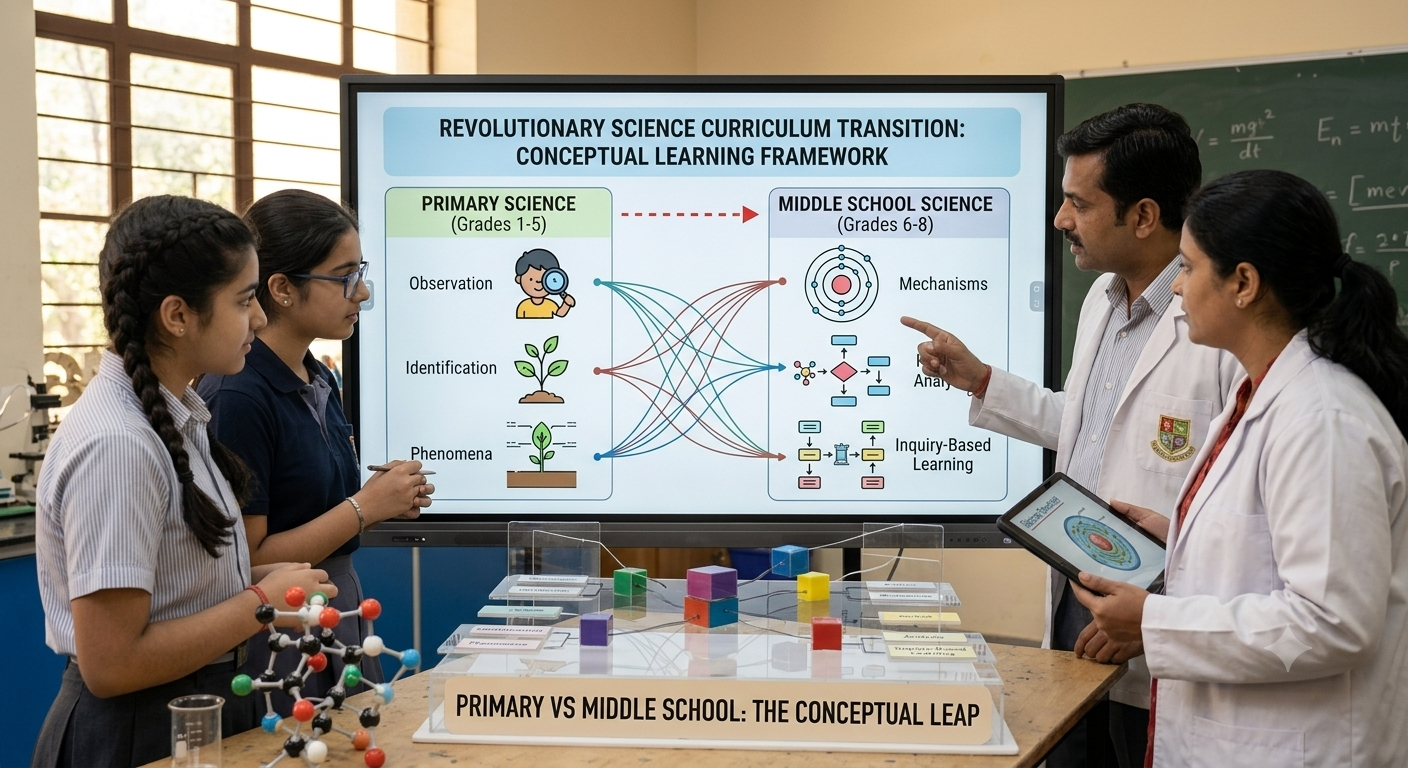
In primary school (Grades 1 to 4), science is predominantly descriptive and observational. The primary goal is to spark curiosity about the physical world. Students learn “what” is happening. They observe that water freezes into ice, that plants need sunlight to grow, and that magnets attract certain metals. The cognitive load is low, focusing heavily on classification, simple identification, and sensory engagement.
In middle school (Grades 5 to 8), science transitions into being explanatory, analytical, and systemic. Students are no longer just observing phenomena; they are expected to explain the invisible mechanisms driving those phenomena. They must move from “what” is happening to “how” and “why” it is happening.
Instead of merely labeling the parts of a plant, they must trace the chemical transport pathways of water movement across cell membranes. Instead of stating that ice melts, they must analyze how thermal energy alters molecular kinetic states. This cognitive shift requires a transition from concrete operational thinking to formal abstract reasoning, representing the core challenge of the middle school years.
2. Understanding the Science Curriculum Transition: Moving Beyond Fact Sheets
The science curriculum transition represents more than just a change in textbook chapters; it is a complete restructuring of how knowledge is acquired and evaluated. In early childhood education, science is often taught as a collection of isolated facts. Students compile flashcards, memorize vocabularies, and draw static diagrams.
When students enter middle school, this fragmented learning model falls apart. The middle school science curriculum is built on highly interconnected, multi-layered systems. For instance, a change in geological plate tectonics directly alters atmospheric carbon dioxide (CO2) levels, which in turn shifts ecological biomes and alters evolutionary patterns.
If a student attempts to navigate this transition using early rote-learning habits, they will quickly experience cognitive overload. The transition demands that students learn to think systemically, recognizing how microscopic inputs produce massive, macroscopic outputs across physics, chemistry, and biology. To explore how modern educational institutions manage this curricular shift, parents can browse the research curated on the Edutopia Learning Frameworks portal.
3. Demystifying the Middle School Science Syllabus: What to Expect
To prepare effectively, families and educators must demystify the core components of the modern middle school science syllabus. While school boards differ globally—whether navigating CBSE, ICSE, or the Next Generation Science Standards (NGSS)—the foundational scientific units across grades 5 to 8 maintain a highly consistent conceptual structure:
Physical Science (Introductory Physics & Chemistry): Moving away from simple states of matter to study atomic structures, molecular bonding, chemical vs. physical changes, Newton’s laws of motion, force vectors, and energy conservation.
Life Science (Introductory Biology & Ecology): Transitioning from naming animals to studying cellular anatomy, specialized organelles, photosynthesis pathways, genetics, ecosystem dynamics, and carbon/nitrogen cycles.
Earth and Space Science (Geology & Astronomy): Exploring plate tectonics, rock cycles, atmospheric layers, greenhouse effects, and the orbital mechanics governing solar and lunar cycles.
Understanding these thematic units allows parents to align home-study blocks with official school benchmarks, ensuring that students are never caught off guard by the depth of their classroom syllabus. To download official curriculum standards and compare syllabus guidelines, families can reference the benchmark publications hosted on the National Science Teaching Association (NSTA) portal.
4. The Power of Conceptual Science Learning over Rote Recalling
The greatest barrier to mastering middle school science is the “illusion of competence” built by rote memorization. A student can easily memorize the definition of photosynthesis or define cell organelles without actually understanding how these biological systems function dynamically. When presented with an unfamiliar, application-based question on an evaluation, the memorized definitions quickly crumble.
To build a resilient scientific mind, students must shift to conceptual science learning. This cognitive strategy treats science not as a static body of facts, but as an active process of questioning, experimenting, and analyzing relationships.
Whenever a student encounters a new scientific concept, they should train their brain to ask three core questions:
Why does this physical phenomenon happen at a microscopic level?
How does this system interact with its surrounding environmental variables?
What would happen if we changed, isolated, or removed one key variable in this system?
By constantly questioning the mechanisms behind the facts, students transition from passive recorders of information to active scientific thinkers. This conceptual approach builds deep neural pathways in the brain, ensuring that knowledge is retained long-term rather than forgotten immediately after an exam.
5. From Concrete to Abstract: Piaget’s Developmental Bridge in Middle School
To understand why the science curriculum transition feels so challenging, we can look to the work of Swiss psychologist Jean Piaget. Piaget identified that around the age of 11 or 12—the exact window when students enter middle school—the human brain undergoes a massive developmental shift.
Students transition from the Concrete Operational Stage (where they solve problems based on physical, visible objects) to the Formal Operational Stage (where they develop the capacity for abstract, hypothetical, and systematic reasoning).
This means that middle schoolers are developmentally ready to tackle abstract science, but they need a cognitive bridge to help them make the leap. If an educator introduces abstract chemical formulas or complex physics laws without anchoring them to physical reality, the student’s brain will struggle to process the data.
To bridge this developmental gap, middle school science must incorporate tactile models, visual organizers, and virtual simulations, turning invisible abstract concepts into tangible physical experiences that the brain can easily digest.
6. Navigating Chemistry Conceptually: Atoms, Molecules, and Chemical Bonds
In the primary school syllabus, chemistry is usually limited to identifying water states or mixing vinegar and baking soda to watch bubbles. In the middle school syllabus, chemistry becomes an abstract exploration of the microscopic universe. Students must conceptualize atoms, proton/neutron/electron configurations, the periodic table, and chemical bonding.
To master middle school chemistry conceptually, students must look past the symbols on the periodic table and visualize the spatial geometry of molecules. For example, instead of simply writing down the formula for water as H2o, they should understand why two hydrogen atoms share electrons with a single oxygen atom, creating a polar covalent bond.
They can study how temperature alters kinetic energy, watching virtually how heat forces solid lattices of sodium chloride (NaCl) to dissolve in liquid solutions. For parents seeking a vast database of safe, high-quality, and curriculum-aligned home projects to explore these chemical concepts physically, families can explore resources hosted on the Science Buddies Platform.
7. Unpacking Physics in Middle School: Force, Work, and Energy Conservation
Physics is historically one of the most intimidating subjects for transitioning students because it relies heavily on invisible forces and mathematical descriptions of movement. In Primary vs Middle School Science, physics shifts from observing “speed” to calculating velocity, acceleration, balanced vs. unbalanced forces, and gravitational pull.
To conquer middle school physics conceptually, students must learn to translate daily physical experiences into structured vector models. For example, when studying friction, they can run simple experiments on different household surfaces—such as wood, carpet, and glass—observing how surface irregularities alter resistance forces.
They can study energy transformation, tracing how potential energy stored in an object at a height converts directly into kinetic energy as it falls under the influence of gravity (Fg). The absolute gold standard for visualizing these invisible force vectors in real-time is the PhET Interactive Simulations by CU Boulder, which provides free, highly interactive physics models designed to build deep conceptual intuition.
8. Biology Shifts in the Transition: Cell Systems and Global Ecosystems
Primary school biology is famously descriptive, focusing heavily on life cycles, animal adaptations, and plant parts. In the middle school syllabus, biology undergoes a dramatic shift, splitting into two complex directions: micro-biology (the study of cells and internal physiological systems) and macro-biology (the study of genetics, evolution, and global ecological systems).
Instead of simply stating that plants absorb water, middle schoolers must study the microscopic vascular bundles of xylem and phloem, understanding how osmotic pressure and transpiration pull water molecules upward against gravity.
They must move away from memorizing list definitions of cell organelles—like the nucleus or mitochondria—and start viewing the cell as a dynamic, self-regulating factory where individual organelles cooperate to sustain life. Exploring these conceptual biological loops helps students see that life science is not a dry list of classifications, but a beautiful, highly coordinated dance of chemical energy.
9. Visual Note-Taking and Spatial Diagrams: Mapping the Conceptual Landscape
Scientific systems are highly interconnected. Trying to study these massive, multi-layered concepts using linear, paragraph-based notes is incredibly exhausting for the human brain. To organize this complex web of information, middle schoolers should master the art of visual note-taking, particularly through concept mapping, flowcharts, and mind mapping.
Start with a primary scientific theme in the center of a horizontal, unlined page—such as “Ecosystem Dynamics” or “Newton’s Laws.” Radiate outward to create primary branches for sub-topics, using colorful lines, simple hand-drawn icons, and single keywords to map out relationships.
Visually tracing how energy flows from one system to another creates a spatial map in your brain. This spatial organization drastically improves memory retention, lowers cognitive load, and makes last-minute exam revision exceptionally efficient.
10. Navigating National Boards and Digital Education Portals Safely
Depending on your geographical location and school system, your middle schooler will navigate different structural science curriculums. Understanding these guidelines helps parents and educators align home-study sessions with official school benchmarks:
Next Generation Science Standards (NGSS): Emphasizes “Three-Dimensional Learning,” integrating crosscutting concepts, science and engineering practices, and core disciplinary ideas.
NCERT and CBSE Guidelines: Focuses heavily on building deep, foundational pathways across Physics, Chemistry, and Biology, prioritizing systematic experiment execution and clear qualitative explanations. To access official curriculum standards and digital text materials directly, families can consult the central resources hosted on the NCERT Official Portal.
Utilizing verified, secure educational portals ensures your student’s home preparation remains organized, highly productive, and aligned with modern academic expectations.
11. Overcoming Science Anxiety: Building a Growth Mindset in Middle School
Science anxiety is a very real psychological barrier that prevents many otherwise highly capable middle schoolers from pursuing advanced STEM courses in high school. This anxiety often stems from a fear of making mistakes, struggling with technical terminology, or feeling overwhelmed by complex, multi-step processes during the science curriculum transition.
To build a strong foundation, we must replace this anxiety with a robust growth mindset. In science, making mistakes is not a sign of failure; it is the exact mechanism through which knowledge is built.
Every time a chemical reaction yields unexpected colors, a virtual circuit fails to power a bulb, or an experiment fails to support a hypothesis, treat it as a design problem. Analyze the system, isolate the weak component, adjust the variables, and try again. Normalizing this “trial-and-error” mindset lowers stress, builds cognitive resilience, and fosters an adventurous attitude toward difficult academic challenges.
12. Designing a Productive Weekly Science Study Routine
Balancing school homework, extracurricular activities, and physical rest requires a highly structured weekly plan. To optimize your study hours and prevent academic burnout during the middle school transition, implement this easy-to-use, conceptual study blueprint:
Day | Study Focus | Suggested Duration | Recommended Middle School Strategy |
|---|---|---|---|
Monday & Wednesday | Conceptual Warm-Up | 30 Minutes | Read through your daily classroom notes. Translate complex scientific terms into your own vocabulary, highlighting key concepts. |
Friday Afternoon | Interactive Visualization | 45 Minutes | Open a virtual lab simulation related to your weekly chapter. Adjust variables, run experiments, and observe physical reactions. |
Saturday Morning | Hands-On Home Science | 60 Minutes | Execute a safe, qualitative backyard or kitchen science experiment, recording your observations in a dedicated notebook. |
Sunday Evening | Complete Rest & Nature Walk | 0 Minutes | Keep screens entirely off, spend time outdoors in a local park, and observe ecological and biological systems in real-life action. |
Following this balanced, consistent routine ensures that middle schoolers digest the material thoroughly, keeping stress to an absolute minimum while building deep, long-term memory.
13. Conclusion: Stepping Confidently Into Your Middle School Journey
Succeeding in middle school science does not have to be a stressful battle fought with dry textbooks, late-night cramming, and practical exam anxiety. By understanding the core cognitive differences of Primary vs Middle School Science, preparing for the science curriculum transition systematically, mastering the middle school science syllabus conceptually, and embracing the power of conceptual science learning, you can turn science into an exciting, lifelong quest of discovery.
Remember that scientific progress is a marathon built on daily curiosity, consistency, and a willingness to try, fail, and rebuild. Treat mistakes as valuable design feedback, use the outstanding free tools highlighted in this guide, and step confidently onto your laboratory bench ready to conquer your middle school journey and unleash your full academic potential!