How to Use PhET Interactive Simulations to Clear School Science Practicals
Preparing for school science practicals can often feel significantly more daunting than studying for standard theoretical examinations. While theory papers evaluate your ability to memorize definitions and explain concepts on paper, practical assessments demand hands-on intuition, procedural precision, and an active ability to handle physical equipment. From the fear of short-circuiting electrical components to the anxiety of handling fragile glassware and volatile chemical solutions, high school and middle school students frequently experience acute stress during laboratory evaluations.
Fortunately, the rapid advancement of educational technology has introduced powerful virtual science lab environments that allow you to practice, experiment, and fail safely from the comfort of your home.
If you are a student striving to secure top marks in your lab exams, a parent looking to support your teenager’s science preparation, or an educator seeking ways to reinforce laboratory lessons, you are in the perfect place. This comprehensive guide details exactly how to use PhET Interactive Simulations to clear your school science practicals with absolute confidence, transforming abstract theories into tangible, visual, and highly interactive learning experiences.
1. The Revolution of Virtual Labs in School Science
For decades, the traditional school lab environment has faced major structural challenges. Fragile equipment, restricted class durations, large batch sizes, and safety constraints often mean that students only get a single, hurried attempt to perform an experiment. In a crowded classroom, it is incredibly easy to miss a vital step in a physical science manual, leaving you unprepared when the final practical board exam arrives.
The introduction of high-fidelity online science simulations has completely revolutionized this landscape. By using a secure, web-based virtual science lab, students are no longer restricted by school hours or expensive physical kits.
You can run experiments an infinite number of times, adjust hidden variables, pause real-time physics forces, and observe microscopic cellular reactions. This modern digital playground bridges the gap between passive reading and active experimentation, giving you the experimental confidence required to walk into any school laboratory examiner’s room fully prepared.
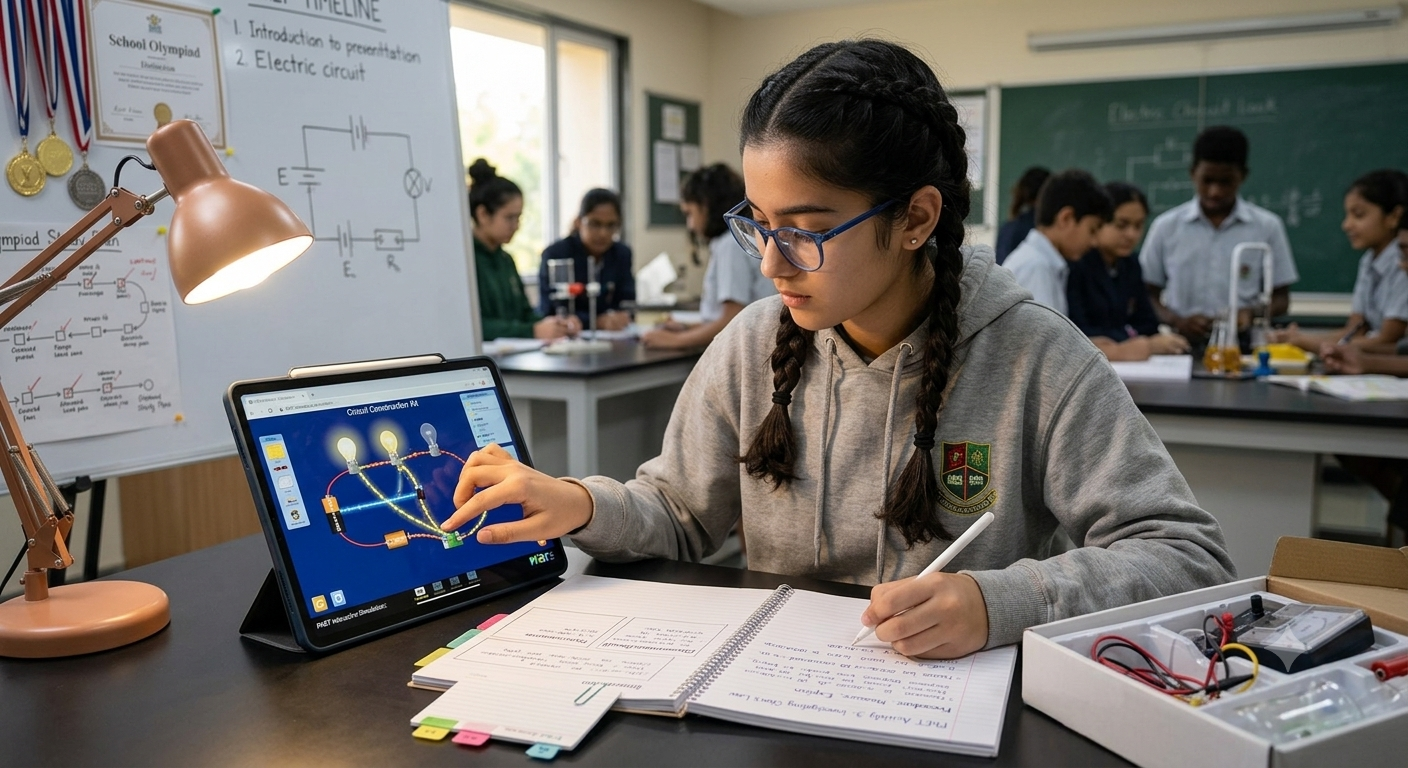
2. What are PhET Interactive Simulations and Why Do They Matter?
Before diving into targeted revision strategies, it is essential to understand what makes this platform so unique. Founded in 2002 by Nobel Laureate Carl Wieman, the PhET Interactive Simulations Project at the University of Colorado Boulder creates free, research-backed, and highly interactive science and mathematics models.
Unlike simple flash animations or recorded video lectures, these models act as open-ended, game-like sandboxes designed to encourage independent inquiry.
When you engage with these online science simulations, you are not just watching a pre-recorded video of an experiment. Instead, you are in complete control of the physical environment. You can drag and drop objects, adjust environmental sliders, and watch the physical laws of nature react instantly to your inputs.
Because these tools are based on intensive educational research, they are specifically designed to align with how human brains process spatial reasoning and scientific models, making them an invaluable asset for your school preparations.
3. The Role of PhET in Clearing School Science Practicals
Securing high marks in your final laboratory exam is not just about memorizing a checklist of steps. Examiners look for conceptual mastery, the ability to troubleshoot errors, and a solid understanding of how variables interact. If your current approach to clearing practicals is simply memorizing your lab manual word-for-word, you are highly vulnerable to unexpected questions during the oral viva-voce section of the exam.
Using a virtual science lab dynamically shifts your brain from rote memorization to intuitive understanding. When you manipulate variables virtually, you build a resilient, multi-dimensional mental map of the scientific phenomenon.
If an examiner asks you what would happen to a system if you altered a specific parameter, you will not have to scramble to recall a textbook paragraph. You will easily visualize the virtual dials you slid, the physical lines that shifted, and the visual feedback you observed on your screen, allowing you to explain the underlying science with complete clarity.
4. Key Benefits of Using PhET Simulations for Physics Practicals
Physics is historically one of the most intimidating subjects for practical evaluations because it relies heavily on invisible, abstract forces. You cannot physically see electric current moving through wires, magnet fields curving in space, or light rays refracting as they pass through different glass boundaries.
By utilizing targeted phet simulations for physics, you can make these invisible forces instantly visible. Consider the following common high school physics practicals:
Ohm’s Law and Electrical Circuits: In a physical school lab, connecting ammeters, voltmeters, batteries, and resistors in series or parallel can be highly confusing. One wrong connection can damage expensive school equipment. With virtual circuit kits, you can construct complex loops, slide a resistor bar, and watch individual electrons speed up or slow down. The visual representation of voltage $V$ and current $I$ changing in size directly reinforces the proportional relationship between the variables.
Light Reflection and Refraction (Optics): Instead of drawing static ray diagrams on paper, you can use the virtual optics bench. Drag laser sources, convex lenses, and triangular prisms across your digital canvas. You can alter the index of refraction of the surrounding medium from air to water, instantly watching the light rays bend at precise boundaries.
Forces and Motion (Mechanics): Play with virtual ramps to see friction coefficients in action. You can adjust gravitational strength to see how an object’s weight alters frictional forces without changing its physical mass.
This risk-free, highly visual experimentation ensures that when you handle real-world physical apparatus, you already understand the core qualitative relationships governing the equipment.
5. Mastering Chemical Reactions and Solutions: PhET for Chemistry Practicals
Chemistry practicals often require students to observe subtle color changes, determine the acidity of diverse substances, or understand how molecules bond with one another. Because school labs must manage strict chemical safety protocols, students rarely get to play with volatile elements or experiment with extreme concentrations.
Using dedicated phet simulations for chemistry unlocks a safe, interactive window into molecular structures and chemical properties:
The pH Scale and Acid-Base Titration: Virtual experiments allow you to dip a digital pH probe into diverse household substances, from battery acid to soapy water. You can dilute solutions with virtual water and observe how the concentrations of hydroxide and hydronium particles shift in real-time. This visual representation turns abstract logarithmic scales into simple, understandable concepts.
Balancing Chemical Equations: Many students struggle with the visual geometry of chemical reactions. Virtual toolkits provide visual scales and balance beams. As you adjust coefficients, molecules of reactants and products are visually stacked on balance pans, helping you see why atoms must be conserved across a reaction.
Solutions, Saturation, and Concentration: Add colorful solutes to a virtual beaker of liquid. You can slide solute levels to watch the water transition from unsaturated to saturated, observing individual salt crystals precipitate out of the liquid when the saturation threshold is breached.
This visual and tactile feedback makes the chemical concepts of molarity, concentration, and molecular reactions incredibly easy to comprehend, ensuring you write out your chemistry observation sheets flawlessly.
6. Exploring Biological Concepts Conceptually Without Complex Equations
School biology practicals frequently focus on microscopic cell division, ecosystem interactions, or physiological cycles. Because biological systems are often incredibly small, highly complex, or require weeks to evolve, studying them in a standard 45-minute school class period can be extremely challenging.
Virtual biology laboratories provide you with an interactive time-machine to explore these systems conceptually:
Natural Selection and Genetics: Run accelerated simulations across multiple generations of virtual organisms. You can introduce environmental predators, food scarcity, or genetic mutations (such as coat color or ear length) and watch how natural selection alters the population dynamics in real-time.
Neuron Firing and Membrane Potential: Dive inside a virtual nerve cell to watch sodium and potassium ions cross the cell membrane during an action potential. This detailed, microscopic visualization makes understanding signal transmission intuitive and memorable.
Greenhouse Effect and Atmosphere: Slide concentration bars to increase atmospheric carbon dioxide levels, watching how greenhouse gas molecules trap infrared radiation inside a planet’s atmosphere.
Exploring these concepts visually allows you to master the qualitative foundations of life science, preparing you to answer any conceptual, analytical, or practical exam prompt with ease.
7. Step-by-Step Guide: How to Use PhET Interactive Simulations at Home
To ensure your at-home study sessions are highly productive and directly aligned with your school requirements, you should avoid unstructured, aimless browsing. Follow this systematic, four-step guide to structure your virtual learning sessions:
Step 1: Open Play and Guided Inquiry
When you first launch a simulation, do not rush to read your textbook. Spend ten to fifteen minutes in “Open Play” mode. Click on every button, adjust every slider, toggle different measurement tools, and observe what happens. This initial play phase removes cognitive resistance, sparks curiosity, and builds an intuitive understanding of how the system functions.
Step 2: Cross-Reference with Your School Lab Manual
Once you are familiar with the digital interface, open your physical school laboratory manual. Follow the exact step-by-step instructions written in your manual using the virtual setup. For instance, if your school practical book tells you to “measure the angle of refraction as the angle of incidence increases,” replicate this exact physical process on your screen using the digital protractor.
Step 3: Record Virtual Observation Tables
Construct a clean, empty table on a sheet of paper. As you adjust the sliders in the virtual lab, write down your digital observations. Collecting this virtual data helps you practice data organization, allowing you to plot trends and draw conclusions long before you enter your school’s physical lab.
Step 4: Self-Test with the "Viva-Voce" Questions
Most simulations include integrated quick-quizzes or conceptual challenges. After completing your virtual experiment, attempt to answer these questions. If you make a mistake, return to the virtual sandbox, adjust the parameters, and visually discover why the system reacted the way it did.
8. Overcoming Practical Exam Anxiety with Risk-Free Virtual Labs
One of the largest contributors to poor performance in school practicals is performance anxiety. When a student stands before a physical table filled with fragile glass pipettes, high-voltage battery eliminators, and color-coded chemical flasks, their hands can shake, leading to procedural errors or accidental equipment damage. This anxiety is a direct consequence of a lack of familiarity with the apparatus.
Virtual trial-and-error acts as an outstanding psychological desensitization tool. Because there are no negative consequences, bad marks, or physical safety hazards in a virtual science lab, you can make as many mistakes as you want.
You can short-circuit a virtual battery, explode a digital cylinder, or spill a virtual solution without any real-world fear.
By normalizing failure and encouraging safe, self-directed experimentation, these digital tools lower your physiological stress response. When you finally sit down at a real physical lab bench, your brain recognizes the spatial layout of the apparatus, allowing you to handle the physical equipment with steady hands, complete focus, and absolute calm.
9. How to Connect PhET Virtual Experiments to Your Board Syllabus (CBSE, ICSE, State Boards)
To maximize your academic efficiency, you must ensure that your virtual experimentation directly supports your specific board exam syllabus guidelines. While the simulations are hosted by a global university, their core concepts align perfectly with national standards, including those from NCERT, CBSE, ICSE, and various state boards.
To build an integrated, high-yield study routine, explore the following connections:
Download Authorized Syllabus Guides: Regularly visit your official board portals, such as the CBSE Board Portal, to download the exact list of prescribed lab practicals for your academic term.
Utilize Centralized E-Learning Platforms: To find curriculum-mapped simulations, cross-reference your PhET sessions with the resources hosted on the NCERT Virtual Labs and OLabs Portal. Developed by Amrita University and C-DAC under government research grants, OLabs provides complete, syllabus-aligned virtual workspaces that perfectly supplement PhET’s open-ended sandboxes.
Practice Explaining Your Logic: During your practical exams, the external examiner will conduct a brief oral interview (viva-voce). Use your virtual experiments to practice explaining scientific mechanisms out loud. If you can clearly explain how sliding a virtual lever changes force distribution, you are fully prepared to articulate that exact logic to a real-world board examiner.
10. Blending Online Science Simulations with Physical Lab Handbooks
While virtual laboratories are an incredibly powerful tool, they are never intended to completely replace physical hands-on practice. True academic excellence is built when you strategically blend modern online utilities with traditional physical training.
Use this balanced approach to optimize your study routines:
Pre-Lab Preparation: Before you attend your weekly school science lab session, spend twenty minutes running the scheduled experiment virtually. This ensures you walk into the classroom already understanding the core apparatus, the procedural steps, and the conceptual relationships, allowing you to utilize your physical lab time exceptionally efficiently.
Post-Lab Revision: If your physical experiment yielded messy data, unexpected outliers, or incomplete measurements due to time limits, log onto your virtual platform at home. Run the exact same experiment under idealized, noise-free virtual conditions to verify what your physical results should have looked like.
Clean Notebook Writing: Use the conceptual clarity gained from your virtual simulations to write clean, logical, and highly structured practical notebooks. Draw precise diagrams, label your variables accurately, and write thorough, descriptive conclusions that demonstrate a deep qualitative understanding of the physical concepts.
11. Essential External Resources and Free PhET Guides for Class 5 to 12
To help you build your ultimate digital study workspace, we have compiled a list of the most secure, reliable, and completely free academic platforms available online:
Official University PhET Portal: Download offline installers, explore interactive translated sims in multiple languages, and access teacher-submitted lesson plans directly on the official University of Colorado PhET Portal.
NCERT Central Institute of Educational Technology: Access the latest central government educational circulars, teacher training schedules, and digital practical guidelines hosted on the official NCERT CIET Portal.
National Scholarship and Tracker Portal: To ensure your academic success translates into valuable career milestones, monitor tracking platforms like the Buddy4Study Portal to find competitive, science-focused scholarships that reward outstanding practical and theoretical achievement.
Using these verified, authoritative portals ensures that your science learning remains highly structured, academically accurate, and aligned with standard high school expectations.
12. Conclusion: Leveling Up Your Science Practical Preparation Today
Clearing your school science practicals with top marks does not have to be a stressful battle fought with dry memorization, late-night cramming, and practical exam anxiety. By incorporating cutting-edge, research-backed virtual labs for school students into your weekly study schedule, you can turn complex physical, chemical, and biological theories into an exciting, hands-on quest of discovery.
Whether you are manipulating virtual electrons to master Ohm’s law, dilution sliders to understand chemical concentration, or natural selection variables to study biological survival, virtual simulations make the invisible visible, turning stress into conceptual mastery.
Be patient with your learning process, experiment freely, use the incredible free resources highlighted in this guide, and step confidently into your school laboratory ready to conquer your practical exams and build a bright, scientific future!