The Class 12 Boards Month-by-Month Revision Timeline: Secure Top Scores in Science, Commerce, and Arts Without Last-Minute Panic
The Class 12 board examination is arguably the most critical junction in an Indian student’s school life. The percentage secured here does not just dictate entry into prestigious undergraduate colleges, but also forms a key part of your academic resume for years to come. In the current highly competitive academic environment, trying to cram the vast syllabus in the final few weeks is a recipe for extreme anxiety and disappointing results. To truly excel, you need a structured, systematic, and highly strategic month-by-month study plan for Class 12.
Whether you are navigating the complex derivations of Physics, untangling the ledger accounts of Commerce, or analyzing the historical movements of Arts, a disciplined timeline is your ultimate weapon. This comprehensive guide outlines the perfect Class 12 board exam revision timeline to ensure you systematically cover every chapter, master past year papers, and confidently walk into the examination hall to avoid last-minute board exam panic.
1. The Psychology of Board Exam Prep: Defeating Procrastination
Before diving into the calendar, it is essential to understand why so many bright students fail to achieve their target scores. It is rarely a lack of intelligence; instead, it is a failure of pacing. When faced with a massive, seemingly endless syllabus, the human brain naturally defaults to procrastination.
To combat this cognitive overload, you must break your academic year into manageable, micro-targeted phases. By focusing on monthly milestones rather than the final grand score, you can leverage the power of spaced repetition. Psychologists have long established that retrieval practice over regular intervals is the only way to move information from working memory to long-term storage.
2. Understanding the Marks Matrix: Theory vs. Practicals
To craft an effective Class 12 preparation schedule, you must know exactly how your final percentages are calculated. The Central Board of Secondary Education (CBSE) and various state boards partition evaluations into distinct components. Most core subjects follow an 80:20 or a 70:30 ratio between the theory exam paper and internal practical assessments.
Because practicals and internal files are evaluated directly within your school premises, maintaining consistent academic performance throughout the year is highly profitable. You cannot afford to ignore your school pre-boards, laboratory files, or projects, as they directly control up to 30% of your overall aggregate score. To stay aligned with official syllabus modifications, project guidelines, and exam patterns, you should frequently monitor the official CBSE Academic Portal, which serves as the ultimate reference point for updated marking structures.
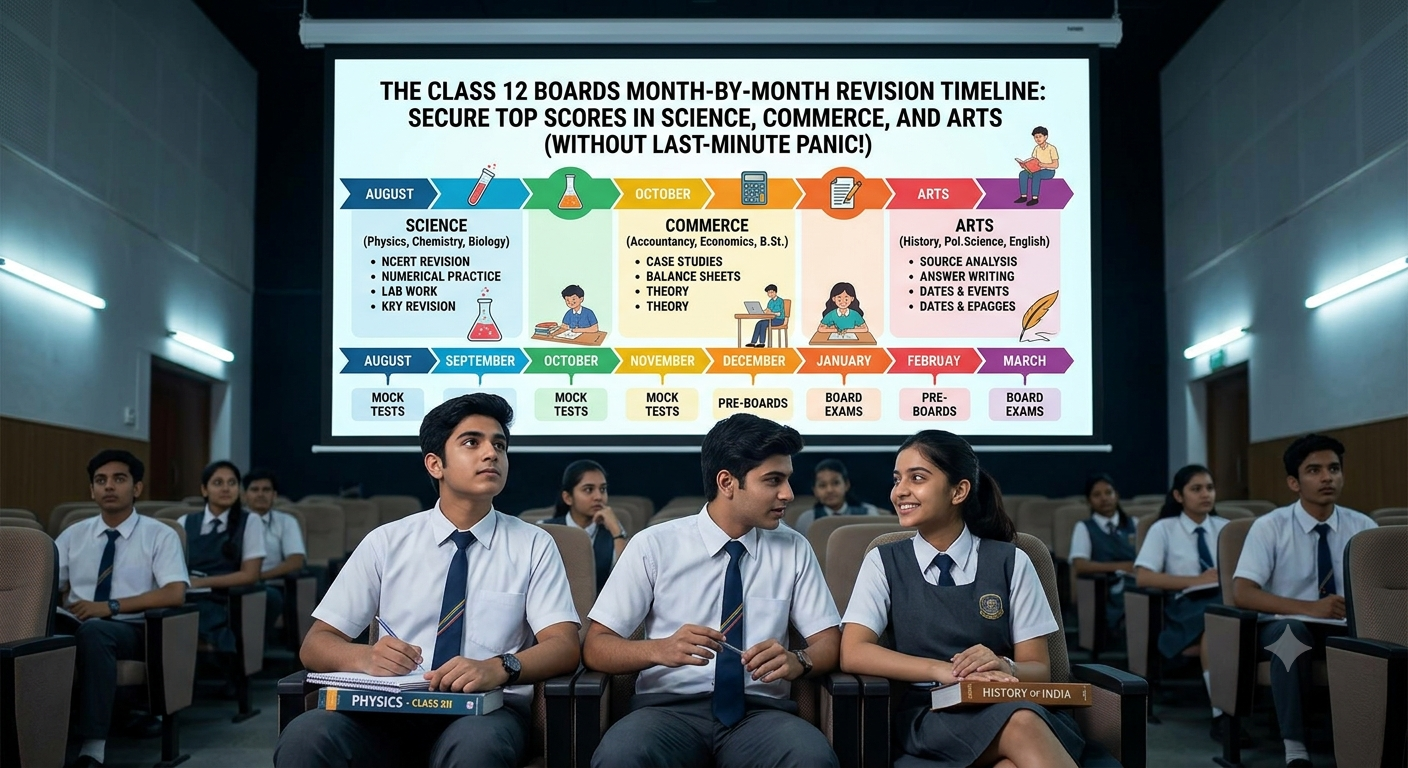
3. Phase 1 (July to September): The Syllabus Consolidation Stage
This is the foundation phase of your Class 12 board exam revision timeline. Your primary objective during these months is simple: complete 100% of your syllabus and build rock-solid conceptual clarity.
NCERT is Your Foundation: Do not make the mistake of buying heavy reference books early on. For boards, the official NCERT books are absolute. Read every line of the theory, solve every single in-text blue question, and complete the end-of-chapter exercises. You can download official, digital copies of these textbooks directly from the NCERT Online Books Directory to study on the go.
Make Micro-Notes: As you finish each chapter, summarize it into 2 pages of micro-notes. Write down key formulas, core definitions, and historical timelines. These notes will serve as your primary revision material during the winter months.
Daily Consistency: Aim for at least 3 to 4 hours of self-study daily during this period, keeping up with the topics taught in your school lectures.
4. Phase 2 (October to November): First-Pass Revision and Deep Practice
By October, your syllabus should be at least 80% complete. This phase marks your transition from passive learning to active retrieval. This is where you lay the groundwork to score 95 in Class 12 boards.
The 3-Pass Revision Method: Revisit your September chapters using your micro-notes. Do not just re-read them; actively write down formulas and structural answers from memory.
Solve Topic-Wise Previous Year Questions (PYQs): Acquire a high-quality, topic-wise PYQ book. When you revise “Electrostatics” or “Company Accounts,” immediately solve the questions asked in the boards over the last 10 years. This teaches you exactly how examiners frame questions.
Strengthen Your Weak Links: Identify the sub-topics where you consistently struggle. Dedicate your weekends to running remedial study blocks to patch up these conceptual gaps before the pre-board storm begins.
5. Stream-Specific Execution: Tailoring Your October-November Plan
While the overarching timeline remains identical, the day-to-day execution must adapt to your specific academic stream.
The Class 12 Science Revision Plan (PCM / PCB)
Physics: Focus heavily on standard derivations (e.g., Gauss’s Law, Lens Maker’s Formula) and conceptual numerical questions. Ensure you write down SI units for every final answer.
Chemistry: Divide your time into Organic (practice mechanisms and named reactions daily), Inorganic (memorize d-block and coordination compound structures), and Physical (focus on numerical steps and formula application).
Mathematics/Biology: For Math, practice NCERT exercises at least twice. For Biology, practice hand-drawn, labeled diagrams of reproductive systems, DNA structures, and ecological cycles.
The Class 12 Commerce Study Strategy
Accountancy: Practice the formats of Balance Sheets, Cash Flow Statements, and Partnership accounts meticulously. One format error can cost you several step-marks.
Economics: Build clear conceptual understandings of Macroeconomics and Indian Economic Development. Practice drawing precise demand-supply and income-determination graphs.
Business Studies: Focus on case studies. Read the CBSE sample papers to understand how to spot the “clues” in long paragraphs that point to specific management principles.
The Class 12 Arts Preparation Tips
History & Political Science: Use chronological timelines to memorize key dates. Focus on structural, point-wise answer writing rather than long, rambling paragraphs.
Geography & Psychology: Practice map marking regularly. For Psychology, make comparative tables of different therapeutic approaches and cognitive disorders.
6. Phase 3 (December): Pre-Boards, Diagnostic Simulation, and Error Logging
December is the month of reality checks. Most schools conduct their first and second pre-boards during this month. Do not panic if your pre-board scores are lower than you hoped; treat them as diagnostic simulations.
Simulate Exam Conditions: Write your pre-boards with the same seriousness as your finals. Keep track of your speed. Are you running out of time in the 5-mark long answer section?
Build an Error Log: This is a vital NCERT revision strategy Class 12 toppers use. Keep a dedicated notebook where you copy down every question you got wrong in your pre-boards. Write down the correct step-by-step solution and the core concept you missed.
Perfect Your Presentation: Examiners grade thousands of sheets; make theirs easy. Learn to write point-wise answers, underline core academic keywords with a pencil, leave double spaces between answers, and draw neat diagrams.
7. Phase 4 (January): The Mock Test Marathon and CBSE Sample Paper.
With your syllabus fully complete and your pre-boards wrapped up, January is dedicated entirely to building speed, accuracy, and exam temperament.
Solve Official CBSE Sample Papers: The board releases official sample papers annually to highlight the exact difficulty level and weightage of the upcoming exams. You must download and solve these papers under strict 3-hour exam conditions (9:30 AM to 12:30 PM to align with your biological clock). You can access these resources on the official CBSE Academic Sample Question Papers Page.
The 3-Hour Exam Simulation: Sit in a quiet room with no phone, no internet, and no interruptions. Solve a complete, mixed-syllabus previous year paper. This is the only way to conquer time management issues and build the mental stamina required to sit focused for three straight hours.
Re-Evaluate Your Errors: Go back to your December error log. Re-solve those exact questions to ensure you do not repeat the same conceptual mistakes on your actual exam sheet.
8. Phase 5 (February): The Final Polish and Stress Management
February is the final lap of your long academic marathon. This month is not about learning new chapters; it is about preservation and strategic polishing.
Review Your Micro-Notes Only: Avoid heavy textbooks or new online resources at this stage. Stick to your proven micro-notes, formula sheets, and organic chemical reactions list.
Prioritize Physical and Mental Health: High cortisol (stress hormone) levels actively block memory retrieval. Ensure you sleep at least 7 to 8 hours daily. A sleep-deprived brain cannot recall complex formulas or construct high-quality answers under exam pressure.
Verify Your Practical Hall Tickets and Documentation: Keep your stationary, boards admit card, and school ID organized. Ensure your academic credentials and certificates are securely linked to your profile via the national DigiLocker Digital Wallet Portal to make post-exam undergraduate admissions and document verification completely seamless.
9. Summary Table: Your Ultimate Month-by-Month Milestone Checklist
The table below provides a structured, high-level summary of your academic objectives from late summer to the final exam week:
+-------------------+----------------------------------+----------------------------------+
| Month             | Primary Academic Focus           | Critical Milestone Target        |
+-------------------+----------------------------------+----------------------------------+
| July - September  | Syllabus completion & NCERT      | Finish 100% textbook theory;     |
|                   | conceptual foundations           | draft 2-page chapter micro-notes |
+-------------------+----------------------------------+----------------------------------+
| October - November| Spaced retrieval, active recall  | Solve last 10 years topic-wise   |
|                   | & weak link remediation          | PYQs; build formula sheets       |
+-------------------+----------------------------------+----------------------------------+
| December          | Pre-boards diagnostic runs &     | Analyze pre-board papers; build  |
|                   | rigorous answer presentation     | a comprehensive error logbook    |
+-------------------+----------------------------------+----------------------------------+
| January           | Timed full-syllabus mock tests   | Solve 15 full-length papers      |
|                   | & official sample papers         | under strict 3-hour simulations  |
+-------------------+----------------------------------+----------------------------------+
| February          | Micro-note review & stress       | Review formula sheets & error logs;|
|                   | control; board exam kickoff      | prioritize 7+ hours of sleep     |
+-------------------+----------------------------------+----------------------------------+
10. Conclusion: Step Confidently Onto Your Path of Success
Securing a 95%+ score in your Class 12 board examinations is not a result of luck, nor is it reserved only for “natural geniuses.” It is the natural outcome of a highly disciplined, scientifically paced, and logic-driven execution plan.
By dividing your preparation into logical phases—using the summer to consolidate your NCERT foundations, the autumn to run active PYQ revision cycles, and the winter to run timed mock test simulations—you completely eliminate the space for last-minute academic panic.
Trust the timeline you have constructed, protect your mental and physical wellness, stay disciplined in your weekly execution, and step confidently into your exam center ready to conquer your boards and pave a brilliant path for your professional future.