What Are Dark Matter and Dark Energy? 5 to 10.
Introduction: The Secrets of the Cosmic Mystery
Have you ever looked up at the night sky and wondered what the universe is made of? You might think that stars, planets, moons, and vast clouds of cosmic dust make up everything in space. However, astronomy shows us a mind-blowing truth: everything we can touch, see, and detect only accounts for a tiny fraction of outer space. The rest is filled with two mysterious forces known as dark matter and dark energy. Learning about these forces helps students understand how galaxies hold together and why our universe is continuously expanding. To dive deeper into space research, explore resources on NASA’s Official Science Website.
1. What Is Normal Matter vs. Invisible Matter?
To understand dark matter, we first need to look at normal matter, also known as baryonic matter. Normal matter includes atoms, molecules, trees, oceans, humans, and every burning star in the night sky. In contrast, invisible matter does not absorb, reflect, or emit light of any kind. This means it cannot be captured by standard optical telescopes or radio receivers. While normal matter interacts through electromagnetic forces, invisible components remain hidden, making dark matter one of the most intriguing puzzles in physics today.
2. The Composition of the Universe: What Is Space Made Of?
Scientists studying the cosmic pie chart have determined the relative amounts of stuff that make up our cosmos. Amazingly, ordinary matter makes up only about 5% of the total mass and energy in the universe. Dark matter takes up roughly 27%, while dark energy dominates with a massive 68%. This means that over 95% of our universe is made of things we cannot directly see. Understanding this cosmic breakdown helps students appreciate how much discovery remains for future scientists.
3. What Is Dark Matter? The Invisible Glue of Space
So, what exactly is dark matter? Think of it as invisible scaffolding or cosmic glue. It has mass, which means it exerts a pull through gravity, but it does not interact with light. Without dark matter, spinning galaxies would fly apart because the gravity from visible stars alone isn’t strong enough to hold them together. Dark matter acts as an unseen anchor, keeping stars in their orbits and preserving the structural stability of spiral and elliptical galaxies across space.
4. How Do Scientists Detect Dark Matter Without Seeing It?
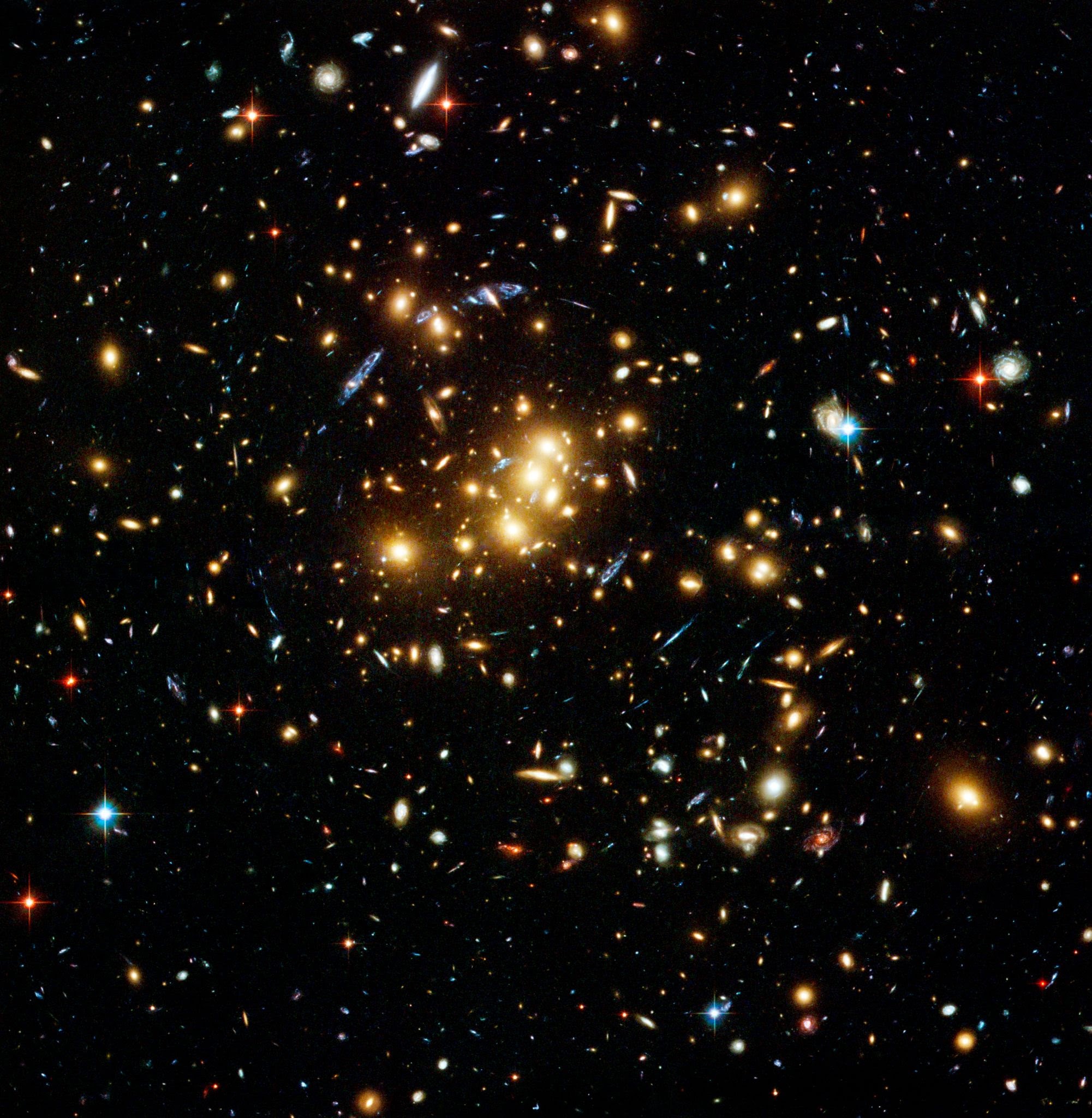
Even though dark matter is completely invisible, astronomers confirm its presence through gravitational lensing. When light from distant stars passes near a heavy concentration of dark matter, the strong gravitational field bends and distorts that light, acting like a giant magnifying lens in deep space. Furthermore, measurements of galaxy rotation speeds prove that extra unseen mass must be present. You can read more about how telescopes map hidden cosmic structures on the European Space Agency (ESA) educational hub.
5. What Is Dark Energy? The Force Pushing Space Apart
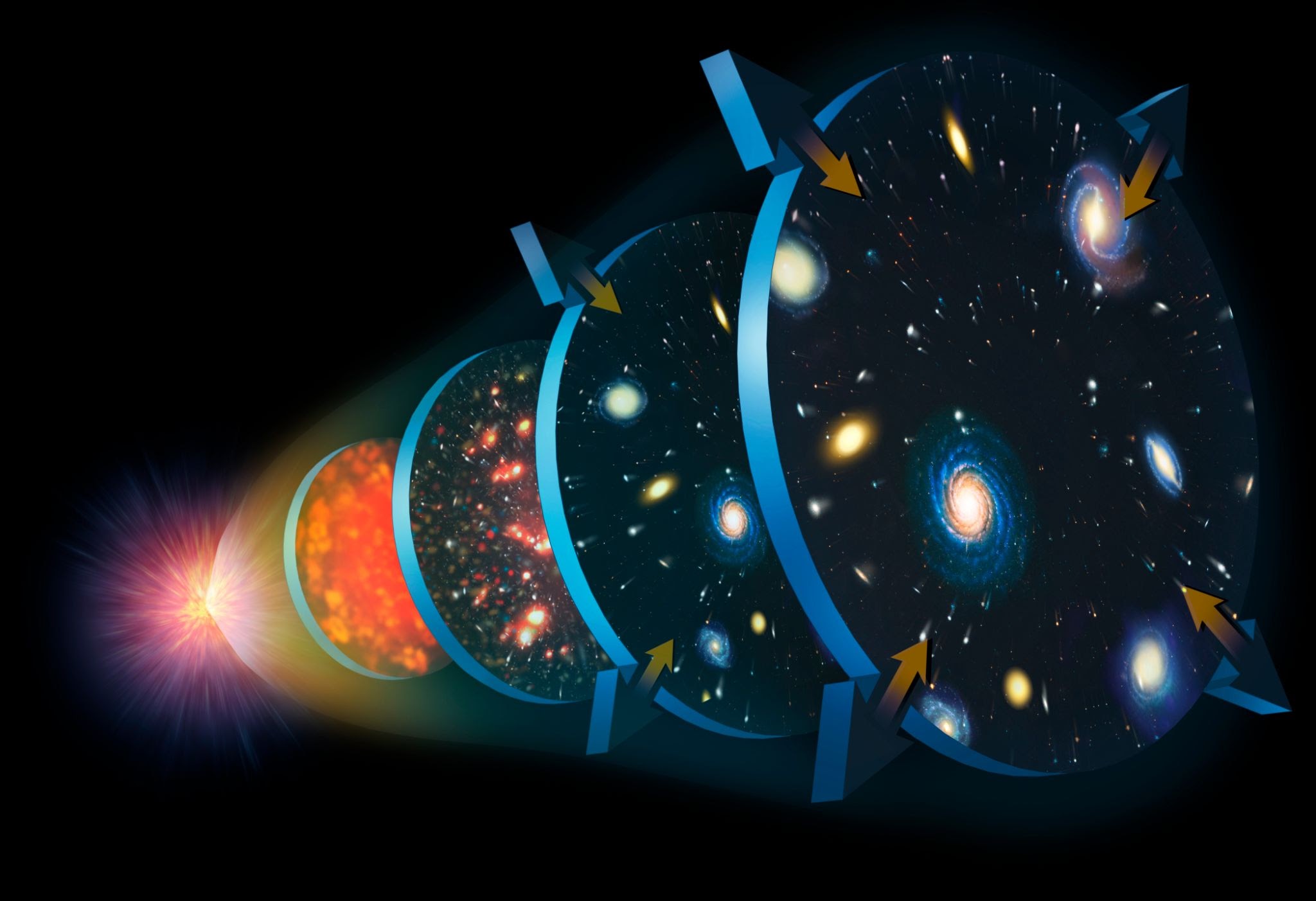
While dark matter pulls things together like glue, dark energy does the exact opposite by driving space apart. Dark energy is a mysterious, repulsive force that acts across the entire cosmos. It exerts negative pressure, pushing galaxies away from one another at ever-increasing speeds. Rather than letting gravity pull all matter back into a single point, dark energy ensures that the fabric of space continues to stretch endlessly.
6. The Accelerating Expansion of the Universe Explained
For decades, astronomers believed that the expansion of the cosmos after the Big Bang would eventually slow down due to gravitational attraction. However, observations of distant exploding stars revealed that the universe’s accelerating expansion is speeding up over time. Dark energy acts like an accelerator pedal for space itself. As space expands, more dark energy comes into existence, causing distant galaxies to recede from us faster and faster as cosmic time progresses.
7. Dark Matter vs. Dark Energy: Key Differences Simplified
It is easy to mix up these two concepts because both use the word “dark.” However, their roles in cosmic evolution are completely opposite:
| Feature | Dark Matter | Dark Energy |
| Primary Effect | Pulls matter together (Attractive) | Pushes space apart (Repulsive) |
| Cosmic Share | ~27% of the universe | ~68% of the universe |
| Role in Galaxies | Acts as invisible glue holding galaxies together | Drives accelerating cosmic expansion |
| Interaction | Interacts via gravity | Acts as a uniform energy property of space |
Understanding this cosmic tug-of-war allows students to see how gravity and dark energy balance the overall architecture of space.
8. Famous Astronomical Discoveries: From Vera Rubin to Hubble
The story of dark matter and dark energy is filled with groundbreaking astronomical discoveries. In the 1970s, astronomer Vera Rubin observed that stars at the outer edges of spiral galaxies were moving just as fast as stars near the center, proving that invisible mass was exerting gravity. Later, in the late 1990s, teams of astrophysicists measuring distant type Ia supernovae discovered that space was accelerating in its expansion. You can explore historically significant astronomical maps through the Smithsonian Astrophysical Observatory.
9. Leading Theories: WIMPs, Axions, and the Cosmological Constant
Scientists have developed several fascinating theoretical models to explain these phenomena:
WIMPs (Weakly Interacting Massive Particles): Hypothetical heavy subatomic particles that interact only through gravity and the weak force.
Axions: Ultra-light hypothetical particles that could account for the cold dark matter distributed throughout galaxies.
Cosmological Constant: First proposed by Albert Einstein, this concept suggests that dark energy is an inherent property of space itself, keeping its energy density constant even as space stretches.
Research facilities like the Large Hadron Collider continue searching for these elusive particles in underground laboratories.
10. Why Dark Matter and Dark Energy Matter for Middle and High School Students
Studying dark matter and dark energy helps students develop critical thinking skills by showing that science is an active, ongoing process rather than a closed book. It demonstrates that humanity has only uncovered 5% of how the cosmos operates. Pursuing topics in physics, astronomy, and mathematics opens up exciting career paths in space science, data analysis, and engineering, giving young learners the opportunity to solve the remaining 95% of the mystery.
Conclusion: The Future of Space Exploration
In summary, dark matter holds galaxies together, while dark energy pushes the universe apart. Together, they shape the past, present, and ultimate fate of our cosmos. As advanced observatories like the James Webb Space Telescope and the Nancy Grace Roman Space Telescope collect new data, future scientists will get closer to solving these mysteries. Maybe one day, a student reading this guide will be the one to uncover the true nature of dark matter and dark energy!