How India’s New AI and Computational Thinking Curriculum Is Transforming School Education: Key Changes, Student Benefits & Future Career Opportunities
The educational landscape in India is undergoing a monumental paradigm shift. With the nationwide rollout of the new AI and computational thinking curriculum starting from Class 3 onwards, India is positioning its young generation at the forefront of global technological innovation. Spearheaded by the Ministry of Education in alignment with the National Education Policy 2020 and developed alongside premier technical institutions like IIT Madras, this visionary framework aims to transform traditional learning into an interactive, future-ready experience. This comprehensive blog post explores the key structural changes, tangible student benefits, emerging career pathways, and the systemic impact of embedding artificial intelligence and computational thinking in Indian school education.
1. The Vision Behind Integrating AI and Computational Thinking in Indian Schools
The primary vision of introducing an AI and computational thinking curriculum in schools is to move away from passive theoretical learning toward active, hands-on problem solving. Under the broad guidelines of the Central Board of Secondary Education (CBSE), the government aims to nurture a generation of digital creators rather than mere consumers of technology. By introducing foundational concepts early in the primary grades, Indian classrooms are building a strong foundation of logical reasoning, algorithmic thinking, and structural problem decomposition. This holistic vision ensures that every child, regardless of their ultimate career choice, develops the essential cognitive agility required to thrive in an increasingly automated world.
2. Key Structural Changes in the Mandatory Class 3 to 10 Curriculum
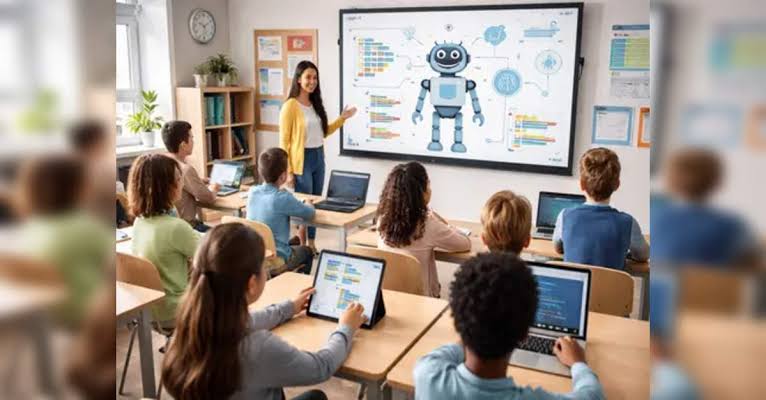
The new school curriculum framework introduces a phased, age-appropriate progression that spans across foundational, middle, and secondary stages. For primary classes (Classes 3 to 5), the focus rests heavily on unplugged activities, visual pattern recognition, spatial reasoning, and interactive logic puzzles. As students transition into the middle stage (Classes 6 to 8), the curriculum shifts toward introductory Artificial Intellegence Concepts project-based learning, and basic data analytics. By the time learners enter Classes 9 and 10, specialized tracks enable deeper exploration into predictive modeling, computer vision, and hands-on software development.
| School Stage | Target Grades | Core Curriculum Focus | Dedicated Annual Hours |
| Preparatory Stage | Classes 3 – 5 | Visual reasoning, logic puzzles, basic pattern matching | ~50 hours |
| Middle Stage | Classes 6 – 8 | Data organization, block-based logic, basic AI literacy | ~100 hours |
| Secondary Stage | Classes 9 – 10 | Predictive systems, automated models, hands-on projects | Integrated / Skill Elective |
3. Shifting from Rote Learning to Algorithmic Problem Solving
For decades, Indian education faced criticism for its heavy emphasis on rote memorization; however, the new computational thinking syllabus fundamentally changes this narrative. Algorithmic thinking teaches students how to analyze complex real-world challenges, identify repeating patterns, remove unnecessary details through abstraction, and design step-by-step solutions. When children learn how to break large problems into manageable components, they gain a structured mental model that applies equally well to language arts, social studies, scientific inquiry, and everyday life choices.
4. Enhancing Critical Thinking and Logical Cognitive Capacities
The systematic exposure to artificial intelligence in education significantly sharpens a student’s critical thinking and cognitive capacities. Through interactive logic exercises, story mapping, and rule-based diagnostic games, young minds learn to evaluate hypotheses and test conclusions systematically. This systematic style of analytical reasoning encourages curiosity and resilience, teaching students that errors are simply feedback points to refine their approach rather than failures.
5. Early Exposure to Data Literacy, Machine Learning, and Automation
In an age driven by big data, understanding how information is collected, processed, and applied is a fundamental modern skill. The AI education mandate for Indian schools introduces basic data literacy early on, allowing students to explore how recommendation systems, language tools, and automated image classifiers process inputs to make predictions. By demystifying the mechanics behind daily digital tools, students gain a clear understanding of technology’s potential and limitations.
6. Fostering Ethical AI Usage, Digital Citizenship, and Data Privacy
As automated systems become embedded in daily life, teaching responsible digital citizenship is as vital as teaching technological skills. The new curriculum places strong emphasis on ethical AI education and privacy guidelines, ensuring students learn about algorithmic bias, data security, digital footprints, and online safety. According to resource materials on the official DIKSHA Learning Portal, lessons encourage open classroom discussions on technology fairness, intellectual property, and respectful digital communication, preparing students to become conscientious global citizens.
7. Empowering Teachers with Advanced Pedagogical Training Initiatives
A curriculum transformation of this scale relies heavily on the readiness of educators across the nation. To support teachers, the Ministry of Education has launched comprehensive professional development frameworks through national platforms like NISHTHA and regional training centers. Educators are receiving hands-on guidance in activity-based teaching, project mentorship, and interactive classroom facilitation. By equipping teachers with updated digital tools and pedagogical strategies, schools ensure a smooth transition from traditional lecture setups to interactive learning environments.
8. Bridging the Urban-Rural Digital Divide Across Indian School Networks
One of the most ambitious goals of the national AI curriculum policy is making quality technology education accessible across all socio-economic backgrounds. By implementing offline-first computational thinking workbooks, unplugged reasoning activities, and open-source teaching resources, government school systems such as Kendriya Vidyalayas and Navodaya Vidyalayas can deliver quality lessons even in regions with limited hardware access. This inclusive approach helps bridge the digital divide and ensures that talented students from tier-2, tier-3, and rural areas have equal access to future opportunities.
9. Preparing Students for High-Demand Career Opportunities of Tomorrow
The skills cultivated by the computational thinking and AI framework directly align with the demands of the global workforce. Early exposure to structured problem solving builds a strong launchpad for numerous career paths, including:
Data Science and Analytics: Organizing, visualizing, and deriving actionable insights from complex information streams.
Software Engineering and System Architecture: Building robust software platforms, mobile applications, and cloud infrastructures.
AI Ethics and Policy Research: Evaluating automated systems for fairness, regulatory compliance, and societal safety.
Robotics and Automation Design: Developing hardware-software integrations for smart manufacturing, healthcare devices, and sustainable technology solutions.
Interdisciplinary Fields: Applying computational thinking to domain-specific challenges in bio-informatics, financial technology, environmental modeling, and creative digital arts.
10. Long-Term Societal and Economic Impact on India’s Knowledge Economy
In the long run, embedding future-ready tech education in schools strengthens India’s national economic competitiveness. By building a digitally literate workforce from the primary school level onward, the nation accelerates its transition into a global technology and innovation hub. Students trained under this curriculum develop the creative confidence needed to start innovative ventures, solve local social challenges, and contribute meaningfully to sustainable development goals.