Advanced Science & Entrance Exam Strategy (Grades 11-12)
The transition from middle school to senior high school is often described as an academic shock. For students in Grades 11 and 12, this transition is further complicated by the immediate necessity of preparing for highly competitive engineering and medical college entrance examinations. At this level, studying is no longer about passing school-level term papers; it is about outperforming hundreds of thousands of peers in highly demanding, timed national-level assessments.
To survive and thrive under this immense pressure, students must completely overhaul their study habits, cognitive methodologies, and psychological frameworks. Relying on the strategies that brought you success in Grade 10 will no longer suffice. In this comprehensive blueprint for advanced science prep, we will analyze the core components of a successful entrance exam strategy, detail how to master senior high school coursework, and provide actionable techniques to help you secure a top rank in your dream competitive exams.
1. The Senior Transition: Why Grades 11-12 Require a New Academic Mindset
The first and most critical step in your entrance exam strategy is recognizing that the academic landscape has shifted beneath your feet. In secondary school, learning is highly linear and descriptive. You read a chapter, memorize the key terms, and reproduce those definitions during school exams.
In grades 11-12 competitive exams, the rules are entirely different. Entrance tests do not ask for definitions, nor do they care if you can recite a textbook paragraph. Instead, they are designed to test your ability to apply abstract scientific principles to entirely unfamiliar, multi-step scenarios. This requires a transition from passive, memory-based learning to active, analytical visualization. If you do not change your cognitive approach immediately upon entering Grade 11, you will quickly find yourself falling behind, creating a cumulative learning backlog that becomes increasingly difficult to clear as your final board exams approach.
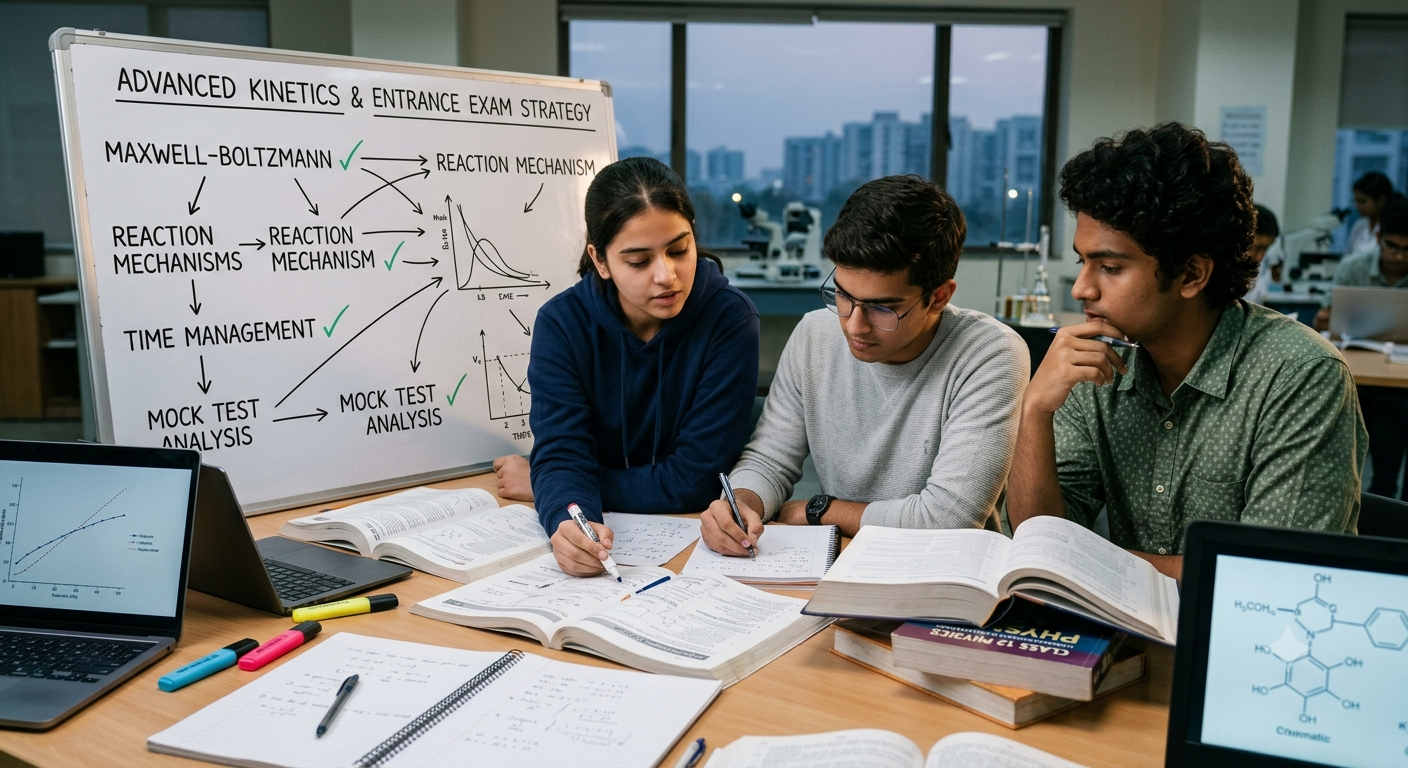
2. Decoding the Competency Matrix: Understanding What National Entrance Exams Actually Test
National-level engineering and medical entrance exams are not designed to find out how much you know; they are sophisticated elimination processes designed to test specific cognitive competencies. When the National Testing Agency (NTA) structures its papers, it focuses heavily on three core areas: conceptual depth, application speed, and logical stamina.
To align your study sessions with these targets, you must regularly monitor official updates, guidelines, and changes in paper patterns published on the official National Testing Agency Portal. Staying updated with these official directives ensures that you are not wasting precious weeks practicing outdated question patterns, allowing you to keep your advanced science prep highly focused and strategically efficient.
3. High-Yield Advanced Physics: Developing Conceptual Mechanics without Mathematical Overwhelm
Physics in Grades 11 and 12 is often considered the most challenging science branch because it undergoes the steepest rise in abstract complexity. Many students make the mistake of assuming that mastering physics is simply a matter of memorizing formulas and practicing mathematical derivations.
This is a fundamental error. Formulas are merely the mathematical language used to describe physical interactions. To build a highly effective entrance exam strategy for physics, you must first master the qualitative concept behind the math. For instance, before attempting to calculate vectors, you must learn to visualize how a physical system behaves—whether it is a solid block sliding down a friction-filled inclined plane or an invisible electric charge moving through a magnetic field.
To achieve this level of deep conceptual visualization, students should explore high-quality educational frameworks and cognitive strategies curated on Edutopia’s STEM Learning Hub. Utilizing these visual and active learning methods ensures that when you eventually face highly complex mechanics or electromagnetism problems, you can intuitively predict the physical behavior of the system before you even write down a single line of calculation.
4. Advanced Chemistry Strategy: Unifying the Three Pillars for Optimal Scoring
Of all the subjects in the senior science curriculum, Chemistry is your highest-yielding zone. It offers the maximum opportunity to score high marks in the shortest amount of time, provided you adapt your study strategy to its three distinct sub-disciplines.
Inorganic Chemistry: Systematic Categorization and Periodic Trends
Inorganic Chemistry is often dismissed as a subject requiring pure rote memorization. However, successful candidates treat it as a logical, highly organized system. Rather than memorizing thousands of isolated chemical reactions, focus on understanding periodic trends, chemical bonding, and coordination anomalies. Treat your primary school textbooks as the absolute source of truth, and systematically record exception charts in a dedicated notebook for quick weekly revision.
Organic Chemistry: Reaction Mechanisms and Electronic Effects
Organic Chemistry must never be studied through rote memorization. Trying to memorize reactions in isolation will lead to complete confusion when you face slightly altered reagents in an exam. Instead, focus on understanding basic electronic effects: inductive effects, resonance, hyperconjugation, and steric hindrance. Once you understand how nucleophiles and electrophiles interact, you will be able to logically predict the outcome of almost any reaction pathway.
To visualize these molecular blueprints and understand how different compounds behave at a fundamental level, you can cross-reference organic structures using the PubChem Chemical Database. This resource provides detailed structural profiles that help bridge the gap between textbook lines and molecular realities.
Physical Chemistry: Conceptual Frameworks and State Shifts
Physical Chemistry requires a strong understanding of state shifts, chemical equilibrium, and thermodynamic transitions. Your strategy here must focus on understanding the physical assumptions behind laws and chemical behaviors, ensuring your theoretical foundations are solid before you apply them to complex scenarios.
5. Advanced Biology Systems: Shifting from Basic Memorization to Multi-Chapter Integration
For medical aspirants, the Biology section represents the backbone of their exam score, accounting for half of the total marks. At the advanced senior level, Biology shifts from basic classifications of living organisms to a highly complex, interconnected study of physiological, cellular, and genetic systems.
To build a high-yield entrance exam strategy for Biology, you must move away from studying chapters in isolation. The modern examination pattern features highly integrated questions that connect concepts across multiple chapters. For example, a question on plant physiology might require a deep understanding of cellular transport mechanisms, genetics, and biochemical processes.
Ensure you are using the most accurate, updated textbook editions directly from the NCERT Digital Textbook Repository to build your foundational notes. Pay close attention to the fine print under diagrams, historical scientist introductions, and end-of-chapter summaries, as these are frequently targeted for direct, high-yield questions.
6. The Science of Learning: Why Active Recall and Spaced Repetition Drive High-Yield Prep
When time is your most limited resource, traditional study methods like passively highlighting textbook pages, reading summaries, or watching hours of passive video lectures are incredibly inefficient. These habits create a “familiarity bias”—you feel like you have mastered the material because you recognize it when you see it, but your brain is unable to retrieve that information under the high-stress environment of an actual exam.
Instead, your grades 11-12 competitive exams strategy must utilize cognitive retrieval techniques:
Active Recall: After reading a complex scientific topic, close the book and write down the core physical principles, conditions, and mechanisms in your own words.
Spaced Repetition: Do not study a topic once and forget about it for months. Schedule systematic revision sessions 1 day, 7 days, 30 days, and 90 days after your initial study session to lock the concepts into your long-term memory.
Feynman Technique: Try explaining a highly abstract scientific concept, such as the Doppler effect or chemical equilibrium, in the simplest possible terms to an imaginary audience. This process will immediately highlight the gaps in your own understanding.
┌────────────────────────────────────────────────────────┐
│             THE RETRIEVAL-BASED STUDY CYCLE            │
├────────────────────────────────────────────────────────┤
│ 1. Active Reading: Focus on mechanisms & connections  │
│ 2. Close Book: Write down core principles from memory │
│ 3. Diagnose Gaps: Re-read highlighted text & summaries  │
│ 4. Spaced Review: Schedule quick recalls at set intervals│
└────────────────────────────────────────────────────────┘
Using these active learning techniques transforms your brain from a passive storage container into a highly efficient, rapid retrieval engine, allowing you to solve complex conceptual problems quickly and accurately.
7. Designing a High-Output Study Schedule for Grades 11-12 Competitive Exams
Balancing active school classes, board exam preparation, practical lab sessions, and target competitive exam coaching is a massive logistical challenge. Without a structured, highly disciplined daily routine, you will quickly find yourself overwhelmed by school deadlines and competitive backlogs.
A successful schedule for grades 11-12 competitive exams must prioritize consistent, daily output over sporadic, high-effort cram sessions. Dedicate your morning hours—when your brain’s cognitive processing capacity is at its peak—to learning new, complex conceptual topics in physics or physical chemistry. Reserve your afternoons for active problem-solving and error analysis, as these tasks require high motor engagement and keep you awake and active. Use your evenings for high-memorization subjects like inorganic chemistry, biology classifications, or reviewing your active recall flashcards.
8. The Psychological Fortitude: Dealing with Low Mock Scores and Academic Stress
One of the greatest points of failure for bright students during their advanced science prep is not a lack of intelligence, but a lack of psychological resilience. When you take your first few advanced mock tests, your scores will likely be low. This is the exact point where many students fall into a spiral of self-doubt and decision paralysis, assuming they are not smart enough to succeed.
You must understand that a mock test score is not a final grade or a reflection of your intelligence; it is simply diagnostic data. It shows you exactly which of your conceptual pathways are fractured, where your time-management failed, and what logical errors you are prone to making. Instead of feeling demoralized, treat every mistake as a victory—it is one less error you will make on the actual exam day. Developing this resilient, data-driven mindset is what separates those who crumble under exam pressure from those who achieve elite national ranks.
9. The Strategic Mock Test Analysis: Treating Errors as Diagnostic Milestones
Taking hundreds of random mock tests without analyzing them is a complete waste of time. To make your practice tests count, you must run a highly systematic diagnostic audit after every single exam.
Create a dedicated “Error Log” where you document every question you answered incorrectly, got stuck on, or guessed. Categorize each error into one of three distinct classes:
Conceptual Errors: You did not understand the underlying scientific principles. The next immediate step is to return to your core textbooks and rewrite your notes.
Calculation or Reading Errors: You understood the concept but made a careless slip under time pressure. The next step is to practice relaxation techniques and slow down your reading speed.
Strategic Errors: You spent too much time on a difficult question, panicking and leaving high-yielding, simple questions unattempted. The next step is to master the art of skipping tough questions to maximize your overall score.
By running this audit after every test, you systematically eliminate your academic weaknesses, ensuring that your preparation becomes stronger and more streamlined with every mock exam you complete.
10. How to Balance Board Exams and Competitive Preparation Simultaneously
A major source of anxiety for senior high school students is the pressure to perform well in their school board exams while simultaneously running their competitive prep. Parents, teachers, and school administrators often demand that you stop your entrance exam prep entirely to focus on descriptive board writing practice.
This is a false conflict. The syllabus for your board exams and your competitive exams is exactly the same; the only difference lies in the presentation of your answers. Board exams require descriptive, step-by-step writing, while competitive exams require rapid analytical deduction.
When you study a topic deeply for your competitive preparation, you are automatically preparing 90% of the concept for your boards. To bridge the remaining 10% gap, dedicate one day a week (such as Sundays) to writing out descriptive answers, practicing step-by-step derivations, and reviewing past board exam papers. This integrated approach ensures you score exceptionally well in your school board exams without losing any momentum in your entrance exam preparation.
11. Conclusion: Transforming Rigor into Long-Term Academic Brilliance
Embarking on your advanced science and entrance exam journey in Grades 11 and 12 is undeniably one of the most demanding challenges of your youth. The volume of content is massive, the competition is fierce, and the stakes are incredibly high.
However, by accepting the reality of this academic leap, implementing a highly disciplined daily routine, and utilizing active learning strategies like active recall and spaced repetition, you can systematically bridge the learning gap. Stop focusing on the sheer size of the syllabus, and stop worrying about how early your peers started. Focus on your daily inputs, analyze your mistakes with logical curiosity, and maintain your psychological resilience. With a structured strategy in hand, you have more than enough time to transform your hard work into academic brilliance and secure your place in the premier institutes of the country.