Top 5 Hardest Chapters in Class 11 Physics and How to Master Them
The transition from Class 10 to Class 11 is often described as a massive academic leap, particularly for science students. Among all the subjects, Class 11 Physics stands out as the most challenging. Many students who easily secured top marks in their high school science exams find themselves struggling to grasp the abstract, highly analytical concepts introduced at this level.
If you find yourself overwhelmed by the vast Class 11 Physics syllabus, you are not alone. To help you navigate this academic hurdle and ace your school exams, JEE physics preparation, or NEET physics class 11 exams, we have compiled a definitive list of the hardest chapters in Class 11 Physics alongside actionable, topper-approved strategies to conquer them.
1. Why Class 11 Physics Feels Like a Giant Leap
For most students, the primary shock of Class 11 Physics lies in the shift from rote memorization to rigorous conceptual application. In Class 10, physics is largely qualitative, focusing on basic definitions, direct formula applications, and straightforward phenomena. In contrast, Class 11 introduces a heavy reliance on mathematical tools like calculus, vectors, and coordinate geometry.
Without a strong foundation in these mathematical tools, understanding even the introductory chapters becomes a steep uphill battle. To succeed, students must shift their mindset from “learning the answers” to “understanding the physical mechanisms.” Acknowledging this difference early in your Class 11 Physics preparation is the first step toward mastering the subject.
2. The Blueprint: How Class 11 Physics Shapes Your JEE and NEET Success
Before diving into the list of the most difficult chapters, it is crucial to understand the high-stakes nature of the Class 11 Physics syllabus. For national competitive exams like the Joint Entrance Examination (JEE) and the National Eligibility cum Entrance Test (NEET), nearly 40% to 50% of the physics questions are derived directly from Class 11 topics.
These chapters form the absolute mechanical and thermodynamic core of advanced physics. Skipping or ignoring these concepts will not only hurt your Class 11 scores but will also make your Class 12 journey—which features complex areas like electrodynamics and wave optics—incredibly difficult. You can keep track of official syllabus shifts and updates on the NTA Official Website to ensure your preparation aligns with the latest exam patterns.
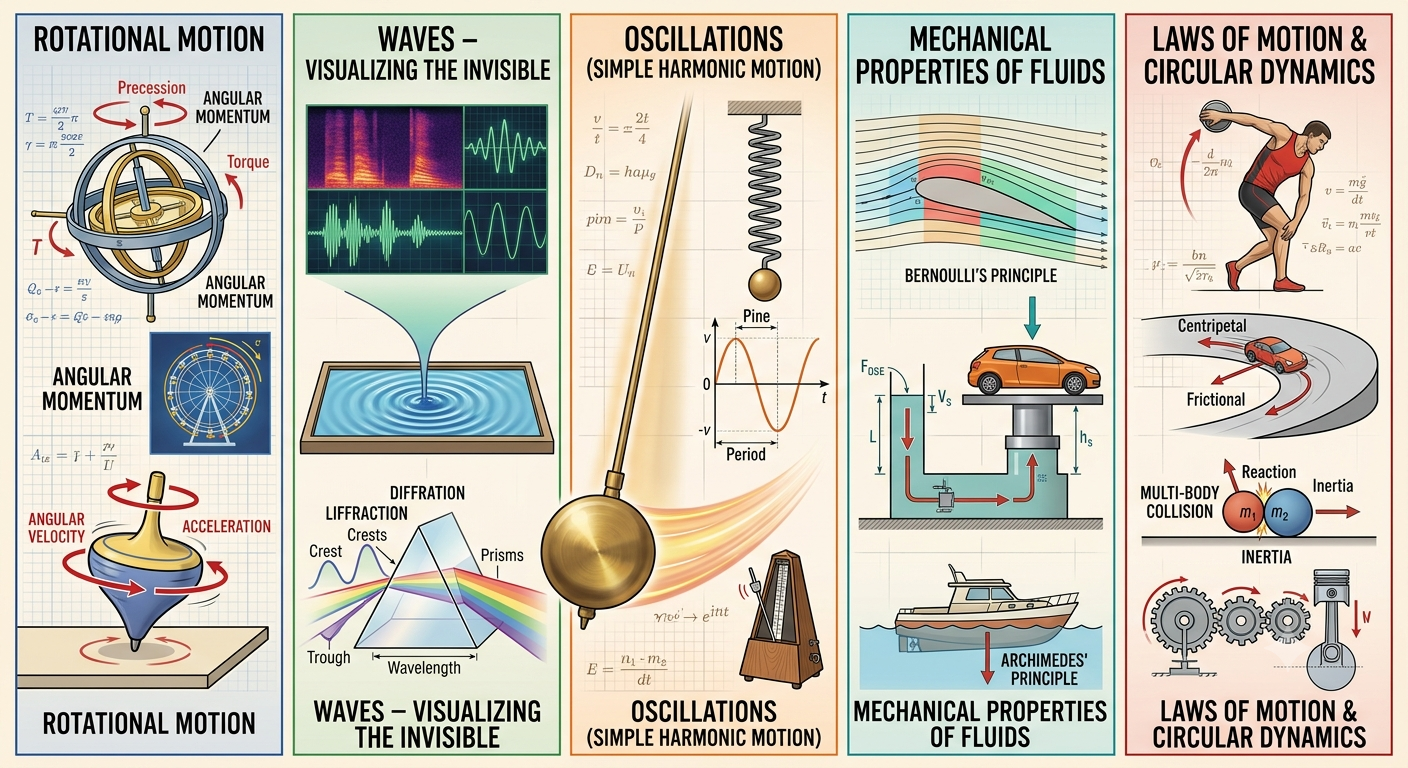
3. Chapter 1: Rotational Motion (System of Particles and Rotational Motion)
Ask any engineering or medical aspirant to name the ultimate boss of Class 11 Physics, and the unanimous answer will be Rotational Motion. This chapter introduces a parallel universe of motion where every linear variable has an angular counterpart.
┌────────────────────────────────────────────────────────┐
│          ROTATIONAL MOTION SYMMETRY CHALLENGE          │
├────────────────────────────────────────────────────────┤
│ Linear Dynamics             ─► Rotational Dynamics     │
│ • Force (Push/Pull)         ─► Torque (Twisting)       │
│ • Mass (Inertia)            ─► Moment of Inertia       │
│ • Linear Momentum           ─► Angular Momentum        │
└────────────────────────────────────────────────────────┘
Why it is considered hard:
Rotational Motion is conceptually complex because it requires students to visualize objects spinning, rolling, and translating all at once. The concept of Moment of Inertia changes based on the axis of rotation, and applying the conservation of angular momentum requires a high level of spatial reasoning.
How to master it:
Master Linear Analogs First: Before studying rotational variables, ensure your concepts of linear kinematics, work, and linear momentum are rock-solid. Every formula in rotational dynamics is directly analogous to a linear dynamics formula.
Focus on Rigid Body Dynamics: Practice visualizing how different points on a rolling wheel move relative to the center of mass and the ground. Visual aids and 3D simulation videos can be incredibly helpful here.
Deconstruct Torque: Think of torque not as a complex abstract vector, but simply as a measure of how effective a force is at causing an object to rotate around a specific pivot point.
4. Chapter 2: Waves – Visualizing the Invisible
The chapter on Waves is the final segment of the Class 11 Physics syllabus, and it represents a massive paradigm shift. Up until this point, students deal with particles and rigid bodies. Suddenly, they are forced to study energy propagation through continuous media.
Why it is considered hard:
Waves are inherently abstract. Concepts like the superposition principle, standing waves, beats, and the Doppler effect require students to construct complex mental images of fluctuating fields and pressure variations. The transition from physical tracking of solid blocks to analyzing continuous sinusoidal wave patterns causes significant cognitive friction.
How to master it:
Differentiate Between Wave Types: Clearly distinguish between longitudinal waves (like sound) and transverse waves (like string waves). Understanding the direction of particle motion relative to energy propagation makes the rest of the chapter far easier.
Use Wave Simulation Software: Interactive physics simulations, such as those provided by online academic portals, allow you to see standing waves and interference patterns form in real-time.
Understand the Superposition Principle: Think of superposition simply as a cosmic addition game where waves passing through the same point either help each other grow larger or work to cancel each other out.
5. Chapter 3: Oscillations (Simple Harmonic Motion)
Directly preceding Waves is Oscillations, focusing heavily on Simple Harmonic Motion (SHM). This chapter serves as the theoretical gateway to wave mechanics, alternating currents, and physical optics.
Why it is considered hard:
SHM is heavily dependent on phase, time-period calculations, and energy transformations. Understanding how kinetic energy seamlessly converts to potential energy and back, while tracking the phase difference between displacement, velocity, and acceleration, requires absolute mathematical and conceptual precision.
How to master it:
The Reference Circle Method: This is the ultimate secret weapon for mastering SHM. Learn to project uniform circular motion onto a straight diameter line. If you can master this geometric visualization, tracking phase differences becomes incredibly simple.
Trace the Energy Path: Focus your study on the conservation of mechanical energy in oscillating systems (like springs and pendulums). Identify the exact physical points where velocity is maximum (zero potential energy) and where displacement is maximum (zero kinetic energy).
Relate to Real-World Examples: Think of SHM in terms of common experiences like playground swings, car suspension systems, or musical instrument strings to keep the theory grounded.
6. Chapter 4: Mechanical Properties of Fluids
Unlike solid mechanics, where shapes are fixed and predictable, fluid mechanics deals with substances that deform continuously under shear stress. This chapter is a major component of the hardest chapters in Class 11 Physics because it is incredibly vast and theoretically diverse.
Why it is considered hard:
The chapter is packed with numerous distinct, non-overlapping physical phenomena: hydrostatic pressure, Pascal’s law, Archimedes’ principle, viscosity, surface tension, and streamline flow. Retaining all these distinct concepts and knowing when to apply Bernoulli’s theorem versus Torricelli’s law can be highly confusing.
How to master it:
Separate Hydrostatics from Hydrodynamics: Divide your study plan into two distinct phases. First, master static fluids (fluids at rest, pressure variations, surface tension). Once comfortable, move on to dynamic fluids (viscosity, equation of continuity, and energy conservation equations).
The “Energy Conservation” Shortcut: Remember that Bernoulli’s principle is nothing more than the law of conservation of energy applied to a moving, non-viscous fluid. Demystify the concept by thinking of pressure energy, potential energy, and kinetic energy as moving together in a closed pipe.
Read Class Notes Daily: Because this chapter contains many qualitative formulas and physical definitions (like terminal velocity and capillary rise), frequent revision of class notes is necessary to prevent retention fade. You can download structural learning guides directly from the NCERT Books Download Center to cross-verify key definitions.
7. Chapter 5: Laws of Motion & Circular Dynamics
While Laws of Motion is introduced relatively early in Class 11, it remains one of the most intellectually demanding chapters. It serves as the foundation for all subsequent mechanical physics.
Why it is considered hard:
The core laws of motion are easy to memorize, but applying them to complex physical scenarios is highly challenging. Students often struggle with drawing accurate Free Body Diagrams (FBDs), resolving forces on inclined planes, dealing with non-conservative friction forces, and calculating pseudo-forces in non-inertial frames of reference.
How to master it:
The FBD is Your Holy Grail: Never attempt to solve a mechanics problem without drawing a clear, isolated sketch of the system. Isolate each body, identify all acting forces (gravity, normal reaction, tension, friction), and resolve them along perpendicular axes.
Respect Friction: Understand that static friction is a self-adjusting force. It only acts to prevent relative motion up to a certain maximum threshold. Master this behavioral nuance before attempting complex block-on-block problems.
Demystify Centripetal Force: Remember that “centripetal force” is not a new, mysterious force that appears out of nowhere. It is simply a job description. Any real physical force—like tension, gravity, or friction—can step up to act as the centripetal force required to keep an object moving in a circle.
8. Actionable Study Strategies to Master Tough Physics Concepts
Now that we have broken down the hardest chapters in Class 11 Physics, how do you systematically study them? Successful students do not study harder; they study smarter by using cognitive learning techniques.
Active Recall and Spaced Repetition: Do not just passively re-read your textbooks. After studying a tough section like rotational dynamics, close the book and write down a brief summary or try to explain the physical mechanism to an imaginary audience.
The Feynman Technique: If you struggle to understand a concept like the Doppler effect, try explaining it in the simplest possible terms, as if you were teaching a ten-year-old child. This process immediately highlights the gaps in your own understanding.
Sequential Learning: Physics is highly hierarchical. You cannot skip Vectors and expect to understand Kinematics, and you cannot skip Kinematics and expect to master Newton’s Laws. Always follow the logical flow of the syllabus.
9. The Role of NCERT and Reference Books in Class 11 Physics
Many students wonder if standard school books are sufficient for mastering high-level physics. The truth is that while school textbooks lay down the core concepts and definitions, they must be supplemented with specialized resources to build deep analytical skills.
To establish a perfect preparation strategy:
Read NCERT for Core Theory: Read the official syllabus texts to build your theoretical base, focus on conceptual definitions, and analyze the “Points to Ponder” sections at the end of each chapter.
Utilize Specialized Reference Guides: Use classic reference manuals like H.C. Verma’s Concepts of Physics to understand the subtle physical applications of mechanics and wave theory.
Leverage Free Digital Portals: For structural revision, lecture videos, and mock tests, explore highly rated academic platforms like the Khan Academy Physics Section to gain alternative visual explanations for tough, abstract topics.
10. Common Mistakes to Avoid in Class 11 Physics Preparation
As you embark on your journey to master these challenging topics, be on the lookout for these common traps that derail many bright students:
Rushing to Solve Problems Without Theory: Many students immediately jump to solving difficult questions without thoroughly reading the theoretical concepts. This leads to memorizing problem-solving steps rather than understanding the physics, which fails when a slightly modified question is presented in exams.
Neglecting the Mathematics: Physics is written in the language of mathematics. If you try to skip learning integration, differentiation, and vector algebra, you will face massive bottlenecks in every single chapter.
Avoiding “Weak” Chapters: It is natural to spend more time on topics you find easy and avoid chapters like Rotational Motion or Waves. However, ignoring these core areas will severely damage your overall percentage and your performance in entrance exams.
Frequently Asked Questions (FAQs) About Class 11 Physics
Q1: Is Class 11 Physics harder than Class 12 Physics?
Ans: Yes, most educators and toppers agree that Class 11 Physics is conceptually more challenging than Class 12. Class 11 focuses heavily on highly mechanics-oriented, visualizable yet mathematically rigorous systems, whereas Class 12 relies more on electromagnetism, field theories, and modern physics, which are highly structured and formula-driven.
Q2: How do I improve my visualization skills for chapters like Rotational Motion?
Ans: Utilize physical, real-world objects around you. Spin a pen, watch a bicycle wheel rotate, or observe a door swinging on its hinges. Try to identify the pivot points, force applications, and rotational directions in these everyday objects to bridge the gap between theory and reality.
Q3: What is the most important chapter in Class 11 Physics for JEE/NEET?
Ans: While all chapters are interconnected, System of Particles and Rotational Motion along with Laws of Motion hold the highest weight and conceptual significance. Mastering these two chapters makes learning the rest of classical mechanics and thermal physics much smoother.
Q4: How many hours should I dedicate to Class 11 Physics daily?
Ans: Consistency is key. Dedicating 1.5 to 2 hours daily of focused, active study—balancing theory reading with conceptual problem analysis—is far more effective than cramming for 8 hours right before an exam.