CBSE vs ICSE vs State Boards: Which Curriculum is Better for Competitive Exams?
For decades, the journey of an Indian student from Class 9 through Class 12 has been defined by a singular, intense focus: securing a seat in a prestigious higher education institution. Whether a student aspires to enter the premier engineering campuses of the Indian Institutes of Technology (IITs), secure a seat in a government medical college, clear national-level university tests, or study at elite universities abroad, competitive exams represent the ultimate gatekeeper.
Faced with this high-stakes academic reality, parents and students frequently ask a fundamental question: Which board curriculum is best for competitive exam preparation?
Choosing between the Central Board of Secondary Education (CBSE), the Council for the Indian School Certificate Examinations (CISCE/ICSE), and diverse State Boards is no longer just about deciding which school to attend. It is a strategic decision that shapes how a student allocates their study hours, manages academic stress, and prepares for national evaluations.
This comprehensive guide analyzes the structural differences, benefits, and challenges of CBSE vs. ICSE vs. State Boards, helping families select the ideal educational pathway to achieve their competitive dreams.
1. Introduction: The Academic Gatekeepers of Secondary Education
In India’s highly competitive academic landscape, secondary and senior secondary education serve as the launching pads for professional careers. For years, the traditional school system focused heavily on rote learning and memorizing textbook definitions to score high marks on final board exams. However, the modern education ecosystem has changed completely.
Today, admissions to top-tier engineering, medical, law, and liberal arts programs are dictated almost entirely by specialized competitive evaluations. Exams like the Joint Entrance Examination (JEE), the National Eligibility cum Entrance Test (NET), the Common University Entrance Test (CUET), and the Common Law Admission Test (CLAT) have replaced board marks as the primary criteria for college admissions.
Because each academic board has its own unique curriculum, teaching methodology, and evaluation style, the board you choose directly influences your child’s ability to navigate these competitive tests. To explore the broader national guidelines governing these educational standards, parents can browse the research and policy briefs curated on the Ministry of Education Portal.
2. Understanding the Contenders: CBSE vs. ICSE vs. State Boards
Before evaluating which curriculum is best for competitive exams, it is essential to understand the core philosophies, organizational structures, and reach of each educational board:
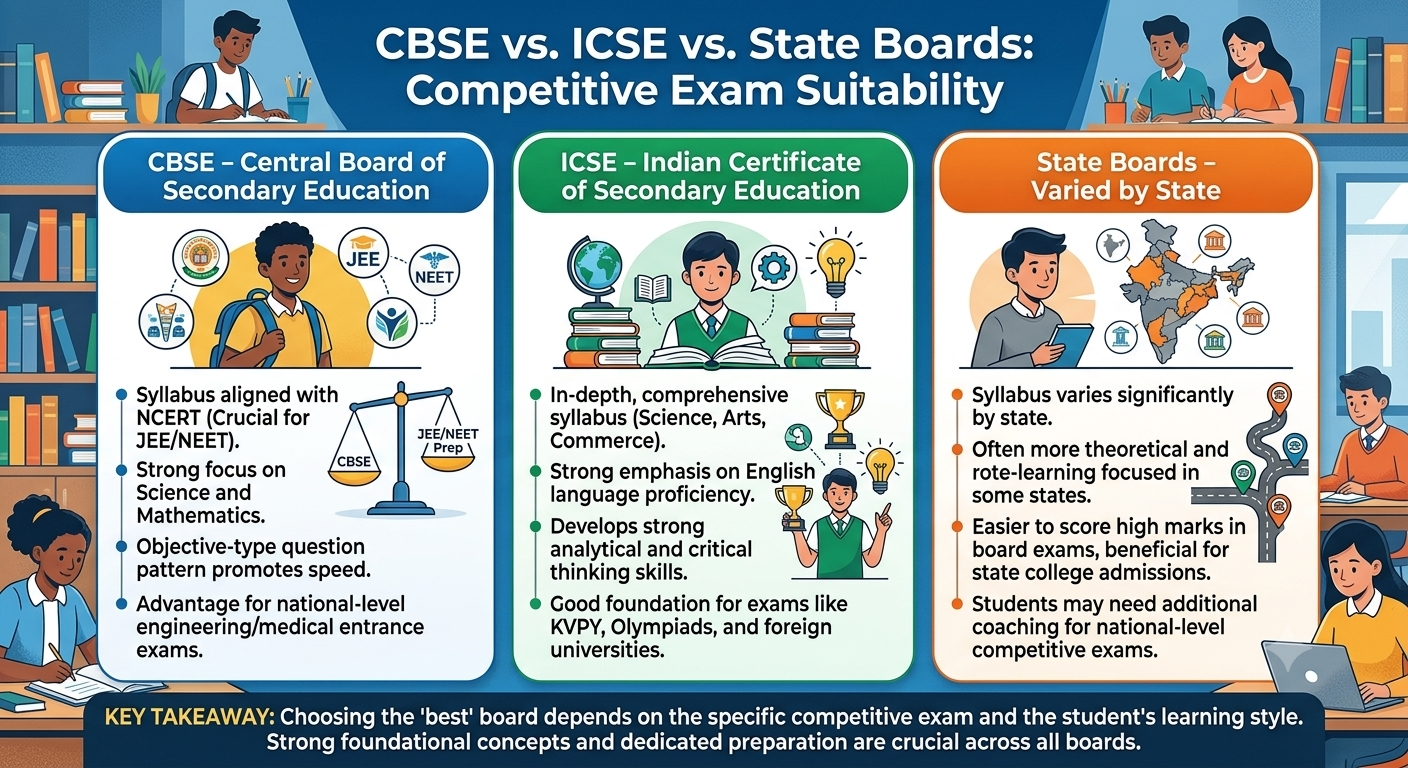
Central Board of Secondary Education (CBSE): A national-level board managed by the Government of India, boasting over 27,000 affiliated schools across India and internationally. CBSE operates on a highly structured, standardized curriculum designed to provide a uniform educational experience, making it the most popular choice for families that relocate frequently due to transferable careers.
Council for the Indian School Certificate Examinations (ICSE/ISC): A private national board (with ICSE representing the Class 10 exam and ISC representing the Class 12 exam) known for its comprehensive, detailed, and language-heavy syllabus. ICSE places a balanced emphasis on humanities, sciences, languages, and creative arts, encouraging a broad-based, school-led educational culture. To learn more about their administrative rules and detailed guidelines, you can visit the CISCE Official Website.
State Boards: Managed independently by each respective state government (such as the Maharashtra State Board, the Karnataka State Board, or the West Bengal Board). State Boards adapt their curriculum, language options, and textbook selections to suit regional cultural identities and local administrative needs, offering highly affordable, accessible, and locally relevant education.
3. The Core Factor: NCERT Alignment and National Entrance Exams
When analyzing competitive exams conducted on a national scale, the single most important factor to consider is NCERT alignment. National-level entrance exams—including JEE for engineering, NEET for medicine, and CUET for central university admissions—are conducted by the National Testing Agency (NTA). The NTA uses the national curriculum framework developed by the NCERT Textbooks Portal as the absolute blueprint for designing exam question papers.
This NCERT-centric design gives CBSE students an immediate, massive structural advantage. Because the standard CBSE curriculum relies directly on NCERT textbooks as its primary teaching material, CBSE students essentially study for their board exams and their competitive national exams simultaneously.
For a CBSE student, the chapters they read in Class 11 and 12 Biology, Physics, and Chemistry match the competitive syllabus page-for-page. Conversely, students from other boards often have to manage two different syllabi, spending extra hours bridging the gaps between their school textbooks and the NCERT-based entrance exams.
4. Analyzing CBSE: The Standard Path for JEE and NEET Preparation
For students who are absolutely certain that they want to pursue engineering or medicine in India, the CBSE board remains the most practical and efficient choice. The board’s science and math streams—commonly categorized as PCM (Physics, Chemistry, Mathematics) and PCB (Physics, Chemistry, Biology)—are engineered to support high-yield competitive preparation:
Syllabus Overlap: Since the competitive exam syllabi are derived directly from CBSE guidelines, there is an approximate 95% to 98% overlap between school board exams and national tests.
Objective Question Training: CBSE examinations place a heavy emphasis on conceptual clarity, short-answer explanations, and objective problem-solving. This style of evaluation trains students to think in terms of specific, direct answers, which mirrors the MCQ (Multiple Choice Question) format used in JEE and NEET.
Step-Wise Marking Rubrics: To support student scoring, the CBSE Official Portal utilizes highly structured marking schemes that award marks for step-wise logical progressions. This structured approach helps students optimize their paper-writing strategies, allowing them to balance boards and coaching with minimal friction.
5. Deconstructing ICSE/ISC: Analytical Learning and the Global Edge
While CBSE is the standard choice for national competitive exams, the ICSE curriculum offers an incredibly rich, application-based foundation that builds powerful analytical thinking. The ICSE board does not simply test a student’s ability to memorize facts; it actively tests their deep, qualitative understanding of physical systems, historical contexts, and linguistic structures:
Analytical Depth: ICSE subjects go into far greater detail than CBSE. For instance, while CBSE provides a concise, streamlined overview of chemical compound behaviors, ICSE explores the deep laboratory mechanisms, organic structures, and multi-step reaction sequences behind them.
Broad Subject Palette: At the Class 10 level, ICSE offers a wider array of subjects, including Computer Applications, Commercial Studies, Environmental Science, and Creative Arts. This multi-disciplinary approach prevents early specialization and fosters a well-rounded, creative intellect.
Critical Thinking: The rigorous academic structure of ICSE trains students to analyze complex, non-linear problems. While an ICSE student preparing for JEE or NEET will need to study NCERT-specific topics, their superior analytical and problem-solving skills often allow them to grasp advanced competitive concepts with ease once they adjust to the MCQ exam style.
6. The State Board Advantage: Local Accessibility and State-Level Entrance Exams
Often dismissed as a secondary option, State Boards offer critical, highly strategic advantages that can be incredibly useful for competitive aspirants under the right conditions. Each state board’s curriculum is designed to align with the specific academic and economic realities of its region:
Alignment with State-Level CETs: If your primary academic goal is to secure admission to top-tier colleges within your home state, the State Board syllabus is highly advantageous. State-level engineering and medical Common Entrance Tests (CETs)—such as MHT-CET in Maharashtra or KCET in Karnataka—are mapped directly to the state’s official board textbooks.
Syllabus Streamlining: In recent years, many progressive State Boards have actively revised their science curricula to match NCERT standards, reducing the learning gap for national exams while retaining local language accessibility.
Flexible Attendance and dummy Schools: State Board schools are often significantly more flexible regarding daily attendance requirements. This flexibility allows students to enroll in integrated “dummy school” models, where they spend their entire day at specialized coaching centers focusing strictly on competitive exam preparation, attending regular school only to write final practical and board evaluations.
7. The Workload and Time-Management Puzzle for Class 11 and 12
When a student enters the Class 11 and 12 bracket, time-management becomes their most valuable asset. Balancing school classes, internal laboratory practicals, coaching sessions, and personal rest requires a highly optimized schedule.
Comparing the cognitive workload of CBSE vs. ICSE vs. State Boards reveals stark differences in how study hours must be distributed:
ICSE/ISC Workload: Highly demanding. The comprehensive, literature-heavy, and project-based nature of ISC means that students must dedicate significant weekly hours to descriptive writing, internal project portfolios, and extensive reading lists. For a student also trying to study 15 hours a week for JEE, this can easily lead to extreme cognitive fatigue and academic burnout.
CBSE Workload: Manageable and highly focused. Because CBSE’s syllabus is concise, stream-centric, and aligned with NCERT, students can easily streamline their study blocks, using their school preparation as an active, high-yield revision session for their competitive tests.
State Board Workload: Typically the lightest of the three. With fewer mandatory project submissions, straightforward paper formats, and relaxed attendance constraints, State Board students often have the highest amount of free, self-directed study hours to focus entirely on competitive mock exams.
8. Language Proficiency and Non-STEM Competitive Pathways (CLAT, SAT, and IELTS)
The debate surrounding the best educational board should not be limited solely to engineering and medical aspirants. For students aiming for careers in law, international relations, business management, journalism, or higher education abroad, language proficiency and communication skills represent the key to success:
ICSE’s English Superiority: This is where the ICSE board holds an undisputed, global advantage. The ICSE curriculum splits English into two separate, highly demanding papers: English Language (covering rigorous grammar, essays, and comprehensions) and English Literature (featuring in-depth studies of classical plays, prose, and poetry).
The International Advantage: ICSE’s rigorous language training aligns perfectly with international standardized tests like the SAT, ACT, IELTS, and TOEFL. The board’s focus on descriptive writing, structured comprehension, and analytical expression helps students excel in these evaluations without requiring expensive language-coaching programs.
Success in Law and Management: For national exams like CLAT, where success depends on a student’s ability to read and analyze massive, complex legal and logical passages under timed conditions, the comprehensive, language-rich background of ICSE students provides a natural, highly visible advantage.
9. Dual Preparation Strategies: How to Balance School Boards with Coaching
Regardless of which board curriculum you study under, achieving academic excellence in competitive exams requires a balanced, highly strategic approach. If a student focuses entirely on coaching and neglects their school board requirements, they risk failing their boards, which invalidates their competitive scores.
To maintain academic balance, implement this proven dual-preparation strategy:
Leverage the Syllabus Overlap: If you are a CBSE student, treat your school science and math lectures as active conceptual warm-ups for your advanced coaching sessions.
Establish Dedicated NCERT Study Blocks: If you are studying under an ICSE or State Board curriculum and your target is a national exam like NET, allocate a dedicated block of 2 to 3 hours every weekend specifically to read NCERT biology, physics, and chemistry textbooks page-by-page, mapping the differences to your school books.
Practice Active Answer-Writing: Board exams require detailed, structured, and legible written explanations, whereas competitive tests demand rapid, mental elimination of incorrect options. Allocate one study block a week to write out long-form answers to previous years’ board papers, keeping your writing muscles and handwriting legibility sharp.
10. The Role of Dummy Schools and Integrated Programs in Different Boards
In India’s competitive exam hubs (such as Kota, Hyderabad, and Pune), the concept of “integrated programs” and “dummy schools” has become highly popular. These models allow students to focus their entire energy on competitive test preparation, bypassing the daily routine of standard school attendance.
However, the feasibility of these programs varies significantly across different academic boards:
Feasibility in State Boards and CBSE: High. Many coaching institutes have formal partnerships with local State Board and CBSE schools, making it incredibly easy for students to transition into these high-focus, integrated study pipelines.
Feasibility in ICSE/ISC: Exceptionally rare. The CISCE board maintains strict, non-negotiable guidelines regarding student attendance, continuous internal assessments, laboratory practicals, and project submissions. ICSE schools rarely offer or support dummy school models, prioritizing holistic, physical school attendance and overall personality development.
Families must evaluate whether their child thrives best under the structured, social environment of a traditional physical school or whether they possess the intense self-discipline required to study independently in an integrated coaching program.
11. Decision-Support Matrix: Comparing Key Parameters for Parents
To help families move from complex analysis to strategic action, we have compiled a comparative decision matrix evaluating CBSE vs. ICSE vs. State Boards across critical academic parameters:
Academic Parameter | CBSE Board | ICSE / ISC Board | State Boards |
|---|---|---|---|
Primary Curriculum Base | NCERT textbooks; structured and concise science/math. | Comprehensive, broad-based syllabus; balanced subject weights. | Regionally specific syllabus; cultural and local context emphasis. |
JEE / NEET Alignment | Outstanding (~98% overlap); direct NCERT-based preparation. | Good; requires supplemental NCERT study to bridge specific gaps. | Varies by state; many have high overlap, others require extra prep. |
Language & English Skills | Standard; functional and exam-oriented communication. | Superior; intensive literature, composition, and analytical writing. | Basic to moderate; focus is typically on regional language proficiency. |
Global/Abroad Recognition | Highly recognized; accepted globally by major universities. | Preferred; closest Indian equivalent to the British IGCSE system. | Accepted; but often requires additional credential evaluations. |
Evaluation Style | Objective, short-answer, step-wise marking rubrics. | Subjective, descriptive, comprehensive internal projects. | Textbook-based recall; traditional percentage-based grading. |
School Network & Mobility | Unmatched (27,000+ schools); easy transfer processes. | Limited (2,500+ schools); primarily in major metro cities. | Localized; transfer outside the home state can be administratively complex. |
12. Crucial Pitfalls to Avoid When Selecting an Academic Board
To ensure your child’s educational journey remains smooth, healthy, and successful, avoid these common preparation and selection mistakes:
Choosing Based Solely on School Prestige: Many parents select a board simply because a highly reputable, expensive school in their neighborhood offers it. Remember that a board’s curriculum dictates how your child spends their study hours. Always prioritize the curriculum’s alignment with your child’s career goals over the school’s brand name.
Ignoring the Child’s Natural Learning Style: If your child gets easily overwhelmed by multiple tasks, forcing them into the comprehensive, subject-heavy curriculum of ICSE can trigger severe academic anxiety. Similarly, if your child enjoys detailed reading, writing, and creative arts, the highly streamlined, science-focused environment of CBSE might restrict their potential.
Underestimating the Workload of Dual Preparation: Do not assume that a high-achieving student can easily manage the massive written workload of ISC alongside a 20-hour weekly JEE coaching schedule without experiencing mental exhaustion. Be realistic about time limits and prioritize cognitive wellness.
13. Conclusion: Which Curriculum is Truly Better for Your Competitive Goals?
Ultimately, the debate surrounding CBSE vs. ICSE vs. State Boards does not have a single, universal answer. No board is objectively “better” than another; rather, each board is uniquely engineered to support different academic pathways and learning styles.
If your child’s absolute, non-negotiable goal is to crack national engineering or medical exams like JEE and NEET, the direct NCERT alignment, manageable workload, and objective exam training of CBSE make it the most efficient and practical choice.
If you value a broad-based, language-rich general education that builds strong communication, analytical, and critical thinking skills—and you plan to explore international higher education, liberal arts, law, or management—the comprehensive depth of ICSE/ISC provides an unparalleled global foundation.
If you are targeting state-level engineering or medical colleges, value local cultural relevance, or seek the flexibility to pursue intensive, integrated coaching programs with minimal school interference, State Boards offer a highly practical, cost-effective, and successful route to academic triumph.
Be patient with the decision-making process, evaluate your family realities, align your choice with your child’s unique personality, and step confidently onto your educational path ready to unlock your full academic potential!