The Vidyarthi Vigyan Manthan (VVM) Study Strategy: Free E-Books and Core Syllabi
For decades, standard school examinations focused on testing a student’s ability to memorize physical facts, biological classifications, and chemical properties straight from the pages of their prescribed textbooks. While this model helped students pass evaluations, it often failed to measure raw scientific aptitude, critical thinking, or an appreciation for historical advancements. To foster a vibrant national culture of logical inquiry and connect students with the rich heritage of Indian discoveries, the Government of India supports a landmark digital initiative.
If you are a middle or high schooler striving to test your scientific intellect on a national scale, a parent looking for prestigious pathways to support your child’s STEM journey, or a school principal aiming to align your institution with national talent searches, you are in the perfect place. This comprehensive guide details the ultimate Vidyarthi Vigyan Manthan (VVM) Study Strategy, outlining how to navigate the VVM core syllabi, access VVM free e-books, understand the VVM exam pattern, and secure national-level recognition.
1. Demystifying Vidyarthi Vigyan Manthan (VVM): India's Largest Digital Science Talent Search
Vidyarthi Vigyan Manthan (VVM) is a national program conceptualized to identify bright minds with a scientific aptitude from the student community and nurture them. This digital-based initiative is organized by Vijnana Bharati VIBHA in collaboration with the National Council of Science Museums NCSM and the National Council of Educational Research and Training NCERT. It stands out as one of the largest and most democratic competitive science talent search platforms in the country.
Unlike traditional examinations that require physical paper layouts or travel to high-stakes offline centers, VVM operates on a completely digital platform. Students take the exam directly from their schools or homes using their personal digital devices, including smartphones, tablets, or laptops. By leveraging modern educational technology, VVM ensures that students from both urban cities and remote rural sectors have an equal opportunity to showcase their critical thinking skills.
2. Eligibility Criteria and Language Options under the VVM Guidelines
Before diving into your Vidyarthi Vigyan Manthan (VVM) Study Strategy, it is essential to understand the eligibility standards and administrative rules set by the national steering committee. The talent search is designed specifically for students progressing through the middle and senior secondary stages of school:
Eligible Grade Levels: School students studying in Class 6 through Class 11 are fully eligible to register.
School Affiliation: Enrolled students can belong to any recognized board across India, including CBSE, ICSE, State Boards, or international curricula.
Group Classifications: To ensure fair competition, participants are split into two broad groups: the Junior Group (comprising Class 6, 7, and 8) and the Senior Group (comprising Class 9, 10, and 11).
Language Versatility: In alignment with national multilingual initiatives, the VVM examination paper is available in over 14 distinct Indian languages, ensuring that language barriers do not obstruct scientific brilliance.
To monitor updates regarding competitive timelines, registration portals, and eligibility guidelines, families can consult tracking services like the Buddy4Study Scholarship Portal.
3. The 4-Stage Selection Workflow of the National VVM Talent Search
The road to becoming a national VVM winner and securing prestigious research internships is structured across four progressive, highly engaging phases:
School-Level Digital Exam: The initial stage is an online examination conducted on a dedicated digital app. This stage tests basic subject knowledge, logical reasoning, and historical scientific contributions.
State-Level Camp (SLC): The top ranking students from each state are invited to attend a hands-on, interactive State-Level Camp. Here, they perform experimental workshops, engage with state-level S&T experts, and face verbal evaluations.
National-Level Camp (NLC): The top two students from each class at the state stage advance to the National-Level Camp. This is an immersive residential event featuring advanced experimental challenges, design thinking sessions, and critical-thinking exercises.
Srijan Internship Program: The final national winners receive extensive financial cash awards, national trophies, and are placed in the prestigious Srijan Internship Program, granting them direct access to top-tier national research laboratories.
4. Understanding the VVM Exam Pattern and Mark Weightage
Succeeding in this national talent search requires a deep understanding of the exam’s unique structural blueprint. VVM does not evaluate students based on standard school textbooks alone. Instead, the paper is split into precise, themed categories designed to test diverse cognitive dimensions:
Science and Mathematics from School Textbooks (50% to 60% Weightage): This section consists of multiple-choice questions aligned with the standard school curriculum of your grade level, ensuring your foundational science concepts are strong.
Indian Contributions to Science (20% Weightage): This component tests the student’s qualitative understanding of India’s historical and modern contributions to physics, metallurgy, astronomy, and medicine.
Biographies of Legendary Indian Scientists (10% to 20% Weightage): Focuses on the lives, discoveries, and professional struggles of selected Indian pioneers, showing students the human side of scientific breakthroughs.
Logic and Reasoning (10% Weightage): Evaluates cognitive agility, verbal reasoning, spatial visualization, and pattern recognition without requiring complex mathematical computations.
To check the official exam timings, section breakdowns, and structural updates for the current academic session, always refer directly to the Official Vidyarthi Vigyan Manthan VVM Portal.
5. Navigating the VVM Core Syllabi: School-Level Science and Mathematics
The foundational component of your Vidyarthi Vigyan Manthan (VVM) Study Strategy is the school-level textbook curriculum. This segment carries the highest weightage on the paper, making it a critical focus area.
The questions in this section are drafted directly from the standard NCERT textbooks prescribed for each respective grade level. For instance, a Class 9 student will face conceptual science questions covering the structure of cells, plant and animal tissues, qualitative laws of motion, and physical properties of matter. A Class 6 student will focus on basic states of water, classification of materials, and magnet behaviors.
To prepare effectively, you must move away from memorizing static definitions. VVM queries are designed to test application. When reviewing a chapter on light refraction, focus on understanding how light bends conceptually when entering different mediums, how images are inverted, and how these optical behaviors are utilized in daily technologies, ensuring you build a deep intuitive grasp of the science.
6. Mastering the "Indian Contributions to Science" (ICAST) Syllabus
One of the most unique and culturally enriching aspects of the VVM syllabus is the dedicated focus on the Indian Knowledge System (IKS) and the Indian Contributions and Advancements in Science and Technology (ICAST). This section accounts for a massive 20% of the final marks.
The broad scope of this syllabus takes students on a historical journey through India’s scientific heritage. Key units within this study block explore:
Ancient Astronomy: Tracking the calendar systems found in the Vedas, the concept of solar and lunar cycles, and the astronomical contributions of Aryabhata.
Historical Chemistry and Metallurgy: Exploring early concepts of the atom proposed by Kanada, ancient practices of metal extraction, and early steel-making techniques.
Traditional Medicine: Studying the Ayurvedic approach to holistic health, the concept of elements like Saptadhatus and Tridosha, and the surgical advancements of Sushruta.
Environmental Conservation: Understanding how ancient texts, sacred groves, and traditional water-harvesting systems promoted ecological balance through community participation.
This syllabus section demonstrates to students that scientific progress is a global, continuous effort, highlighting India’s long-standing role as a center of technical and philosophical innovation.
7. Studying the Biographies of Eminent Indian Scientists
To inspire young minds to choose active careers in research, VVM includes a dedicated segment on the lives and achievements of legendary Indian scientists. This section changes periodically to feature different pioneers, focusing on their scientific resilience, societal contributions, and professional challenges.
When analyzing these biographies, students should construct chronological timelines of the scientists’ lives. Pay close attention to:
The historical context in which they worked, including the socioeconomic challenges of pre-independence or early-independence India.
The specific scientific institutions they established or helped expand to support national development.
Their key conceptual breakthroughs, such as advances in meteorological instruments, solid-state physics, organic chemistry, or satellite communications.
How their discoveries directly improved human safety, agricultural yields, or industrial independence.
Learning about these lives helps students understand that science is not just about abstract laboratory experiments; it is a human pursuit driven by curiosity, dedication, and a desire to improve society.
8. Cracking the Logic and Reasoning Section Conceptually
The Logic and Reasoning section accounts for 10% of the exam, acting as a crucial differentiator for top national rankings. Many students make the mistake of ignoring this section, assuming it cannot be prepared for in advance. However, logical deduction is a skill that can be systematically trained.
VVM’s reasoning questions focus heavily on qualitative relationships, spatial reasoning, and pattern decoding. To excel in this section:
Practice Sequence Series: Learn to spot the underlying logic governing patterns in sequences of letters, images, or configurations.
Master Blood Relations and Sequencing: Practice mapping out complex family trees or sequential seating arrangements logically on a sheet of paper.
Deconstruct Visual Puzzles: Practice mental rotation exercises, spatial folding puzzles, and Venn diagram categorizations.
Focus on Binary Logic: Learn to identify consistent truths or lies within complex statements, building robust analytical frameworks that help you eliminate incorrect options quickly.
Since this section strictly avoids complex, calculation-heavy mathematical questions, focusing on the conceptual and qualitative logic behind each puzzle is your fastest route to a perfect score.
9. How to Access VVM Free E-Books and Digital Study Materials
To ensure a level playing field for all participants, Vijnana Bharati does not sell expensive physical reference books or print guides for the specialized sections of the exam. Instead, all specialized study materials—including the complete ICAST syllabus and the detailed biography booklets—are provided entirely for free.
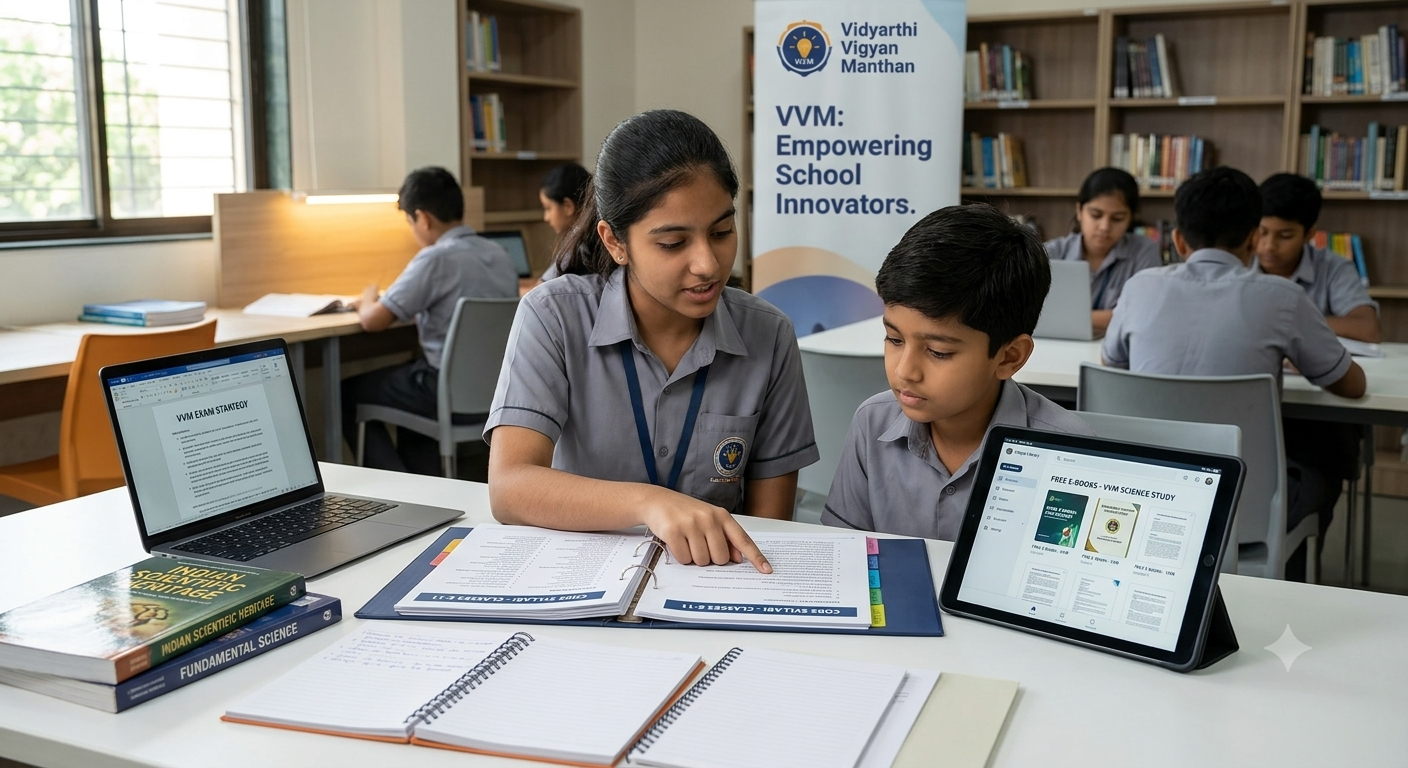
These VVM free e-books are published directly on the official VVM web portal. Registered students can log onto their personal dashboards beginning on August 16th of each academic year to download high-resolution PDF copies of these study guides.
The e-books are available in multiple regional languages, allowing students to study in their preferred medium. By providing these secure, open-source digital files, the organizers ensure that high-quality, comprehensive scientific knowledge is accessible to every single family, completely free of cost.
10. Designing a High-Yield At-Home VVM Study Blueprint
Preparing for a national-level talent search alongside your daily school schedule requires a balanced, highly structured weekly plan. To optimize your preparation, implement this easy-to-use study blueprint:
The Textbook Foundation (Weekdays): Allocate two short study blocks of 30 minutes during the week to focus on your standard school science and math chapters. Focus deeply on the conceptual explanations and real-world applications of each topic.
The Heritage Exploration (Saturdays): Spend 45 minutes on Saturdays reading through the downloaded VVM free e-books on Indian Contributions to Science. Treat this as an engaging reading session rather than a chore, highlighting key historical events, timelines, and locations.
The Logical Challenge (Sundays): Dedicate 30 minutes on Sundays to solving logical reasoning puzzles, pattern decoders, and spatial puzzles, practicing the conceptual step-by-step methods without rushing.
The Scientist Biographies (Weekly Review): Spend 20 minutes a week reviewing the designated scientist biographies, summarizing their achievements and organizational contributions in your own vocabulary.
Following this consistent, low-stress study routine ensures that you cover the entire core syllabus thoroughly without experiencing academic burnout.
11. What to Expect at the Camps: EST, Design Thinking, and Vocal for Local
For the select few who clear the school-level digital exam, the journey continues at the State and National Camps. These camps are highly dynamic, collaborative, and entirely practical. They are designed to test how a student thinks under real-world laboratory conditions.
The camp evaluations are divided into several innovative, hands-on components:
Experimental Skill Test (EST): Students perform real-world, hands-on experiments in Physics, Chemistry, Biology, and Math. They are evaluated on their ability to set up apparatus safely, make precise observations, and interpret qualitative scientific trends.
Design Thinking Skills: This individual activity tests a student’s problem-solving ability through a human-centered design approach. Students are presented with a real-world societal challenge and must design a practical, empathetic, and sustainable technical solution.
Vocal for Local Theme Presentations: Students participate in brief, presentation-based interactions based on designated national themes, explaining how local Indian technologies and sustainable practices can solve global environmental and industrial challenges.
12. Crucial Pitfalls to Avoid in Your VVM Preparation Journey
To ensure your VVM study blocks remain highly effective and directly support your academic growth, keep a close eye out for these common preparation mistakes:
Relying on Passive Rereading: Simply highlighting paragraphs in your science textbooks does not build long-term retention. Use active recall, closed-book summaries, and self-testing to confirm your understanding of the concepts.
Ignoring the Specialized E-Books: Do not assume that your standard school science textbooks are sufficient to clear the exam. The specialized sections (ICAST and Biographies) carry up to 40% of the total marks and must be studied systematically using the official VVM free e-books.
Cramming at the Last Minute: The vast historical and scientific concepts covered in the Indian Contributions section require time to digest. Start your preparation early, covering small sections weekly to build deep qualitative familiarity.
Treating Logic as a Guesswork Section: Proactively practice logical reasoning puzzles before the exam day. Familiarity with pattern logic prevents time management panics during the actual test.
13. Conclusion: Navigating Your Path to Scientific Leadership with VVM
Securing academic success in the Vidyarthi Vigyan Manthan (VVM) talent search is an incredibly prestigious milestone. By utilizing a structured study strategy, mastering your grade-level school textbooks conceptually, studying the specialized free e-books systematically, and practicing logical deduction, you can unlock your full scientific potential.
Remember that VVM is not just about earning certificates and cash awards. It is a transformative platform designed to connect you with India’s rich intellectual heritage, challenge your analytical boundaries, and partner you with leading global research minds.
Be patient with your learning journey, stay endlessly curious about how the universe operates, use the incredible digital resources highlighted in this guide, and step confidently onto your competitive path ready to build a bright, highly successful future in science!