The Best Free AI Homework Assistants and Math Solvers (Reviewed for Safety & Accuracy)
The modern classroom environment has undergone an unprecedented digital transformation. Today, students are no longer solely dependent on heavy textbooks or expensive after-school tutoring programs to clarify complex academic concepts. The emergence of artificial intelligence has introduced a new paradigm in self-directed learning. High schoolers, middle schoolers, and college students alike are increasingly relying on the best free ai homework assistants and advanced free math solvers to navigate their coursework.
However, the sheer volume of available tools presents a major challenge for families. With hundreds of software programs claiming to deliver instant academic answers, issues regarding digital security, child safety, and factual accuracy have come to the forefront. How can parents ensure their children are using a truly safe ai for school rather than a platform that collects private data or encourages shortcuts? This exhaustive, comprehensive review examines the leading platforms, grading them on security, usability, and conceptual precision, to help you find the absolute best ai homework helper for your family’s needs.
1. Why AI Homework Helpers Are Revolutionizing Modern Education
The traditional homework routine has historically been a point of friction for families. Students frequently get stuck on advanced topics, while parents may find themselves unable to recall specialized concepts studied decades prior. This is where an ai homework assistant free of charge can bridge the gap, functioning as a patient, round-the-clock tutor.
Unlike static search engines that simply provide a list of blue links, modern educational technology explains the underlying methodology behind a concept. These digital guides do not merely hand over the final outcome; they decompose intricate ideas into bite-sized, chronological steps. By highlighting the logical progression of a subject, they foster independent problem-solving skills, turning frustrating study sessions into empowering opportunities for conceptual mastery.
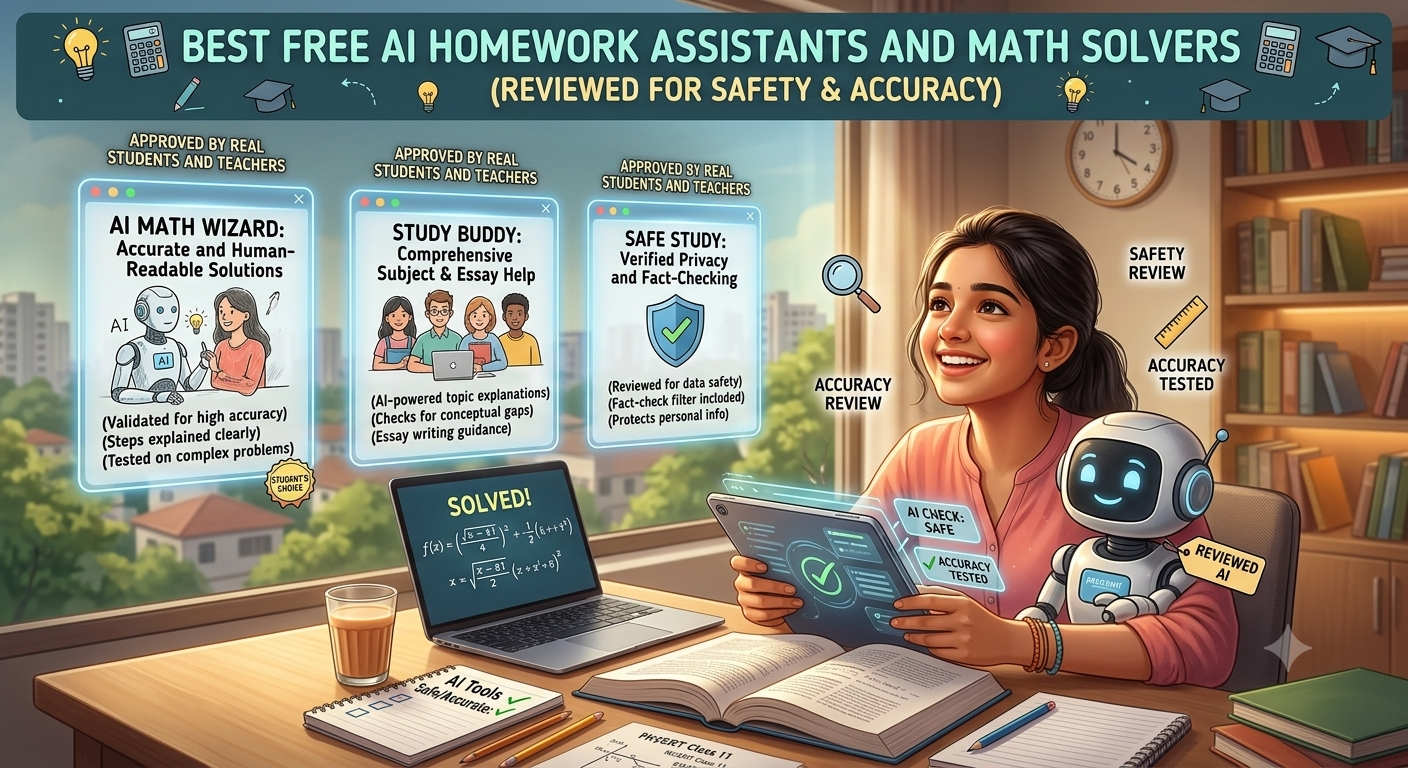
2. Key Criteria for Reviewing the Best Free AI Homework Assistants
When choosing an academic application, users must look beyond eye-catching marketing copy. To compile this definitive guide, we evaluated each platform against four rigid benchmarks:
Accuracy: Does the system consistently deliver correct, logical, and factually sound educational support?
Safety & Privacy: Does the platform comply with child safety laws, limit advertisements, and protect sensitive student metadata?
Step-by-Step Pedagogy: Does the tool actually teach the student the logical structure of the problem, or does it simply display a shortcut solution?
Cost & Accessibility: Are the core learning features genuinely free, or are they hidden behind aggressive, recurring paywalls?
By evaluating these specific criteria, we have separated superficial engines from robust, secure platforms that prioritize genuine cognitive development.
3. Socratic by Google: The Ultimate Visual AI Homework Helper for Multi-Subject Support
For students who require visual clarity across multiple academic disciplines, Google Socratic stands out as an elite, completely free application. Built with Google’s proprietary machine learning technology, this software allows users to take a photo of a confusing textbook paragraph, science diagram, or history prompt to receive instant, highly curated educational resources.
Rather than merely displaying a basic text response, Socratic generates highly visual “explorers.” These modules contain hand-drawn diagrams, curated explainer videos, and step-by-step breakdowns of the core academic concepts. Because it covers everything from biology and chemistry to world history and English literature, it serves as an all-in-one companion. Best of all, Socratic features zero advertisements, requires no premium subscriptions, and adheres to strict student data safety protocols, making it an incredibly secure option for younger learners.
4. Photomath: The Gold Standard for Real-Time Camera-Based Math Solver Apps
Originally launched as a pioneer in optical character recognition, Photomath has cemented its reputation as one of the most widely used free math solvers in the world. Now officially under the Google software umbrella, the platform uses a device’s built-in camera to scan both printed and handwritten academic problems, instantly generating structured, linear explanations.
Photomath excels at breaking down complex algebraic processes, coordinate geometry, trigonometry, and advanced calculus. The application’s basic tier remains completely free and provides detailed, logical progressions for equations. For students who require deeper conceptual context, the premium subscription layer offers animated tutorials and textbook-specific answers. The high-precision scanner is remarkably adept at reading messy handwriting, ensuring that students rarely encounter scanning errors when importing their daily schoolwork.
5. Microsoft Math Solver: A Safe and Ad-Free Experience for Diverse Grade Levels
For parents who are highly concerned about digital safety and distracting pop-up advertisements, Microsoft Math Solver is an outstanding, entirely free solution. Developed to integrate seamlessly with the broader Microsoft educational ecosystem, this web-based and mobile utility is designed with a clean, distraction-free user interface.
What sets this tool apart from other math solver apps is its versatile input methods. Students can scan their problems, type them out using an advanced scientific keyboard, or literally draw them directly onto their touchscreens. The system then processes the query, providing a highly comprehensive step-by-step breakdown alongside interactive graph plots. Furthermore, it automatically retrieves similar problems from around the web, pairing the solution with high-quality video tutorials from reputable educational channels.
6. Wolfram Alpha: The Computational Engine for High-Level Science and Mathematics
While standard applications are excellent for foundational school levels, advanced students in high school and college need a more robust analytical tool. Wolfram Alpha operates not as a basic language-processing chatbot, but as a massive computational knowledge engine.
This professional-grade tool handles highly complex, specialized topics, including differential equations, linear algebra, discrete thermodynamics, chemistry formulas, and astrophysics. While the free tier provides immediate, highly accurate answers and visual graphs, the pro version unlocks the step-by-step logical sequence. Because Wolfram Alpha relies on curated, systematic data rather than speculative web-scraping, it is widely recognized as one of the most structurally reliable and accurate math solvers online for STEM-focused students.
7. Brainly: Blending AI Homework Assistant Free Tools with a Collaborative Peer Community
If a student thrives on collaborative learning, Brainly Community offers a unique hybrid environment. It fuses generative artificial intelligence with a massive, worldwide social community of educators, parents, and high-achieving peers.
Students can post questions across diverse school subjects, and the platform’s integrated AI companion immediately crafts an initial, structured explanation. Following this, human experts and verified moderators review, refine, and verify the response to guarantee accuracy. This dual-layered verification system drastically reduces the likelihood of errors. While the community-centric model is highly interactive, parents should monitor account settings to ensure secondary interactions remain positive, respectful, and strictly focused on schoolwork.
8. TutorGPT and MathGPT: Exploring the Next Wave of Generative AI Homework Assistants
The landscape of educational technology has been further revolutionized by specialized generative engines. Tools like TutorGPT and MathGPT represent a new class of conversational tutors. Instead of offering rigid, pre-recorded databases, these applications simulate a real-time conversation with an academic expert.
TutorGPT: This system operates as a comprehensive, multi-subject private tutor. It can analyze written essays, provide critique on historical narratives, and generate customized practice quizzes based on a student’s specific weaknesses.
MathGPT: Engineered specifically to bypass the conversational limitations of general-purpose large language models, this tool concentrates exclusively on quantitative logic. It excels at translating complex word problems into clear, sequential equations without skipping vital intermediate steps.
These conversational engines represent the future of student-led learning, offering adaptive, personalized coaching tailored to an individual student’s comprehension speed.
9. The Accuracy Dilemma: Why Even the Most Accurate Math Solvers Online Struggle
While the technology powering these systems is incredibly advanced, users must understand that no digital application is entirely infallible. Even the highest-rated platforms can occasionally hallucinate or misinterpret a complex academic question.
The primary limitation of many general-purpose tools is their reliance on pattern recognition rather than mathematical logic. When presented with highly nuanced, multi-step word problems, an AI model might misinterpret semantic context, apply an incorrect formula, or make simple calculation errors. Therefore, students should never view these applications as absolute, final arbiters of truth. Instead, they should treat them as diagnostic partners, utilizing them to verify their manual calculations and identify potential procedural gaps.
10. Data Privacy and Student Safety: Identifying Red Flags in Educational Technology
Protecting a student’s digital footprint is paramount when introducing any technological tool into their daily study routine. Many free applications monetize their services by tracking user behavior, gathering geographic locations, or serving highly targeted, invasive advertisements.
When evaluating a new ai homework helper, parents should look for certifications from trusted child safety advocates, such as the comprehensive privacy audits conducted on Common Sense Media. A secure, student-friendly platform should never require unnecessary device permissions—such as access to contacts, location services, or personal social media profiles. Additionally, check if the application complies with the Children’s Online Privacy Protection Act (COPPA), which legally limits how companies collect and store personal details belonging to minors.
11. Best Practices: How Parents and Students Can Utilize Safe AI for School
To ensure that these advanced digital assistants remain constructive educational tools rather than avenues for academic dishonesty, families should establish clear guidelines for their usage:
Prioritize the “How” Over the “What”: Encourage students to use these tools to understand the step-by-step methodology, rather than simply copying down the final answer to submit for school credit.
Verify with School Resources: Instruct your child to double-check AI-generated answers against their official school textbooks and lecture slides to verify accuracy.
Use Shared Screens: Keep study sessions in open, communal areas of the home where parents can easily monitor the screen and ensure the tools are being used responsibly.
Engage in active self-testing: Once an AI has explained a concept, the student should attempt to solve a similar, un-assisted problem independently to confirm true cognitive mastery.
By approaching these tools with a disciplined, educational mindset, students can dramatic improve their academic performance while maintaining complete academic integrity.
12. Final Verdict: Selecting the Ideal Free AI Study Companion for Your Needs
Ultimately, the best digital study companion is the one that aligns perfectly with a student’s unique learning style and academic level. For younger students seeking visual, multi-subject explanations in a highly secure environment, Socratic by Google is the most well-rounded option. If the primary focus is conquering quantitative subjects with minimal digital distractions, Microsoft Math Solver provides an unparalleled, safe environment.
Regardless of which tool you select, the key is to view artificial intelligence not as a replacement for human teachers or hard work, but as a powerful, supplementary study aid. When used thoughtfully and securely, these free assistants can turn the stress of daily homework into a rewarding journey of intellectual curiosity and growth!